For almost fourteen centuries, the Egyptians buried the sacred Apis bulls beneath the desert of Saqqara. The site lies in the necropolis of Saqqara, some thirty kilometers south of Cairo, north of the funerary complex of Djoser. In life, the Apis bull was kept at the temple of Ptah in Memphis and was held to be the incarnation of that god. At death it became Osiris-Apis, a name that turned into Serapis in the Hellenistic period, and from which the Serapeum takes its name.
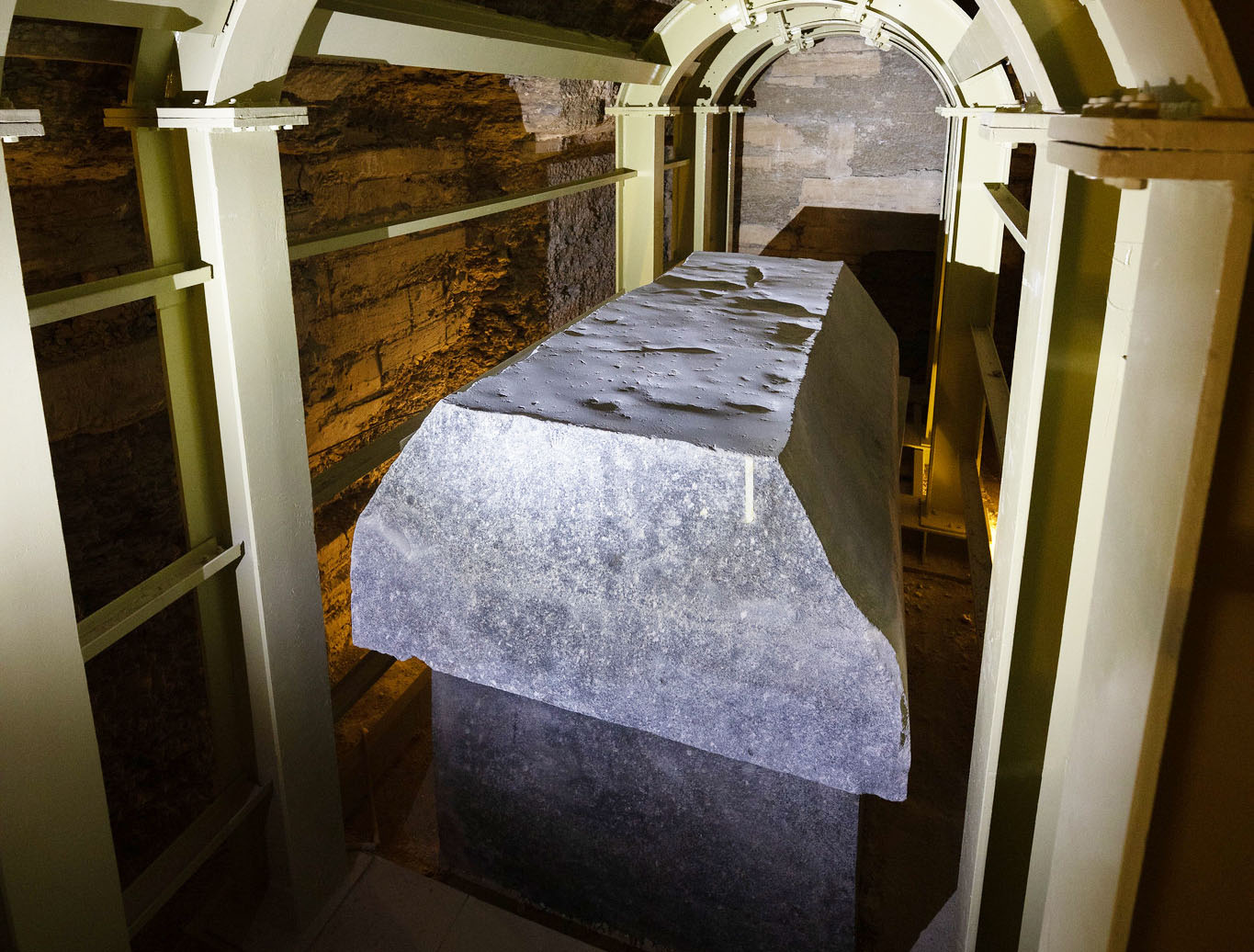
Visitors today enter the Greater Vaults, galleries cut into the rock where twenty-four hard-stone sarcophagi have remained in place.
The first tombs
The oldest burials date from the reign of Amenhotep III, in the 18th Dynasty, in the 14th century BC. His son, Prince Thutmose, inaugurated the site. For about 140 years, until the reign of Ramesses II, each bull received its own tomb: a sloping passage cut into the rock led to a chamber holding coffins and canopic jars, beneath a decorated chapel whose outer walls bore votive stelae. At that time the bodies do not yet seem to have been mummified. What remained of the bull was preserved in bitumen or resin.
Khaemwaset, son of Ramesses II and High Priest of Ptah, then had the first collective tomb dug: a gallery whose side chambers received the following bulls. These are the “Lesser Vaults”, used until the beginning of the 26th Dynasty. Their ceiling has collapsed in places, and Mariette had to leave several tens of meters unexplored. In 2020 a mission began clearing the sand above them and stabilizing the rock, so that they can at last be excavated.
The Greater Vaults
Around 612 BC, when an Apis died, the Serapeum was in poor condition. Psamtik I, of the 26th Dynasty, restored the temple and opened a second gallery, the “Greater Vaults”. The Ptolemies enlarged it: its main corridor is over 200 meters long, with a service tunnel running alongside.
Once the bull had been laid to rest, its chamber was walled up. Stelae were fixed to this wall, usually recording the reign in which the bull was born, its installation at the temple of Ptah, its lifespan and the date of its funeral. In the 19th century these dates helped to establish Egyptian chronology, especially for reigns that the king lists have not preserved. Under the Ptolemies, the stelae were grouped on the walls of the entrance and of the service tunnel.
In the Late Period, according to the Apis Papyrus, the embalming of the bull lasted 68 days. The last two days were given over to funeral processions, the final one ending at the Serapeum.
The sarcophagi
The oldest of the twenty-four sarcophagi dates from Amasis, around 550 BC, the most recent from the reign of Augustus, five centuries later. Cut from granite, basalt or diorite, they weigh around 40 tonnes, and their lids about half as much. They were moved on rollers, with winches and levers. The floor of each chamber lies two to three meters below that of the corridor: the chamber was first filled with sand, the sarcophagus slid in, and the sand then removed little by little to lower it. According to a stela, it took 28 working days to bring one of them and its lid into its chamber, in year 37 of Ptolemy II, around 247 BC.
Only four bear inscriptions. That of Amasis, in red granite, is decorated with paneling and a spell from the Pyramid Texts. That of Cambyses II, the first Persian ruler of Egypt, around 530 BC, blocks the original entrance to the gallery.
The rediscovery
The Serapeum was abandoned at the beginning of the Roman period, shortly after 30 BC. Looting began while hieroglyphs could still be read: on many stelae, the names of the bulls have been scratched out. All the tombs but two were plundered, the mummies torn to pieces, and stones piled on the sarcophagi as a sign of contempt.
In 1850 Auguste Mariette, who had come to Egypt to collect Coptic manuscripts, spotted the head of a sphinx sticking out of the dunes. He cleared the avenue, originally lined with 370 to 380 sphinxes and probably laid out under Nectanebo I, and entered the catacombs in November 1851. He found thousands of objects connected with the cult there. The statue of Apis found in a chapel along the avenue is now in the Louvre.
The site opened to visitors soon after the excavations. In 1862 the Prince of Wales, the future Edward VII, had lunch with his party in one of the sarcophagi. The 1992 Cairo earthquake cracked the walls and the Serapeum was closed; its ceilings and walls were consolidated from 2001 to 2012. Most of the Greater Vaults are open to visitors today.
The mastaba of Mereruka
The mastaba of Mereruka, north of the pyramid of Teti, is nearly a thousand years older than the first Apis tombs. Mereruka was vizier at the beginning of the 6th Dynasty, under King Teti (c. 2345-2323 BC), whose daughter he had married. His tomb has thirty rooms, six of them for his wife and five for their son Meryteti. The walls show herds of cattle, hippopotamus hunting with harpoons, fishing and fowling, animals being force-fed, hyenas among them, and a representation of the three seasons of the Egyptian calendar. In the hall with six pillars, a life-size statue of Mereruka steps out of a niche, facing the table where offerings were laid.
Sources: Egyptian Ministry of Tourism and Antiquities, “Serapeum” and “Tomb of Mereruka”; Wikipedia, “Serapeum of Saqqara” (English article), “Sérapéum de Saqqarah” and “Mastaba de Mérérouka” (French articles).
Another virtual tour in Egypt: the tomb of Ramses VI in the Valley of the Kings.
This tour is part of the catalog of virtual tours of underground heritage.