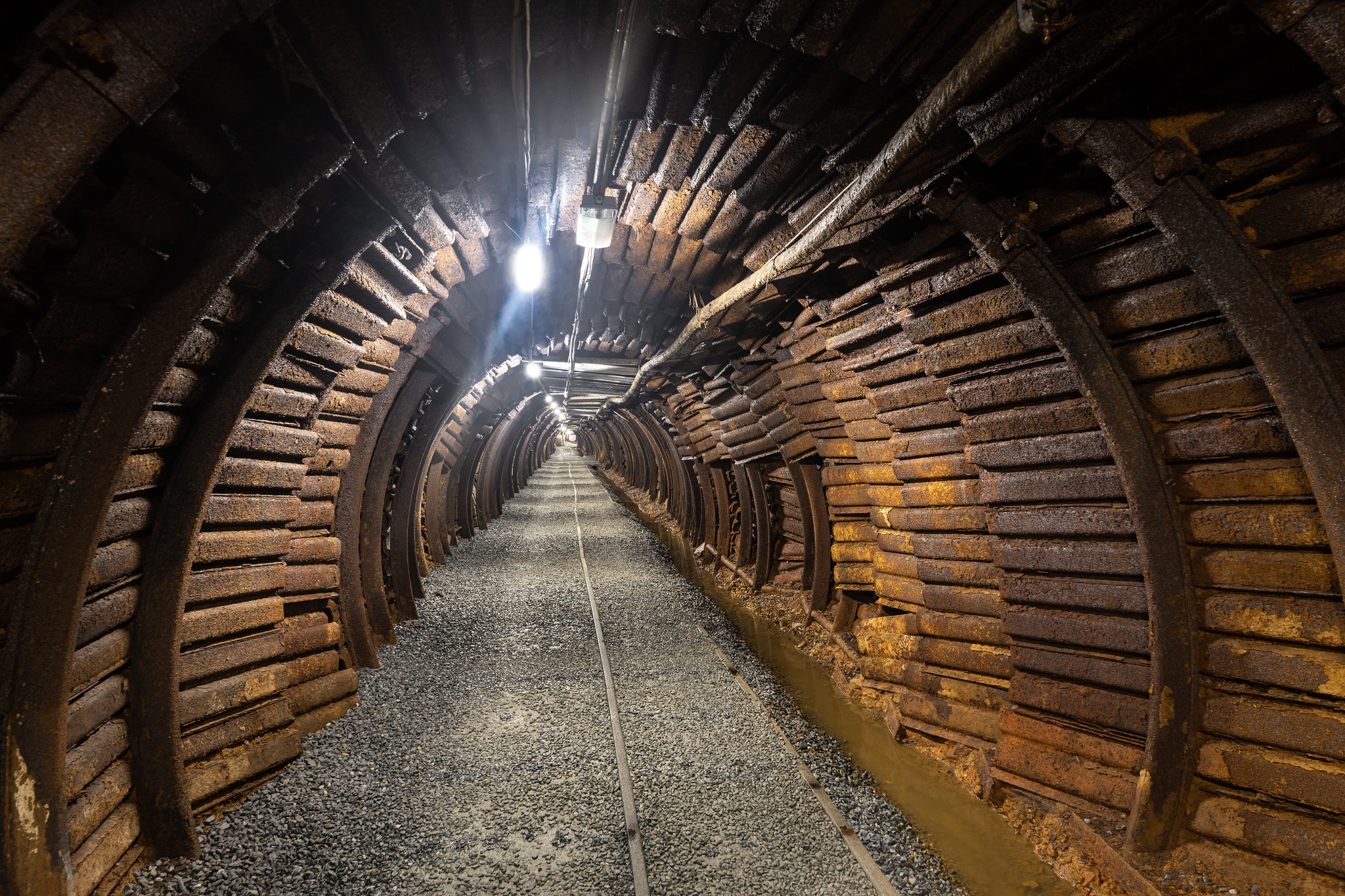
Some underground spaces are entered neither to extract, nor to take shelter, nor to visit: people go down into them to breathe. At Zlaté Hory, in the Jeseníky Mountains, 1,600 metres of galleries in a former gold mine have been converted to treat asthmatic children. This is speleotherapy, the medical use of the underground atmosphere, and it is a working healthcare facility, not a heritage site.
A gold mountain turned treatment room
Zlaté Hory, literally “the Golden Mountains”, lives up to its name. The town was founded in 1224 and its history is bound up with gold panning and then with mining. Its heyday came in the 16th and 17th centuries, under the authority of the bishops of Wrocław; nuggets weighing 1.38 and 1.78 kilograms were found at that time. Over the years, gold gave way to pyrite, processed into vitriol and then into sulphuric acid, and to iron, copper, zinc and silver.
The old mining activity died out in 1883. A modern revival took place from 1952 to 1993, under the communist regime, and the final extraction came on 17 December 1993. What remains are dozens of kilometres of galleries, some of which date back to the 16th century.
In 1995, the EDEL sanatorium converted part of these workings into a treatment facility. The chosen site lies seven kilometres from the sanatorium, at an altitude of 620 metres: some 1,600 metres of galleries, down to 93 metres below the surface, where the temperature stays between 7 and 8 °C all year round, in air that is almost saturated with moisture, with no dust or allergens.
The EDEL sanatorium
The institution has a long history as a spa. In 1882, Dr Karl Anjel founded a hydrotherapy establishment there; in 1889, Dr Ludwig Schweinburg took it over and gave it his name, the “Schweinburg forest sanatorium”. Its modern equipment and forest cover made it an early destination for respiratory and nervous complaints.
Today, EDEL is a private facility with 105 beds that takes in children aged 3 to 15 suffering from chronic or recurrent respiratory diseases. The stay combines climatotherapy, speleotherapy sessions underground, inhalations, respiratory physiotherapy, hardening and dietetics, under medical supervision. A school and a nursery school operate on site, so that the treatment does not interrupt schooling.
The underground site is not reserved for patients: the treatment gallery can be visited at weekends, accompanied by a guide.
A wartime discovery
The idea arose from an observation made in a shelter. During the Second World War, the people of Ennepetal, in Westphalia, took refuge in the Kluterthöhle during the bombing raids. The physician Karl Hermann Spannagel noticed that the asthmatics who spent their nights in the cave were clearly doing better than the others. He published his observations in 1943; after the war the cave became a treatment establishment, and the word Speläotherapie entered the medical vocabulary.
The mining branch developed in parallel in the East. In Poland, from the late 1950s onwards, the physician Mieczysław Skulimowski set up a sanatorium in the chambers of the Wieliczka salt mine, and set out the theory of subterraneoterapia as climatic treatment carried out in a mined-out space. The model spread throughout Central Europe.
What people seek underground
The underground environment offers a combination of conditions that no hospital room can easily reproduce. The temperature is stable, generally between 10 and 20 °C depending on the site, with no seasonal variation. Humidity is high and constant. Above all, the air is practically free of pollen, spores, dust mites and fine particles: for someone with allergies, it means complete rest for the respiratory system.
Added to this, depending on the geological setting, are factors specific to each place. In salt mines, a suspended aerosol of sodium chloride, said to thin bronchial secretions. In some cavities, a particular ionisation of the air. In the former uranium mines of Kowary, in Lower Silesia, it is radon itself that is sought: the inhalatorium there uses a natural radioactive gas as a form of radon therapy, one of five sites of this kind in the world.
The conditions treated are primarily respiratory: asthma, chronic obstructive pulmonary disease, recurrent bronchitis, allergic rhinitis. Courses of treatment typically last two to three weeks, with several hours spent underground each day, combined with breathing exercises and physiotherapy.
The other major European sites
- Wieliczka (Poland), located in a chamber 135 metres down in the salt mine, which is a World Heritage Site.
- Bochnia (Poland), the other salt mine of Lesser Poland, also equipped for treatment.
- Kowary (Poland), a radon inhalatorium in the galleries of a former uranium mine.
- Kluterthöhle, Ennepetal (Germany), the founding site, still in operation.
- Bystrianska jaskyňa (Slovakia) and Tapolca (Hungary), karst caves fitted out as treatment centres.
- Solotvyno (Ukraine), one of the largest saline subterraneotherapy establishments in Eastern Europe.
What the science says
Speleotherapy is recognised and reimbursed in several Central European countries, where it is part of the standard spa offering. It remains marginal, however, in France and in the English-speaking world, for lack of large-scale clinical trials.
The available systematic reviews conclude that the evidence is of low quality: existing studies are few, often small, rarely comparative, and the benefit observed may owe as much to the avoidance of allergens and to rest as to the supposed properties of the aerosol. The subject therefore deserves to be presented for what it is: an old practice, empirically solid in the relief that patients report, but whose mechanism and size of effect remain debated.
The fact remains that these treatment chambers are underground heritage in their own right: mined-out spaces which, after producing gold, salt, coal or uranium, have found a second use entirely devoted to the human body.
Sources: Sanatorium EDEL, Zlaté Hory; town of Zlaté Hory, file on the mining history of the district; K. H. Spannagel, observations on the Kluterthöhle (1943); work by M. Skulimowski on subterraneoterapia at the Wieliczka salt mine; Kowary radon inhalatorium; systematic reviews on speleotherapy in asthma.
This tour is part of the catalogue of virtual tours of underground heritage.