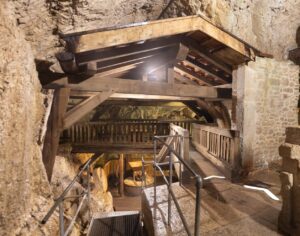
Above Carrara, on the ridges that the 2020 municipal plan designates for protection, open-cast marble quarrying is no longer allowed. A quarry can only extend there by galleries, through an entrance opened lower down than the protected zone. Beneath the mountain, some chambers reach 80 meters in height.
Only one of the tour’s five panoramas is taken in the open air, on a sawn marble platform lined with wooden barriers, at the top of a quarry. Two faces have been painted on a block left in place, facing mountains cut into by other quarries. The other four are taken underground. The chambers rest on marble pillars with sawn faces, and a loader and an excavator work in them. A large block lies at the foot of a pillar with a ladder leaning against it. In a long gallery lit by lamps stands a chain saw, its toothed chain arm mounted on a column.
The marble of the Apuan Alps
Carrara marble was originally a limestone. It was deposited in the Early Jurassic, about 200 million years ago, on a marine platform comparable to today’s Persian Gulf. Between 27 and 12 million years ago, during the formation of the Northern Apennines, these limestones were buried to a depth of about 12 kilometers and heated to between 300 and 450 °C. They became marble. Today they outcrop in the Apuan Alps, above the town, over an area of about 20 kilometers by 10.
White marble makes up about 85% of production. Statuario, ivory white and very uniform, supplied the block for Michelangelo’s Pietà. Ordinario, pearly white to light gray, is speckled with gray spots caused by pyrite. Bardiglio owes its gray color to very fine pyrite or to a carbonaceous pigment. Calacatta and arabescato are breccias: pieces of marble set in a matrix that is ochre yellow in the former, gray to dark green in the latter.
Before cutting, quarrymen read the rock along three directions. The “verso” follows the main foliation of the marble; the “secondo” and the “contro” are two sets of almost vertical fractures.
Luni marble
In 177 BC, Rome settled 2,000 citizens in the colony of Luna, on the coast. The marble was shipped from its port, hence its ancient name of Luni marble. The geographer Strabo describes quarries so numerous and of such good quality that they supplied most of the great buildings of Rome. The blocks reached the city by sea, then up the Tiber.
Quarrying reached an industrial scale in the 1st century BC, driven by Caesar. Pliny the Elder notes that stones whiter than Parian marble had been found at Luni. In Rome, the seventeen drums of the shaft of Trajan’s Column, nearly 4 meters across, are cut from this marble.
The Romans cut channels with hammer and chisel, then widened the split with wedges of iron or of wet wood. Where the fractures were widely spaced, they extracted blocks of 20 to 30 tonnes, which they brought down by sledge or by cart to the port. At least 23 Roman quarries have been identified in the Carrara district.
Quarrying stopped with the fall of the Western Empire. It resumed on a modest scale in the Middle Ages and only truly revived in the Renaissance.
Michelangelo’s blocks
In Michelangelo’s time, at least twenty or so quarries were active, in the hands of a few families. For the Pietà commissioned by Cardinal Jean Bilhères de Lagraulas, the sculptor left for Carrara in November 1497 and stayed there until early March 1498. He chose statuario from the Torano basin. The statue, now in St Peter’s in Rome, was completed in 1499.
In 1505, for the tomb of Pope Julius II, he spent from April to the end of the year in the quarries choosing his marble. In 1517, he left Carrara for Seravezza, in Versilia, from where he drew the marble for the façade of San Lorenzo in Florence. Over thirty-five years, he made at least ten trips to Carrara or Seravezza, perhaps more than twenty, and some stays lasted several months.
The David, carved from 1501 to 1504, comes from an older block. Agostino di Duccio had begun it, then abandoned it in the 1460s. This block of at least 35 tonnes had arrived in Florence from Carrara in 1466.
Cutting the marble
Explosives arrived in the 18th century. From the end of that century to the first half of the 20th, an entire section of mountain was sometimes brought down with black powder: these were the “volate”. In the second half of the 19th century, up to 90% of the rock brought down went to waste, and the debris slopes, the ravaneti, grew on the mountainsides.
At the end of the 19th century came the helical wire: three braided iron wires, driven by pulleys, which wore through the rock with quartz sand and water. Diamond wire replaced it from the late 1970s. It cuts about thirty-six times faster.
The chain saw cuts into the rock even when the block has only one free face, which makes it possible to work in galleries. Work today follows a cycle. The chain saw cuts the base of a slice about 10 meters high, the “bancata”, which is then freed with diamond wire. Water-filled cushions and jacks tip it over onto a bed of debris. Once lying down, it is cut into blocks, again with wire.

Bringing the blocks down
As late as the 1960s, blocks came down one by one on “lizze”, wooden sledges held back by teams of ten to twelve men. At that time, people walked up to the quarries, and no lorry reached them.
The ferrovia marmifera, a railway built from the 1870s onwards and completed in 1890, linked the basins to the plain and the port. It closed on 15 May 1964, superseded by lorries. Since 2012, the marble road, 5.6 kilometers long including 4.5 kilometers in tunnel, has diverted these lorries away from the center of Carrara.
After the war, a worker extracted about 70 tonnes of marble a year in the Apuan Alps. Today a worker extracts more than 1,000.
Quarrying in galleries
Around 2009-2010, Carrara had 10 underground quarries out of 78 active quarries. In the one shown in the tour, as in many other underground quarries, marble pillars left in place support the ceiling.
In 1997, the Tuscan Regional Council required that, in the quarrying areas of the Apuan Alps park, working in galleries be given priority. Open-cast working was allowed there only if it could be shown that there was no other way, and galleries had to avoid cutting through natural cavities. The park notes that underground, extraction disappears from the landscape.
The galleries grow as extraction proceeds, in height as well as in width. Large chambers more than 100 meters long are opened up in them to reach the best-quality marble. The other rocks extracted underground are presented in the article on the extraction of materials from underground quarries.
Marble powder
From 2012 to 2015, an average of 3.56 million tonnes of rock a year was extracted at Carrara. Blocks accounted for only just over a quarter of this, about 909,000 tonnes. The rest is mostly ground into calcium carbonate, sold for cement, agriculture, food, cosmetics, paper and toothpaste. According to the association Legambiente, 1% of the marble extracted goes to sculpture.
The “marmettola”, a very fine carbonate powder mixed with oils and metals, clogs the streams and seeps through the karst down to the aquifers. It clouds the springs at every flood. After the 2003 flood, a court-ordered expert report found the activity of the quarries to have been a decisive factor in the overflowing of the Carrione.
The Apuan Alps Regional Park was created in 1985. In 1997, its boundary was reduced by about 200 km², and the quarries became areas adjacent to the park. Some reach altitudes of up to 1,600 meters. The park has been a UNESCO Global Geopark since 2015.
The quarrymen
In the 1950s, Carrara had about 330 active quarries. About 80 remain, where some 600 people work.
From 2006 to 2015, the health services recorded an average of 102 accidents a year, and 9 fatal accidents over the period, for 700 to 800 workers. On 14 April 2016, two quarrymen were killed by a rockfall while cutting an unstable section of mountain. Breakage of the diamond wire, which sends its beads flying, also causes accidents, some of them fatal.
From the late 19th century, many quarrymen joined the anarchist movement. In 1911, their union won a working day of 6 hours 40 minutes. In September 1945, the Italian Anarchist Federation held its first national congress in Carrara.
A 1751 edict of Maria Teresa Cybo-Malaspina granted quarry land in perpetuity to whoever had worked it for twenty years. These “beni estimati” still cover about a third of the quarried area of the municipality. In 2023, the quarries brought Carrara nearly 26 million euros, a fifth of its revenue.
Visits
The regional tourism website lists five marble quarries open to visitors on the Apuan Riviera, open-cast or in galleries. Vehicle tours leave from the town and go underground. Near Colonnata, the Roman quarry of Fossacava, from the 1st century BC, has kept its trenches, its benches and quarrymen’s marks. It is explored along paths marked out with signs in Italian and English, with guided tours by reservation, mainly in summer.
The Museo Civico del Marmo, founded by the municipality in 1982, holds a collection of 310 marble samples and extraction tools from Roman times to the present day. In November 2026, the regional tourism website lists it as temporarily closed.

Sources: Coli M., Di Benedetto F. and Buccianti A., Applied Sciences, 2025; Coli M. and Criscuolo A., IOP Conference Series: Earth and Environmental Science 833, 2021; Vagnon F. et al., Sustainability, 2020; Barron A. J. M., Mercian Geologist, 2018; Baroni C. et al., Geografia Fisica e Dinamica Quaternaria, 2010; Carmignani L. (ed.), map of the marble deposits of the Apuan Alps, University of Siena for the Tuscany Region, 2007; Livy, History of Rome, XLI; Strabo, Geography, V; Pliny the Elder, Natural History, XXXVI; Sovrintendenza Capitolina, Trajan’s Column; Dizionario Biografico degli Italiani, entry “Buonarroti, Michelangelo”; Museo Galileo, Versilia itinerary, 2008; municipality of Carrara, plan of the extraction basins, 2019 and 2020; Apuan Alps Regional Park, 2010; Il Post, 2016, 2023 and 2024; Il Fatto Quotidiano, 2012; Diari Toscani, 2021; Greenreport, 2024; Tuscany Region tourism website
This tour is part of the catalog of virtual tours of underground heritage.