In Lorraine, iron ore is called “minette”, a diminutive of “mine”, because of its low iron content. Yet in the 1960s this low-grade ore took France to third place in the world for iron ore, behind the United States and the USSR.
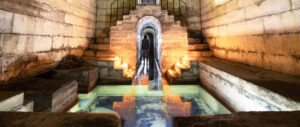
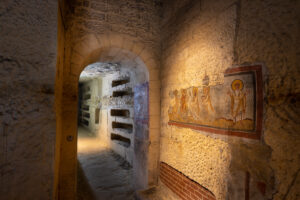
The tour above goes through a mechanized iron mine, from the shaft cage to the underground workshops. It shows the loaders, the compressor, the crushing room and the wagon tippler where the wagons were emptied.
Minette
The ore outcrops in seams along a wide band west of the Moselle, between Lorraine and Luxembourg, and extends slightly into Belgium. On the French side, the iron-ore basin covers 100,000 hectares, over about 80 kilometers from north to south and at most 30 kilometers across. The seams emerge on the sides of the Chiers, Alzette, Fensch and Orne valleys, then dip about 3% toward the west, beneath the plateau. The deepest mine there worked at 260 meters.
It is a Jurassic sedimentary rock, made of small grains of limonite, an iron hydroxide, set in a calcareous or siliceous cement. These grains are called ooliths. The workable seams grade 30 to 35% iron and alternate with poorer beds, the interbeds; in places, as many as six seams were mined one above the other. The miners named them after colors: red, yellow, gray, black or green. The imported ores, to which minette would eventually give way, graded 70%.
The Thomas process
Minette also contains phosphorus, from 0.5 to 1.7%, and phosphorus makes pig iron brittle. Until around 1878, only the parts of the deposit that contained none were mined. Most extraction at the time concerned another ore, “fer fort”, found at the surface, richer and free of phosphorus.
In 1871, by annexing Alsace-Moselle, Germany took four fifths of the outcrops and of the worked areas. In 1878, two Englishmen, Sidney Thomas and Percy Gilchrist, presented a basic lining for the Bessemer converter: the lime it contains removes the phosphorus from the pig iron. The ore that had been left in the ground became the raw material of an industry.
On the French side, the Orne valley deposit was discovered in 1882, then the Briey plateau was explored by drilling from 1893, and a rush for concessions followed. At the beginning of the 20th century, Meurthe-et-Moselle was the leading department in France for steel. Even the phosphorus found a buyer: ground into meal, Thomas slag went onto the fields as fertilizer.
The Lorraine basin
In 1913, the part of Lorraine that had remained French supplied 19.5 of the 21.7 million tonnes extracted in France. With annexed Lorraine and Luxembourg, the basin produced 47 million tonnes that year, a third of world production.
Manpower was needed. Between 1890 and 1913, the number of miners rose from 7,000 to 35,000, largely through Italian immigration. In 1929, out of about 35,000 miners, there were nearly 11,000 Italians and 11,500 Poles; the French made up only 22% of the workforce.
The record came in 1960: 62.7 million tonnes in Lorraine, out of 67 million for the whole of France. In the early 1960s, more than 20,000 people worked in the Lorraine iron mines, and about 100,000 in the steel industry. In all, more than three billion tonnes were taken from the deposit.
The room and pillar method
Minette was mined by room and pillar. Galleries 4 to 7 meters wide, the rooms, divided the seam into pillars 10 to 25 meters wide, as high as the seam was thick, from 3 to 7 meters.
Most often, the miners later came back to these pillars to take out their ore, until only “stumps” were left, which were blasted to bring down the roof. This is caving. In the early 1980s, almost all of the basin’s production came from sections worked this way. At the surface, the ground sank in a bowl shape, then settled within five years. Elsewhere, the pillars were left in place, and the voids remained after closure.
The ore was broken with explosives. Black powder, liquid oxygen and nitro explosives were used for this.
Mechanization
Underground, electricity was first used to produce compressed air for the rock drills and pneumatic picks; it did not light the workings. The tour passes through an electrical substation and by a 3,000-volt compressor.
The big change came after the war. Roof bolting, which secures the roof rock with rods anchored deep inside it, replaced timbering from 1950 and cleared the galleries for vehicles. From 1955, all loading was done by machine.
In the 1960s, the main machine was the Joy loader, an American machine with gathering arms, which filled electric and then diesel-electric shuttle cars. The basin had 181 of them in 1965. Only 9 remained in 1980: they had been replaced by load-haul-dump machines, which load and carry the ore themselves in trackless galleries. The tour shows an electric Joy loader and an Eimco loader.
Scaling means bringing down from the roof and walls the blocks that threaten to fall. Just after the war, accidents were very frequent, particularly deaths from falling blocks. Scaling machines came late: 3 in the basin in 1971, 69 in 1980. Even with them, miners kept sounding the roof with a scaling bar and by ear. The tour shows one of them.
Productivity followed. In 1946, a worker mined about 11 tonnes of ore per shift; in 1992, more than 200.
From the face to the surface
Haulage, meaning transport underground, used horses, then steam, benzol and later electric locomotives, and finally conveyor belts. Around 1980, in a large mine in the basin, 17-tonne electric locomotives pulled trains of ten 18-tonne mine cars on meter-gauge track; a working section was on average 3 kilometers from the tipping station.
At the wagon tippler, a platform turns each wagon over to dump its ore; in the tour, the ore falls into a huge shaft. In the mine mentioned above, a crusher underground broke it into 200-millimeter blocks, then two 12-tonne skips, large automatic buckets, hoisted it to the surface, 800 to 900 tonnes per hour. The tour also passes through a crushing room.
In mines with several levels, other shafts, the blind shafts, connect the levels to one another without going up to the surface. The tour shows a blind shaft and its cage, the double winch room, which lowers two cages far down into the lower seams, the hoist that brought up ore from the levels below, and the mine’s emergency staircase.
Saint Barbara
Saint Barbara protects miners from explosions and accidents. Her statue stands at the entrance to the declines or deep in the mine. In the mining towns, her feast day, December 4, matters more to the profession than Christmas: procession, mass, banquet and dance, and a wreath at the memorial to the victims. Before the war, it lasted a week.
In the tour, an underground workshop bears her name, and a classroom has been set up below ground.
The end of minette
From 1963, large ore carriers brought ores from Africa, Australia and South America to Europe, high-grade and cheaper than minette. Steelworks switched to pure oxygen, which favors hematite pig iron. The same year, a strike with occupation of the underground workings answered the first layoffs.
Twenty mine sites closed between 1963 and 1969. Closures slowed until 1978, then twenty-five sites shut down in ten years, and production fell from 51 to 10 million tonnes during the 1980s. The last Lorraine mine stopped extracting in July 1997. It was operated by the Luxembourg company ARBED, which the same year stopped using minette by shutting down the last blast furnace in Luxembourg, at Esch-Belval.
Water and ground
To bring out one tonne of ore, 5 to 20 cubic meters of water had to be pumped. Caving had fractured the marls and drained almost all of the Dogger limestone aquifer toward the mines. From 1946 to 1993, the basin discharged an average of 179 million cubic meters a year, and nearly 350,000 people drank this mine drainage water.
The pumps were stopped reservoir by reservoir, from 1994 to 2005, and the water rose back into the voids. Laden with sulfates, it is no longer drinkable. In 1996, after the pumps of the southern basin were stopped, houses subsided in Auboué; further subsidence hit Moutiers in 1997, then Roncourt between 1998 and 1999. These mines, less than 200 meters deep, had been worked by room and pillar with abandoned pillars.
The mining code was reformed in 1999. Since 2001, a public consortium, Géoderis, has served as the State’s mining expert, and leveling networks still monitor the ground in 54 municipalities of the basin.
Other iron basins
Other regions had their own iron mines, on a different scale. In Normandy, concessions opened from 1865 in the Manche, Calvados and Orne; before 1914, 17 of the 21 concessions granted were controlled by Germany. The region then supplied 4% of French ore, and reached its record in 1960, nearly 3 million tonnes. Delivered to Dunkirk, ores from Liberia and Mauritania ended up costing less than Orne ore, and the last Norman mine shut down on August 1, 1989.
Around Segré, in Anjou, a siliceous and phosphorus-bearing magnetite was extracted from the 1870s, harder to process than minette; mining took off after the loss of the Alsace-Lorraine mines. The basin closed in the mid-1980s.
In the Pyrenees, the Canigou mines produced siderite and hematite; the Decazeville steel industry stopped ordering from them in 1987.
Elsewhere, the deposits remained modest. In the Ardennes, the ore pits were exhausted and stopped producing in 1886. In Aveyron, the mines of the Causse de Mondalazac worked a red hematite with 18 to 28% iron from 1852 to 1931. In Ardèche, shafts of the former Saint-Priest iron mines are listed as historic monuments. In the Var, the Beausoleil mines, between Ampus and Châteaudouble, ran from 1875 to 1914 with around ten workers. In Vaucluse, at Lagnes, an iron mine dug into a karst was worked intermittently from the early 15th century, then taken up again in the early 19th.
Iron mines to visit
In southern Luxembourg, the extension of the Lorraine basin can be visited. The National Iron Mining Museum in Rumelange has occupied the galleries of three former mines, connected underground, since 1973; visitors enter it aboard a mine train. At Fond-de-Gras, another mine train, the Minièresbunn, leads to a mine reopened to visitors. Other museums are presented among the underground museums and in the article on underground and open-pit mines.
Sources: INERIS, study report DRS-06-75685/R01, 2006; Pascal Raggi, “Un demi-siècle de désindustrialisation en Lorraine du fer (1963-2013)”, Revue du Rhin supérieur, 2019; Pascal Raggi, “Ingénieurs et syndicalistes des mines de fer de Lorraine face au gigantisme industriel”, in Corps et machines à l’âge industriel, Presses universitaires de Rennes, 2011; Alain Leménorel, “Mines de fer et sidérurgie bas-normandes”, Annales de Normandie, 2010; Louis de Launay, “La Valeur minière et industrielle de l’Alsace-Lorraine”, Revue des Deux Mondes, 1919; Musée des mines de fer de Lorraine, teaching guide, 2020; François-Xavier Bibert, “Les mines de fer de Lorraine au début des années 1980”; Encyclopædia Universalis, “Minette de Lorraine”; Université de Lorraine, “Lecture des paysages lorrains”; Académie de Nancy-Metz, “Géologie de la Lorraine”; “La stratégie des Schneider”, Presses universitaires de Rennes; Minièresbunn, “Minette”; DREAL Grand Est, “Bassin ferrifère”; Géoderis, “Historique”; SAGE du bassin ferrifère, baseline assessment, 2007; BRGM, explanatory notes to the Craon geological map, 2010; Patrimoines du Sud, 2022; Bruno Prati, “La Fonte ardennaise et ses marchés”, 2013; Institut occitan de l’Aveyron, “Salles-la-Source”; Ministry of Culture, Mérimée database; Nice-Matin, September 16, 2024; Ministry of Culture, regional scientific report for Provence-Alpes-Côte d’Azur, 1996; INA, “Fête de la Sainte-Barbe à Crusnes”
This tour is part of the catalog of virtual tours of underground heritage.