The tomb of Ramesses VI was not dug for him. His predecessor Ramesses V (c. 1147-1143 BC) began the work in the Valley of the Kings, on the west bank of the Nile opposite Luxor, and had the corridors cut as far as the well chamber. Ramesses VI, his uncle (c. 1143-1136 BC), completed the excavation for his own burial and had his name and image carved over those of Ramesses V in the first corridors. It is not known whether Ramesses V was ever buried there.
The tomb, numbered KV9, runs in a straight line for almost 117 meters, corridor after corridor, down to a vaulted burial chamber that remained smaller than planned. While cutting the lower corridors, the workmen accidentally broke into the rear chamber of an older tomb, KV12. Their huts, built over the entrance to the tomb of Tutankhamun, buried it, which helped to preserve it.
The decoration
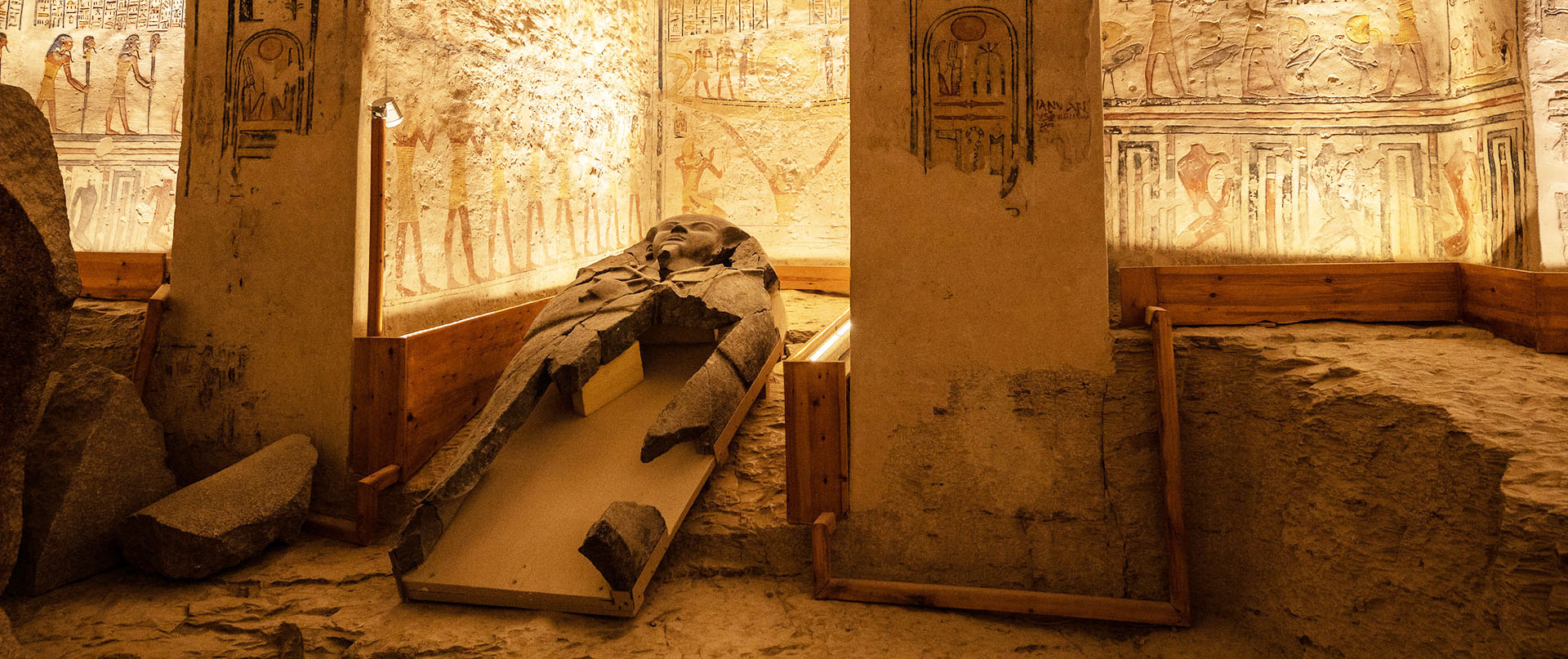
The walls carry painted sunk reliefs taken from the funerary books that were meant to guide the king through the afterlife. In the first corridors, the Book of Gates runs along the left wall and the Book of Caverns along the right. Further down come the Amduat, chapters of the Book of the Dead and, in the burial chamber, the Book of the Earth. On the ceilings, the goddess Nut stretches full length above the Book of the Day and the Book of the Night: the sun passes through her body during the night and is reborn in the morning.
In the burial chamber, the red granite box of the outer sarcophagus was broken in two in antiquity. The inner sarcophagus, also smashed, has been pieced back together and is displayed in place.
A tomb open since antiquity
The plundering is ancient. Papyrus Mayer B mentions thefts in KV9, and a graffito dated to year 9 of Ramesses IX, on the ceiling of the burial chamber, may record the inspection that followed. The tomb has remained accessible ever since. In the Graeco-Roman period it was taken to be the tomb of Memnon, the legendary king of the Ethiopians who fought at Troy, and visitors flocked to it. They left nearly a thousand graffiti, mostly in Greek but also in Latin, Demotic and Coptic, from the 1st century BC to the 4th century AD. One of them wrote: “I visited and I did not like anything except the sarcophagus!”
The reliefs have remained in good condition, and floods have caused little damage. Conservation technicians of the Supreme Council of Antiquities have cleaned the decoration and consolidated the plaster; lighting and wooden walkways with railings have been installed for visitors. The tomb is open to the public.


Sources: Theban Mapping Project, “KV 09: Rameses V and Rameses VI”; Egyptian Ministry of Tourism and Antiquities, “Tomb of Ramesses VI (KV9)”; Wikipedia, “KV9” (French and English articles), for the Graeco-Roman graffiti.
Another virtual tour in Egypt: the Serapeum of Saqqara, where the Apis bulls were buried.
This tour is part of the catalog of virtual tours of underground heritage.