In 2014, archaeologist Gilles Prilaux, of Inrap, was excavating the floor of the Naours tunnels, in the Somme. Looking up, he saw names written in pencil on the chalk walls. The survey published in 2021 counts nearly 3,200 inscriptions from the First World War, more than 2,200 of them left by Australian soldiers.
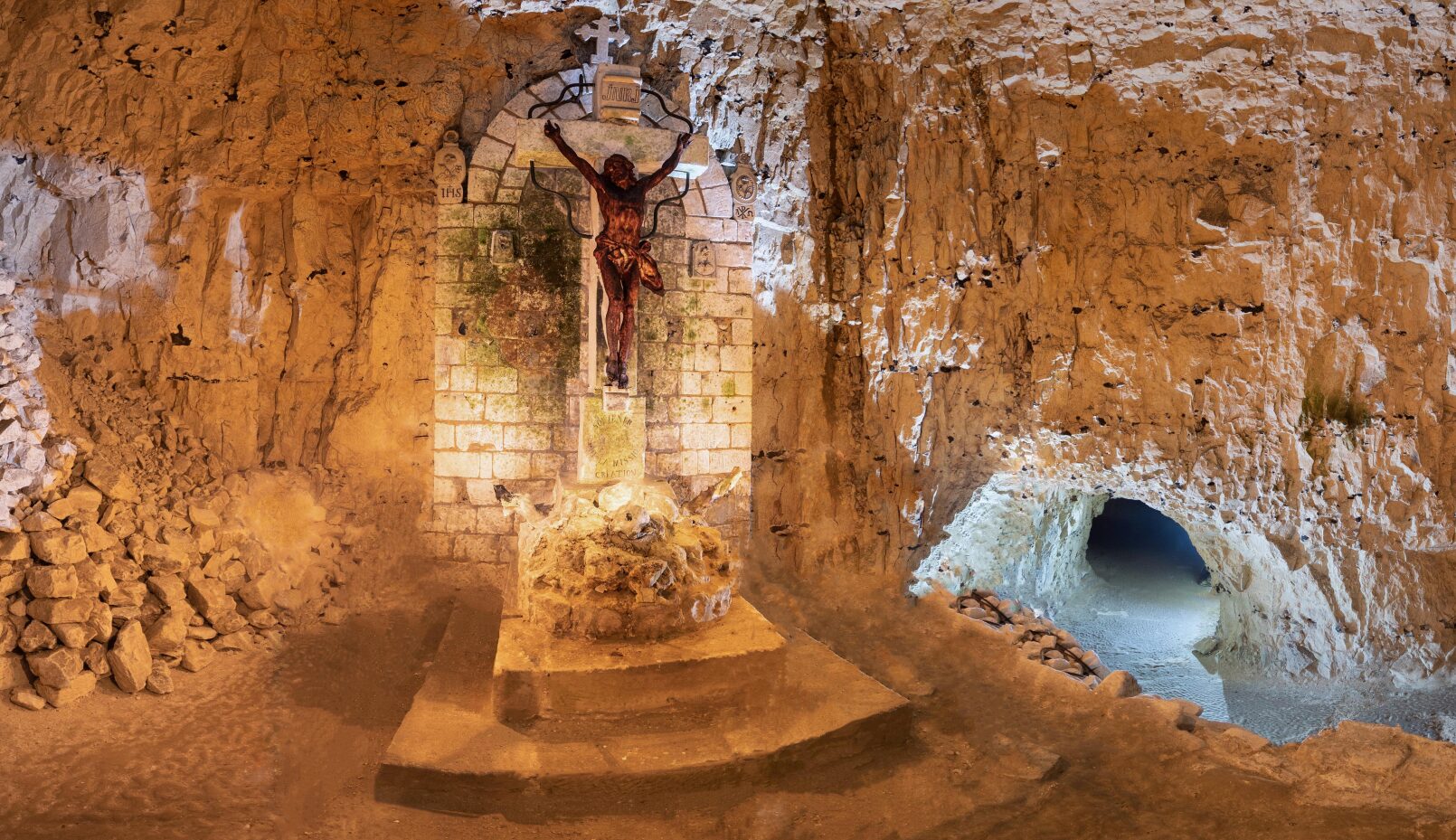
The tour above begins in the rotunda. A plaque there states that it was cleared from 1901 to 1905, by removing 4,000 cubic meters of white dust mixed with large stones. Next comes the congress hall, around an engraved obelisk, then the ancestors’ hall, where a column topped with a cross stands. The tour ends in front of a crucifix set in a stone niche.
The muche
In Picard, “se mucher” means to hide. A muche is an underground passage where people hide themselves and their belongings. The one at Naours, twenty minutes north of Amiens, was dug by hand into the chalk, about thirty meters below the plateau.
The network developed from former quarries, where chalk was extracted to improve the fields or for building. About a dozen branches lead off from this core, in no apparent order, and form more or less distinct groups of rooms. The other muches in the region usually consist of narrow, straight galleries lined with rectangular chambers.
At its greatest extent, the underground complex had 28 galleries and 300 chambers, over 2 to 3 kilometers depending on the source. It has public squares, a chapel and chimneys cut for ventilation and smoke. The temperature stays between 9 and 10°C all year round.
The villagers’ refuge
In the 16th and 17th centuries, the Picardy countryside lived in almost constant insecurity. Troops, friendly or enemy, helped themselves to the peasants’ stores, and the situation worsened from 1635, when France entered the Thirty Years’ War. As early as September 1597, Jean Vaultier described peasants near Poix who had taken refuge underground and burst out of it without mercy.
At Naours, excavations have uncovered coins, pottery, musket balls and inscriptions from the early 17th century. It is the only occupation that archaeology establishes with certainty. Other texts date the refuge back to the 14th or 15th century, without offering proof.
Later, the underground complex was used for smuggling. An old man told Abbé Danicourt that he used to run errands in the tunnels, as far as a room nicknamed the salt store, where smugglers kept their stocks.
The lost entrance
According to the archives, the entrance was blocked up in 1796. It was reopened in 1818 to quarry stone, then closed again in 1822, after the death of a stonecutter. Even so, a homeless family settled in a room near the entrance. In 1832, a collapse forced them to leave and closed the entrance for good.
Abbé Danicourt
On Sunday, December 4, 1887, the parish priest of Naours, Abbé Ernest Danicourt, called on his parishioners from the pulpit to find the entrance again. A team led by two stonecutters set to work, helped by the memories of the village elders. After eleven days of digging and clearing, the team reopened the passage.
Danicourt published a first guide as early as 1888, and clearance work went on for eighteen years. He published reports on his excavations, then a study of the underground complex in 1906. In 1905, the surveyor Balesdens drew up the only known topographic plan of the complex before the laser scanner surveys by INSA Strasbourg, begun in 2015.
On July 3, 1893, the Congrès archéologique de France, meeting in Abbeville for its 60th session, came to visit the church and the tunnels. In the congress hall, an obelisk engraved “in perpetual memory” commemorates this visit and lists the members present.
The traveling soldiers
Ever since the site opened to tourism, it had been said that the tunnels served as a military hospital during the First World War. Archaeology contradicts this account. Soldiers billeted a few kilometers from the front came to visit the tunnels during their periods of rest or convalescence, led by English-speaking guides, for a small fee.
The first Australians arrived in July 1916, during the Battle of the Somme. Many came from Vignacourt, seven kilometers away, where there was a major rear base, a hospital and a convalescent center. The guides mixed history and legend: a soldier noted in 1916 that everything had been dug “in the time of the Normans (850)”.
To sign, the soldier smoothed a small square of wall with a knife blade, then wrote in pencil, more rarely in blue ink. He gave his name, his initials, his unit, often his battalion and the state where he was born, sometimes the date. A few Zouaves signed in 1914 and 1915. Most of the other names come from the British divisions: English, Scots, Irish, Canadians, New Zealanders, South Africans, Indians. In 1918 came American soldiers from the 7th and 148th aero squadrons.
Some signatures have a known story. “HJ Leach. Merely a private. 13/7/16. SA Australia.” wrote an ordinary private, killed at Pozières on August 23, 1916. Lieutenant Leslie Russel Blake, geologist, cartographer and Antarctic explorer, signed on January 1, 1917. He died on October 3, 1918.
Inventory of the signatures
The inventory of the inscriptions was entrusted to Thierry Hardier, a member of CRID 14-18. The count grew as he progressed: 2,800 names in April 2016, nearly 3,200 in the report published in 2021. The final figure will probably be higher, as part of the underground complex remains inaccessible. Gilles Prilaux has identified nearly 500 Australian soldiers with certainty and written their biographies.
During the Second World War, the German army occupied the caves. It left the 1914-1918 signatures in place and added about ten. Since 2020, an interpretation center, “Les Soldats voyageurs”, has been telling the story of these visits. To protect the signatures, they are only shown with a guide.
The estate
The underground complex is not protected as a historic monument. The two windmills on Guet hill are listed: the Belcan mill, brought from Linselles, in the Nord, in 1961, and the Westmolen mill, brought from Stavele, in Belgium, in 1976.
Since December 1, 2013, the site has been managed by the intercommunal authority, now the Territoire Nord Picardie community of communes. It received about 38,000 visitors a year at the time of the takeover, and nearly 60,000 in 2025. The visit also includes a museum of old trades. In winter, the underground complex shelters more than 250 bats.
The underground complex is closed to the public for the 2026 season, for safety work planned to last nearly two years: it has to be protected from falling stones and the graffiti preserved. The entire site will be closed for the whole 2027 season.
Sources: Gilles Prilaux, “Underground Traces of the Great War at Naours: Some Australian Soldiers and Their Stories”, The French Australian Review, 2021; Inrap, “Les souterrains de Naours, haut-lieu touristique au temps de la Grande Guerre”, April 21, 2016, and press release of the same day; Gilles Prilaux and Matthieu Beuvin, Nordoc’Archéo blog, May 9, 2016; Australian War Memorial, “Thomas Charters Forbes and the subterranean city of Naours”, 2023; The Age (Associated Press), April 5, 2015; Courrier picard, 2015 and 2026; L’Abeille de la Ternoise, February 9, 2026; Mérimée database, records PA00116209 and PA00116210; Conservatoire d’espaces naturels Hauts-de-France; INSA Strasbourg, abstracts of final-year projects, 2016 and 2018; catalog of the Bibliothèque nationale de France (publications by Abbé Danicourt); website of the Cité souterraine de Naours; plaques and obelisk visible in the tour
This tour is part of the catalog of virtual tours of underground heritage.