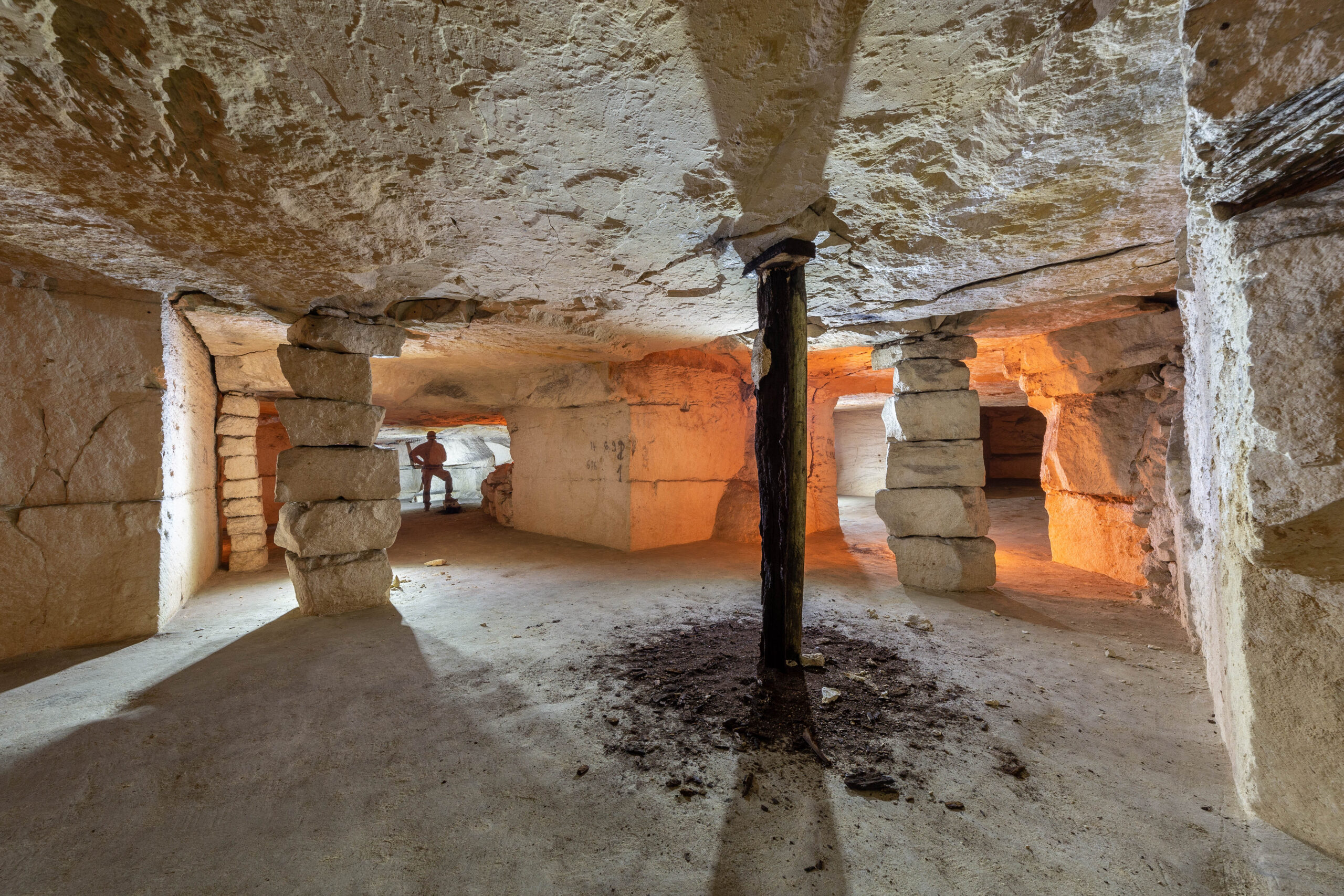
Stone from Aubigny, in the Yonne, was extracted underground by hand, with two iron tools. In Paris it can be found in the Louvre, the Hôtel de Ville, the Opéra Garnier and the masonry foundations of the Eiffel Tower.
An underground quarry is a working dug beneath the ground to extract stone. The word comes from the Latin quadrus, the “squared stone”, in other words dressed stone. In France, the nature of the rock is what separates a quarry from a mine: coal, salt, iron or gold come under the rules for mines, and every other rock under the rules for quarries. The quarries shown on this site supplied limestone, chalk, tuffeau, gypsum, ochre, marble or slate.
The stones of underground quarries
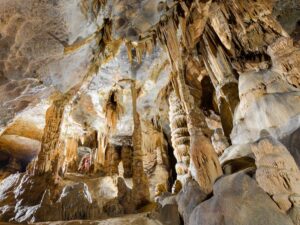
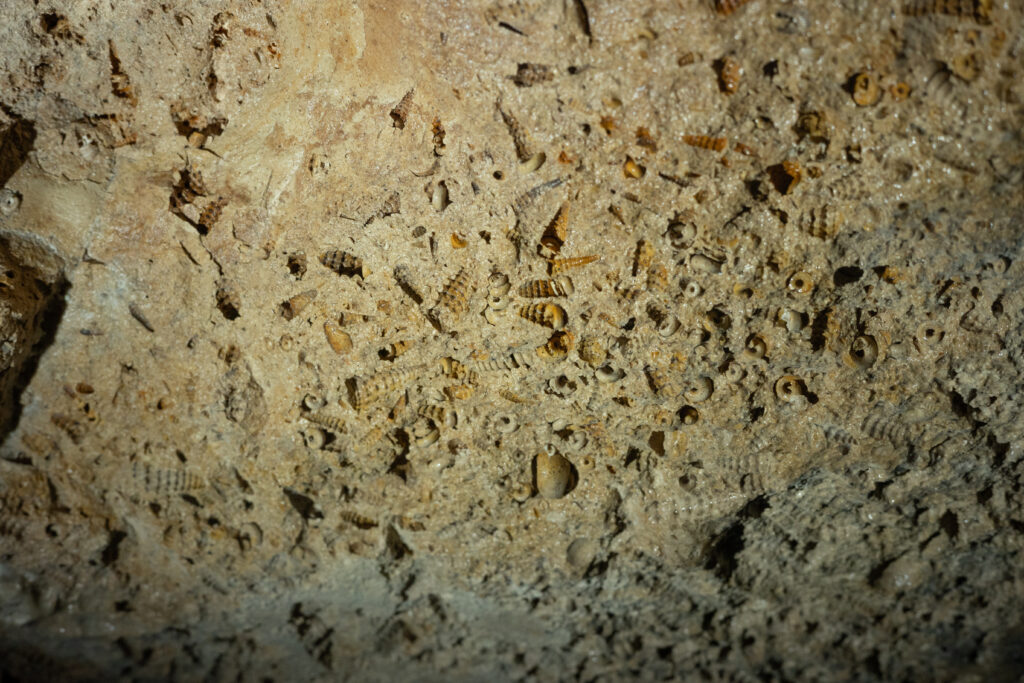
Beneath Paris, calcaire grossier, the city’s building stone, and gypsum were quarried until the end of the 19th century. This Lutetian limestone was laid down about 45 million years ago, at the bottom of a warm sea that covered the Paris Basin. Some beds are full of fossil shells, hence the name “shelly limestone”. At Carrières-sur-Seine, quarrymen also extracted liais, a fine stone used for the Basilica of Saint-Denis and for the Neuilly bridge.
Other limestones appear in the site’s tours. Aubigny stone, from the Jurassic, is white, uniform and fine-grained. Crazannes stone, in Saintonge, is soft when quarried and hardens in the air. In Dutch Limburg, Maastricht limestone, 70 million years old, reaches almost 80 meters in thickness, and the region still calls it “marl” out of habit. Beneath Orléans, Beauce limestone was extracted on the spot, under the houses: the town now has almost 700 cavities.
Tuffeau is a marine sedimentary rock made of fossil debris cemented together, laid down about 90 million years ago. It is soft and easy to cut. At Bourré, in the Cher valley, a village street was carved out of the rock mass, deep inside a quarry at the Cave des Roches.
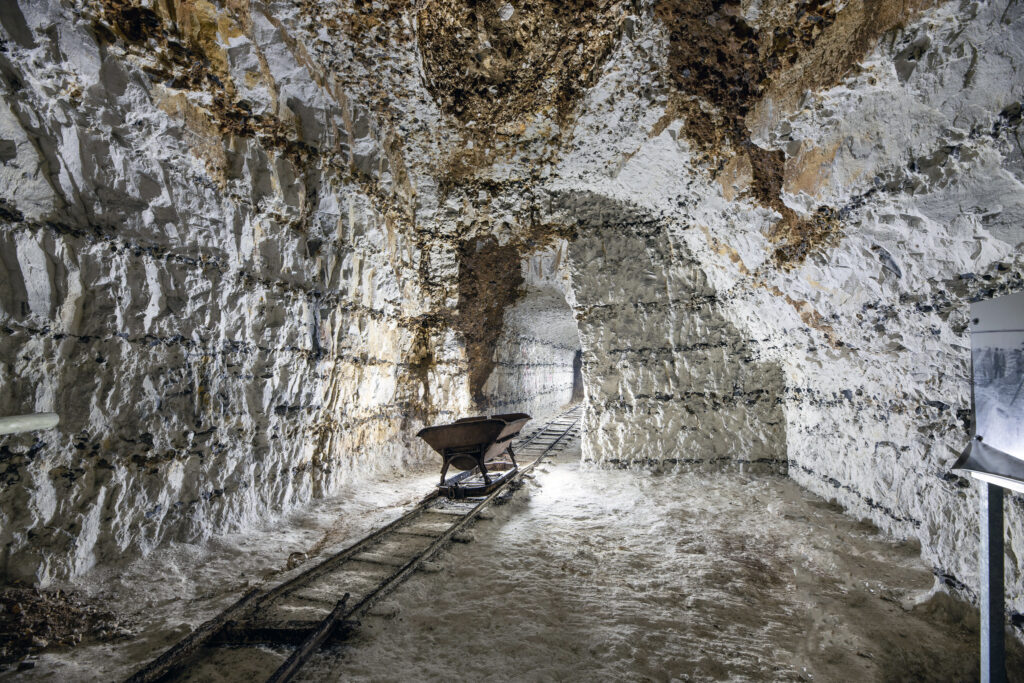
Chalk comes from the microscopic shells of marine organisms. Mixed with clay and fired, it produces limes and cements. Crushed, washed and settled, it becomes Meudon white, found in paints, glazier’s putty and cleaning products. Beneath the Rodin hill, the Arnaudet quarries left almost eight kilometers of galleries on three levels.
Gypsum, formed by the evaporation of salt water, is used to make plaster. It has one weakness: it dissolves in water, and seepage causes collapses.
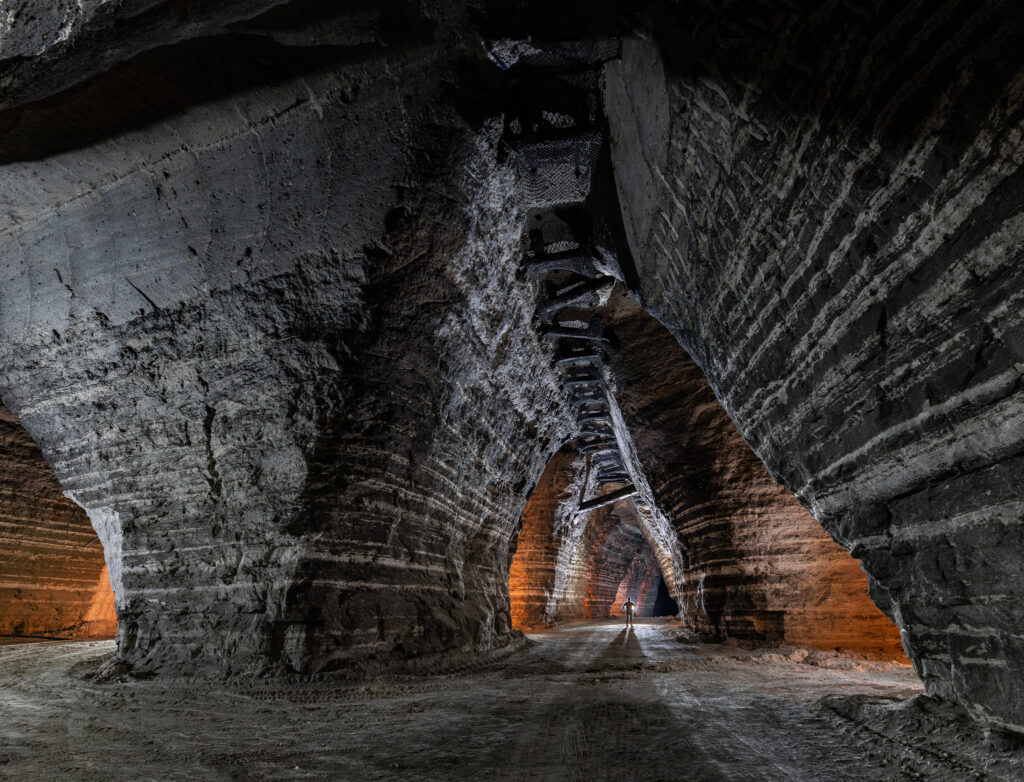
Other materials were quarried underground too: Luberon ochre, sand, marble and slate. The 1810 mining law classed slate workings as quarries; in the 19th century, Maine-et-Loire was the leading producing region. The rocks, how they formed and how they were used are described in the article on the extraction of underground quarry materials.
Extracting the blocks
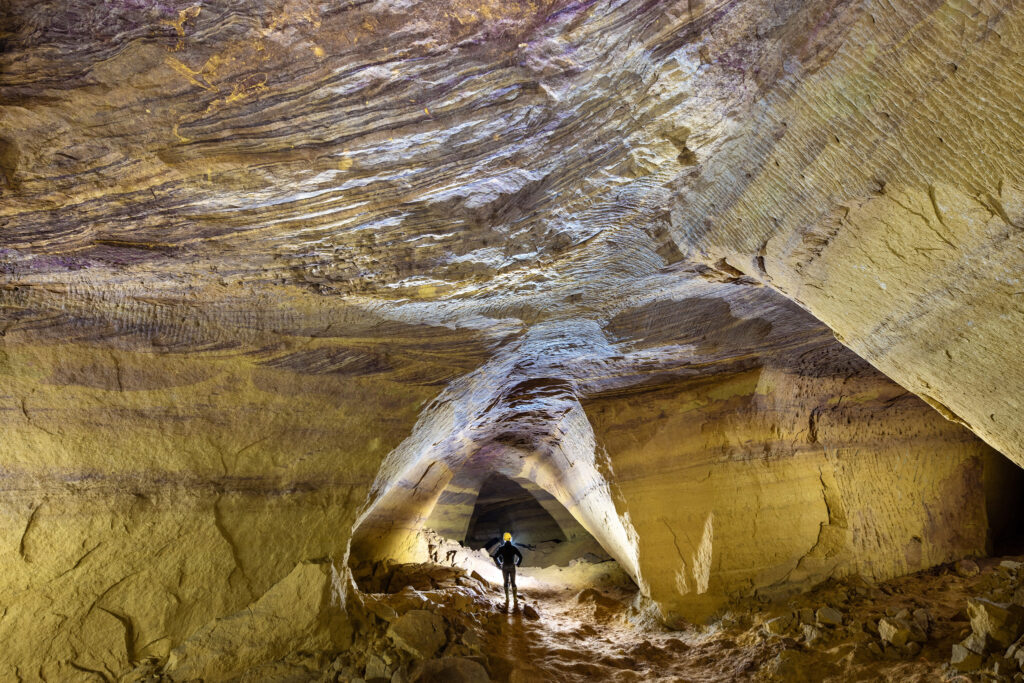
Every tool leaves a recognizable mark on the rock. In Limburg, the roofs of the oldest workings bear rounded strike marks, those of the pick; the chisel and the saw came later. A gallery can therefore be dated by walking through it. The block cutters also wrote on the walls, in red chalk or black pencil, the tally of blocks sawn during the day, and hundreds of these tallies can still be read.
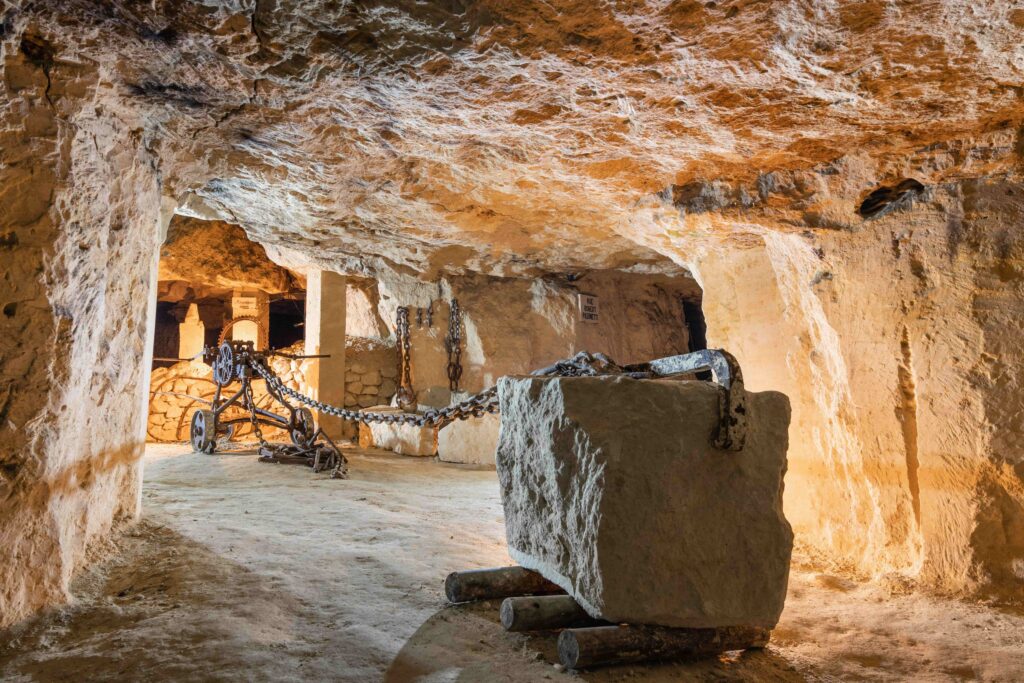
At Aubigny, the quarryman first opened two vertical channels about one meter deep. He used the lance, a heavy pointed iron bar hung from a chain, which he swung and let fall back into the same groove. He then freed the block from its bed with the needle, a wedge driven in until the stone moved along its natural plane of fracture. No explosives or machines were ever used there, and every stroke of the lance is still visible on the walls.
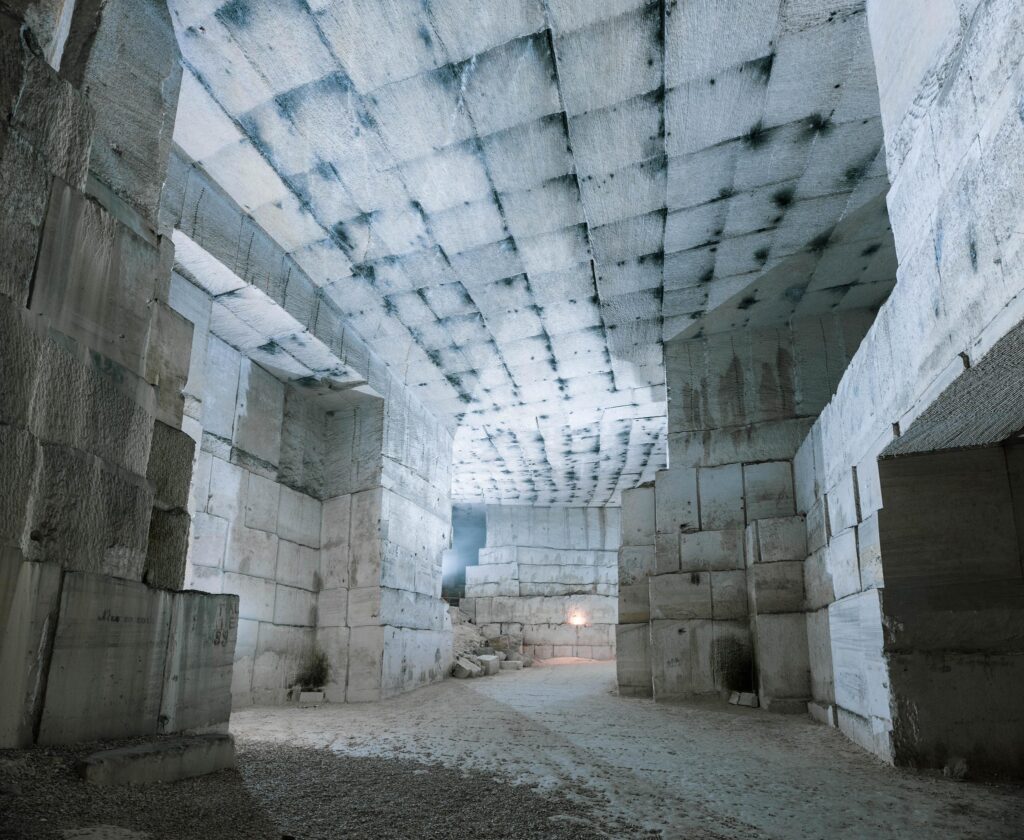
At Carrières-sur-Seine, in the quarry that became the Carrara-City Space, a quarryman’s lance has been reassembled: a three-meter metal rod set on a wooden frame, which could only be used where the quarry roof was high enough to install it.
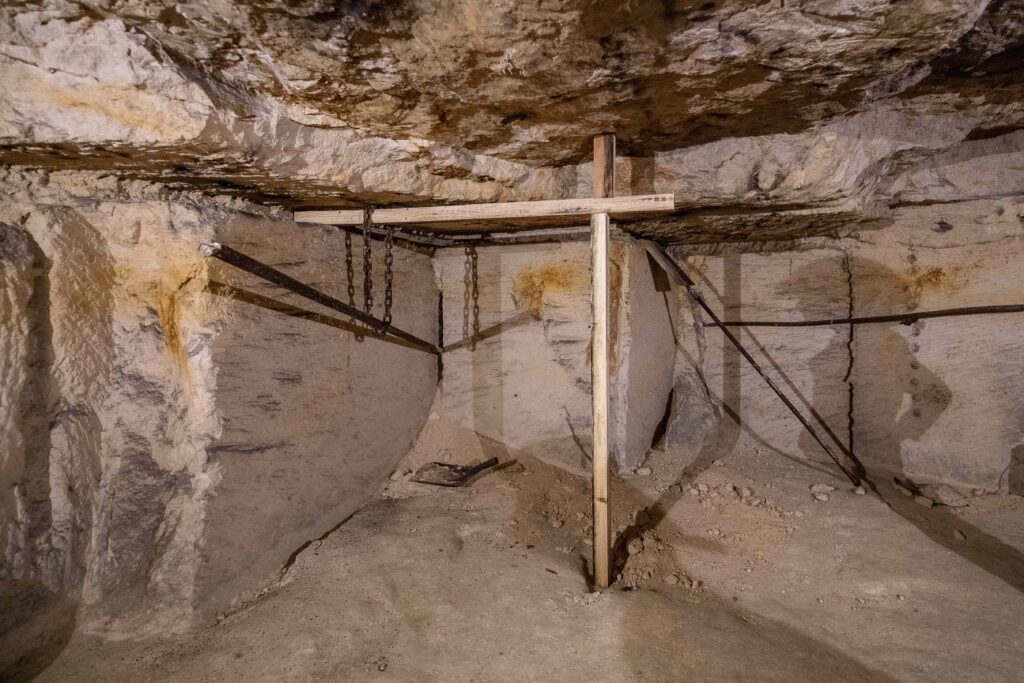
In chalk, stone was also quarried in benches: vertical blocks are cut first, then horizontal slices are removed, and each block extracted leaves its imprint, which shows the direction in which the quarrymen advanced. In mechanized quarries, a cutting machine slices the stone, then pneumatic cushions detach the cut blocks.
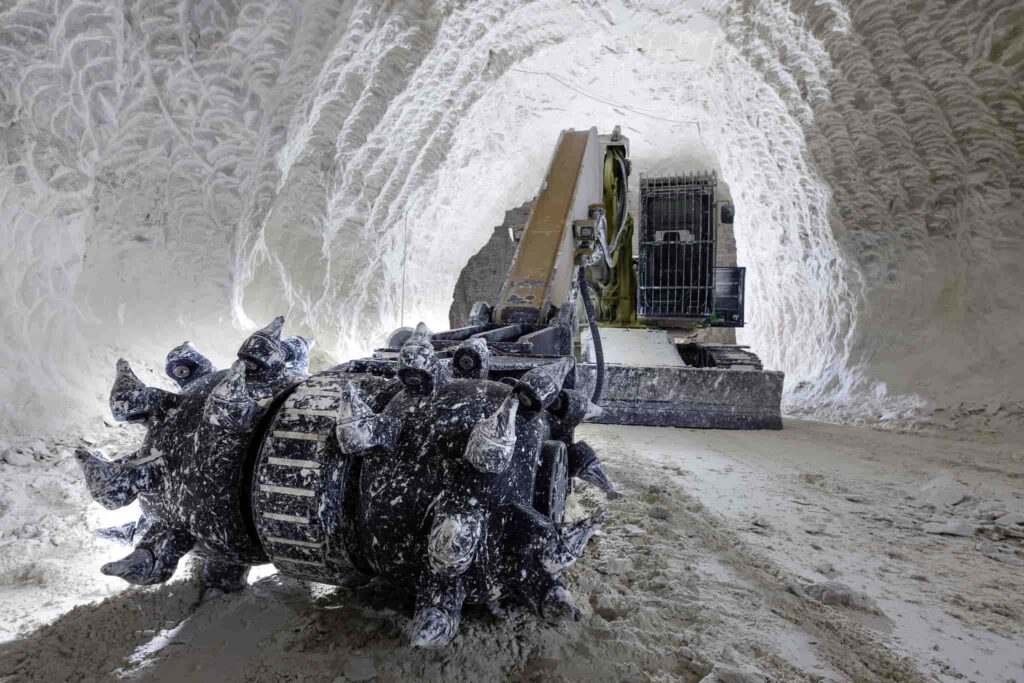
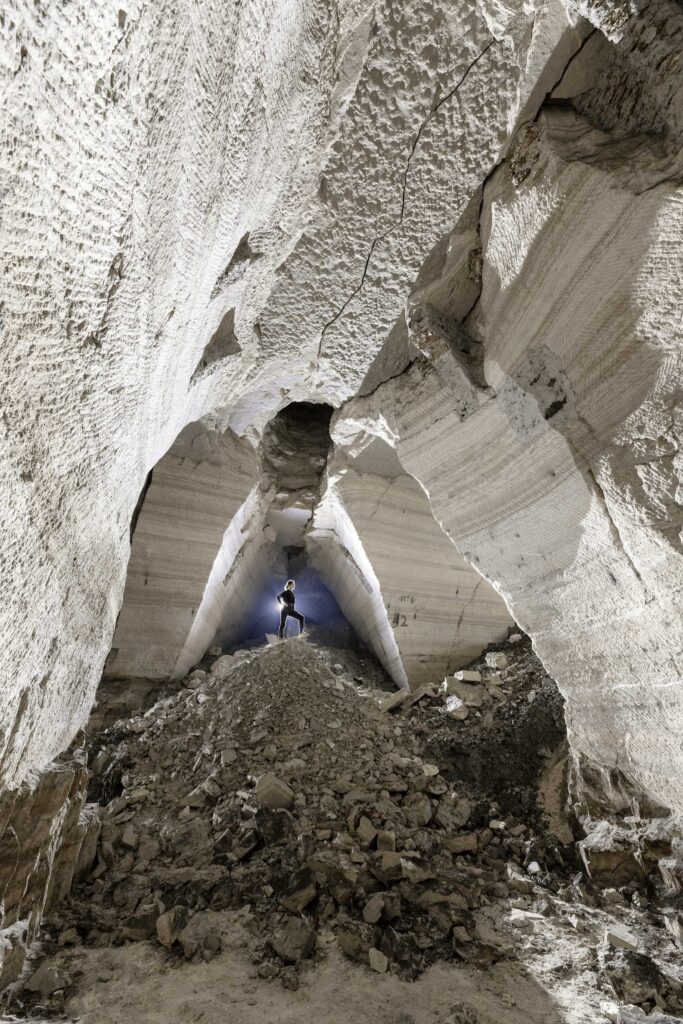
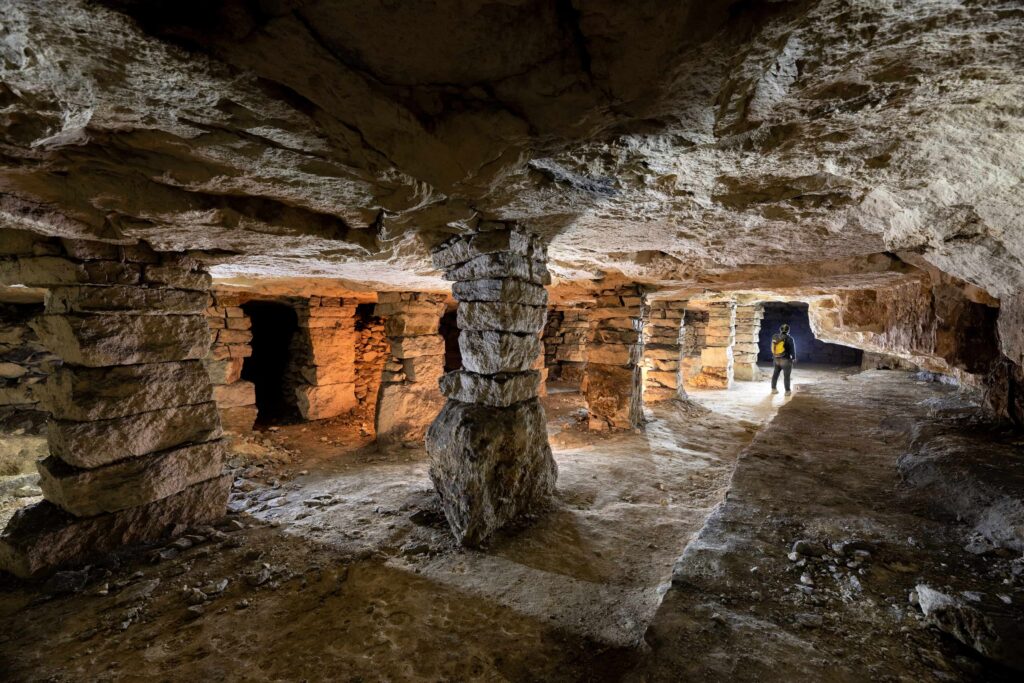
To support the roof, columns of rock are left in place between the dug areas: these are the turned pillars. At Aubigny, they mark out vast chambers whose height follows the thickness of the bed being worked. Beneath Paris, all the stone was often extracted, then the voids were filled with cutting waste and lower-quality beds, the backfill, held back by low dry-stone walls called hagues.
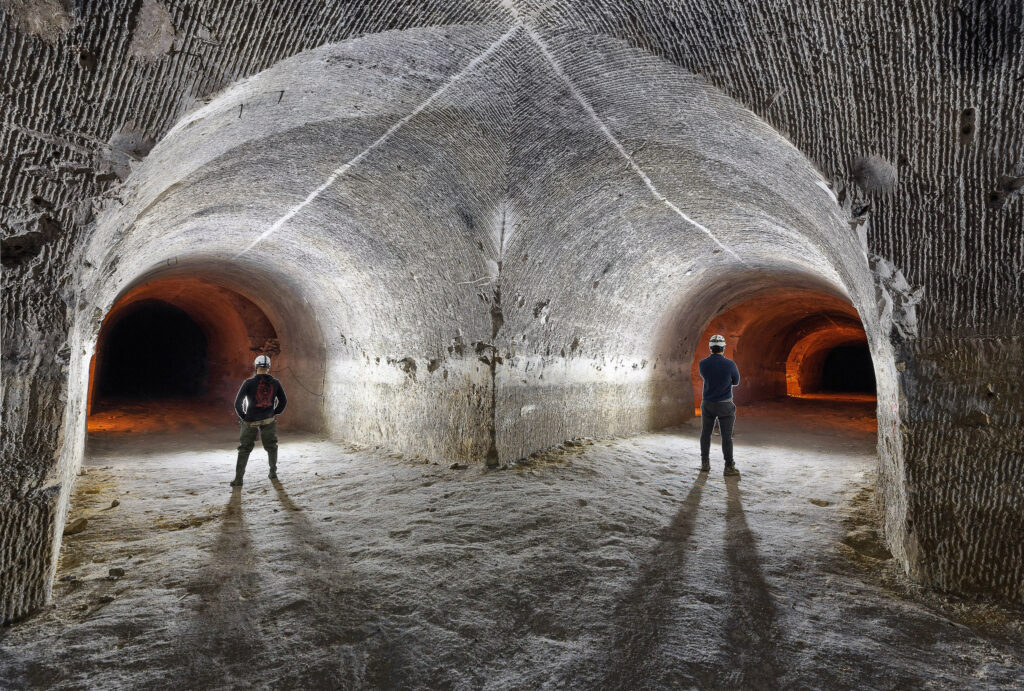
Transporting the stone
Until the 1910s, blocks sent by road almost all traveled on horse-drawn carts. Many quarries open near a river, and shipping by water gave rise to stone ports. In Limburg, the blocks for Maastricht’s second city wall, begun around 1347, arrived by cart and by boat. Aubigny stone first went to the cathedrals of Sens and Auxerre, within carting distance, then to Paris once waterways and the railway became available.
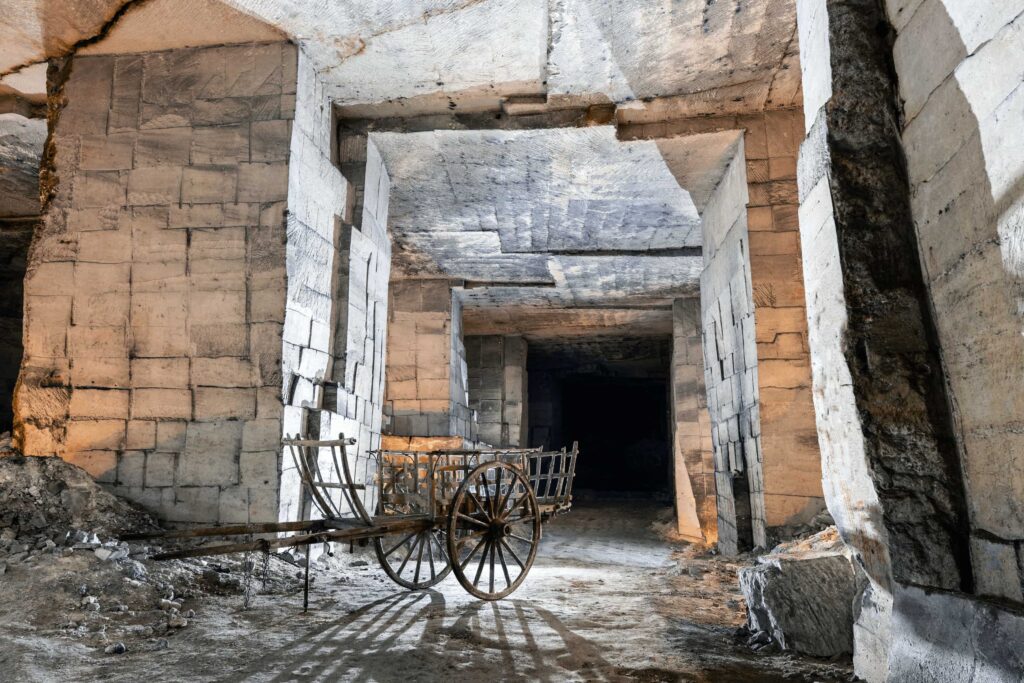
Inside the quarry, narrow-gauge tracks were laid along the main galleries, and the rails were moved as the working face advanced. Winches called “crapauds” hauled the blocks, and other winches lifted them from one level to the next. At Saint-Cloud, the entrance cut into the hillside made it easier to carry materials out by cart. The equipment is described in the article on transport in underground quarries.
Collapses and consolidation
In 1774, a collapse opened a chasm in what is now the Denfert-Rochereau district; in 1776, another caused heavy damage at Clamart. In 1777 Louis XVI created the General Inspectorate of Quarries, entrusted to Charles-Axel Guillaumot and responsible for monitoring the voids beneath Paris. The danger did not go away: on June 1, 1961, the collapse of old chalk quarries at Clamart killed 21 people.
A fontis is a sudden, localized collapse that follows the failure of a pillar or a gallery; the bell it forms can rise to the surface. At Saint-Cloud, where there is no hard limestone bed in the roof, fontis reach 6 to 8 meters. To consolidate one beneath a street, a vault about 14 meters high at the keystone was built there, the Lescuyer underground cathedral.
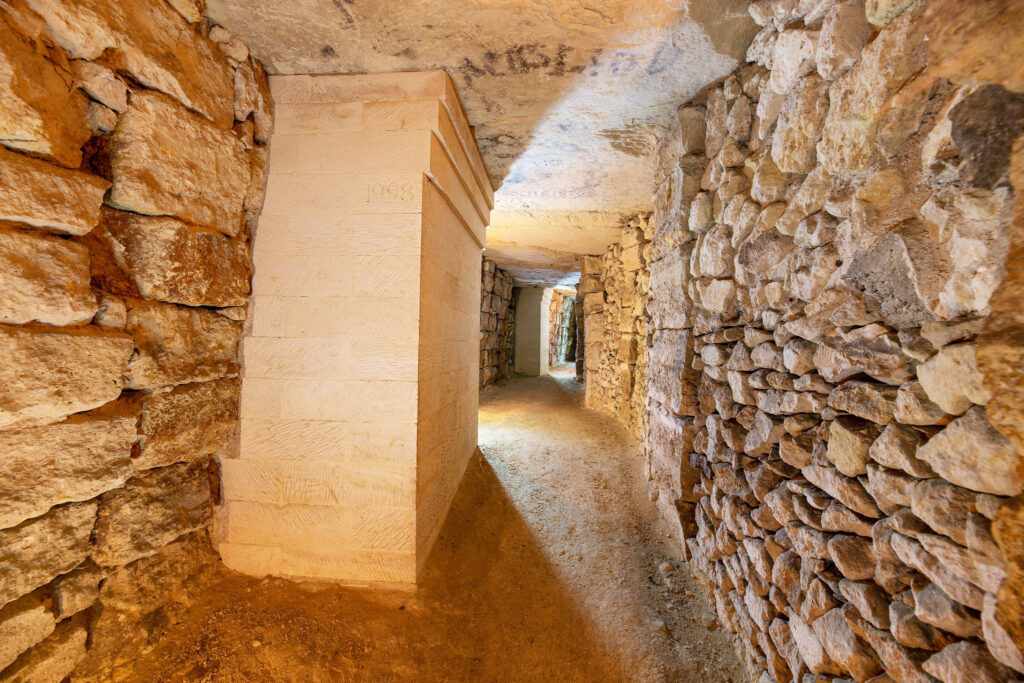
Hand-stacked pillars of solid stone were built, as well as masonry pillars set in lime, later in concrete. Each consolidation in Paris bears a plaque with the pillar number, the initial of the inspector in office and the year. Inspection galleries generally follow the streets above, whose names they bear. Beneath the Montsouris reservoir, 1,800 pillars were built between 1868 and 1874.
Today, voids are also filled in or injected with cement grout. At Meudon, the permission granted in 2022 to fill about 45% of the Arnaudet quarries with spoil from the Grand Paris works drew opposition from scientists, cavers and heritage associations. The techniques are described in the article on consolidating the subsoil, and the history of the Inspectorate in the one on the underground quarries of Paris.
Quarries after extraction
Quarries give mushrooms what they need: darkness, a steady temperature between 12 and 16 °C and humidity of 85 to 90%. Tradition credits a farmer from Passy, Chambry, with the idea of growing them there, around 1811. In 1891, there were 250 mushroom growers working 3,000 quarries. At Meudon, mushroom farms operated in the Arnaudet quarries until 1973. An underground mushroom farm can be visited in 360° on this site.
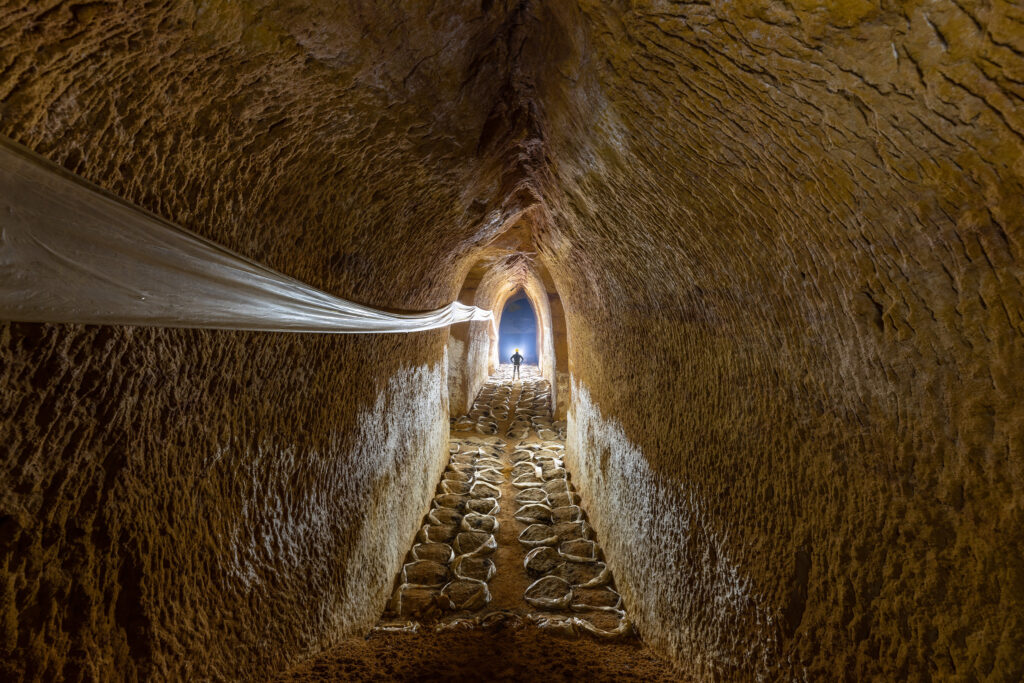
The constant temperature of the galleries also suits cellars. At Sèvres, the galleries dug from 1540 onward by winegrowers to store their wine later passed to Louis XIV’s wine merchants, then to a brewery. In Orléans, people speak of the “cellar-quarry”: the void was opened to sell the stone and kept for storage. Beneath Paris, quarries have housed breweries, wine and cheese cellars, and even bananas.
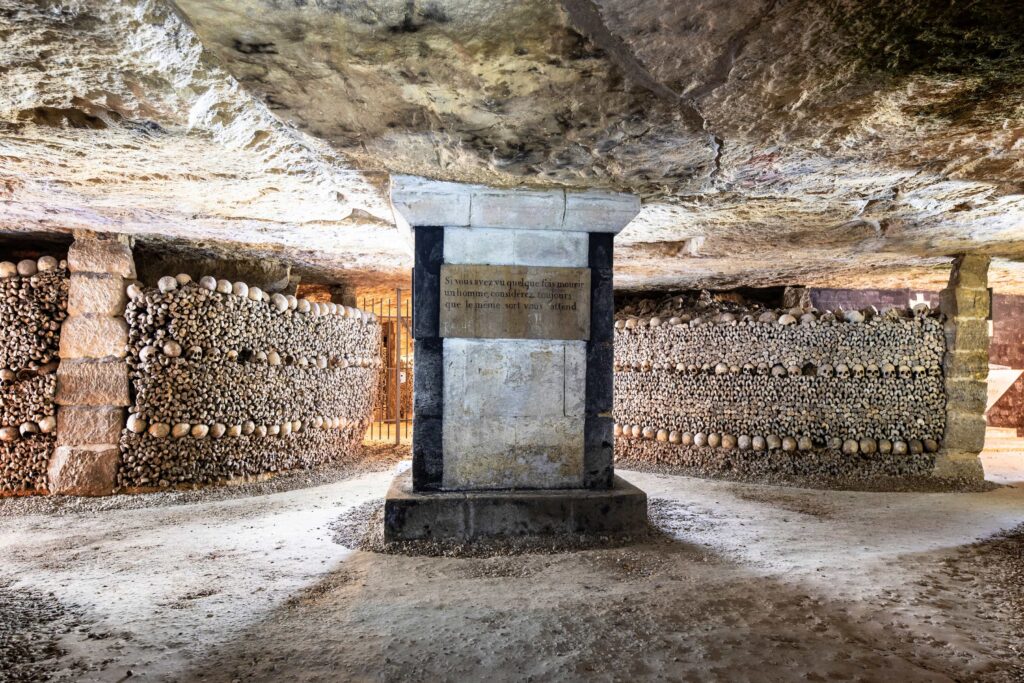
The voids also received the dead. Between 1786 and 1788, the bones from the Cimetière des Saints-Innocents were brought down into the quarries of Paris through two service shafts, then arranged by the quarrymen; Héricart de Thury later turned them into the museum of the catacombs. The Montrouge cemetery and the city of Orléans also have their own underground ossuary.
In wartime, quarries become refuges. In the creutes of the Chemin des Dames, the armies of the First World War set up dormitories, command posts, infirmaries and chapels, and French, German, British and American soldiers left graffiti and carvings there. At Naours, the galleries dug in the chalk have served as shelters since the Middle Ages. At Meudon, part of the Arnaudet quarries was fitted out as passive defense shelters during the Second World War.
In 1895, Armand Viré discovered beneath the Jardin des Plantes a network of old quarries and had an underground laboratory fitted out there to study cave fauna and flora. Between 1810 and 1815, the Inspectorate’s works supervisors set up small museums beneath Paris, the mineralogical cabinets, including that of M. Guérinet.
Several quarries have been covered with carvings or drawings. At the Jezuïetenberg, near Maastricht, Jesuits covered the quarry with carvings from 1880 onward, on their only day of rest, Wednesday. At Les Lapidiales, at Port-d’Envaux, artists have been carving a collective fresco into the quarry faces since 2001. In another quarry, large religious drawings traced in black on the pillars, with Latin inscriptions, gave its name to the rock painting quarry; no one knows who drew them, or when.
Underground quarries to visit on the site
Each of these places has its own page, often with a 360° virtual tour.
- Paris: the underground quarries of Paris, the Capuchin quarry beneath the Cochin hospital, the Jardin des Plantes quarries, the Costa Rica quarry, the coal cellar in the 13th arrondissement, the Catacombs Museum, the crypt of the Montrouge cemetery and the Guérinet mineralogical cabinet
- Île-de-France: the Arnaudet quarries in Meudon, a tasting room in the chalk cellars of Meudon, the Carrara-City Space at Carrières-sur-Seine, the Lescuyer underground cathedral at Saint-Cloud, the King’s Cellars at Sèvres and an underground mushroom farm
- Picardy: the creutes of the Chemin des Dames, the Officers’ Creute, the Creute of Poilus and Civilians and the Underground City of Naours
- Other regions of France: the Aubigny underground quarry in the Yonne, the underground town of the Cave des Roches at Bourré, Les Lapidiales at Port-d’Envaux, the underground ossuary of Orléans and the ochre quarries of the Luberon
- Netherlands: the underground quarries of Limburg and the Jezuïetenberg
- Italy: the Carrara marble quarries
All the 360° tours are gathered in the catalogue of underground virtual tours, and those of the capital on the page of virtual tours of underground Paris.