Beneath Orléans lies a place that has changed trades three times. Stone was first extracted from it. Goods were then stored in it. Then, in the 18th century, the dead of an overflowing cemetery were dumped into it. The church that covered it burned in 1940; the void, however, remained.
Beauce limestone beneath the city
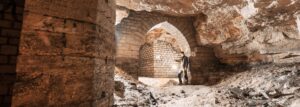
Orléans sits on the southern part of the Paris Basin, where successive epicontinental seas laid down limestones, sands and clays. The local building stone, Beauce limestone, lies just beneath the city: rather than fetching it from afar, the people of Orléans extracted it on the spot, digging under their own houses.
The result is a riddled subsoil. Nearly 700 cavities are recorded today within the municipal area. Many belong to a hybrid type, the quarry-cellar: the void is opened to sell the stone, and the void is kept for storage. The same excavation thus serves twice, which explains their density beneath built plots.
Since 2015, the SICAVOR program, for “système d’information contextuel sur les caves d’Orléans”, has been inventorying and dating this network, with 3D laser scanning surveys, core sampling and penetrometer tests. The results distinguish two major phases of urban expansion, from the late 12th to the late 14th century, then from the mid-15th to the late 16th century. Radiocarbon dating assigns the rib-vaulted quarry-cellars to the 13th-14th centuries; dendrochronology has dated the wooden ceiling of a storeroom to 1514.
When the cemetery overflows
In the 18th century, the large Saint-Paul cemetery, behind the church of the same name, was full. The problem was the same everywhere in Europe: urban parishes had been burying their dead for centuries in an enclosure that had not grown, common graves were reopened too soon, and the neighbors complained. In Paris, the same impasse would lead in 1785 to the emptying of the Cimetière des Innocents into the quarries of the Montrouge plain.
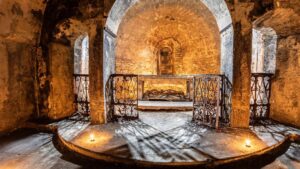
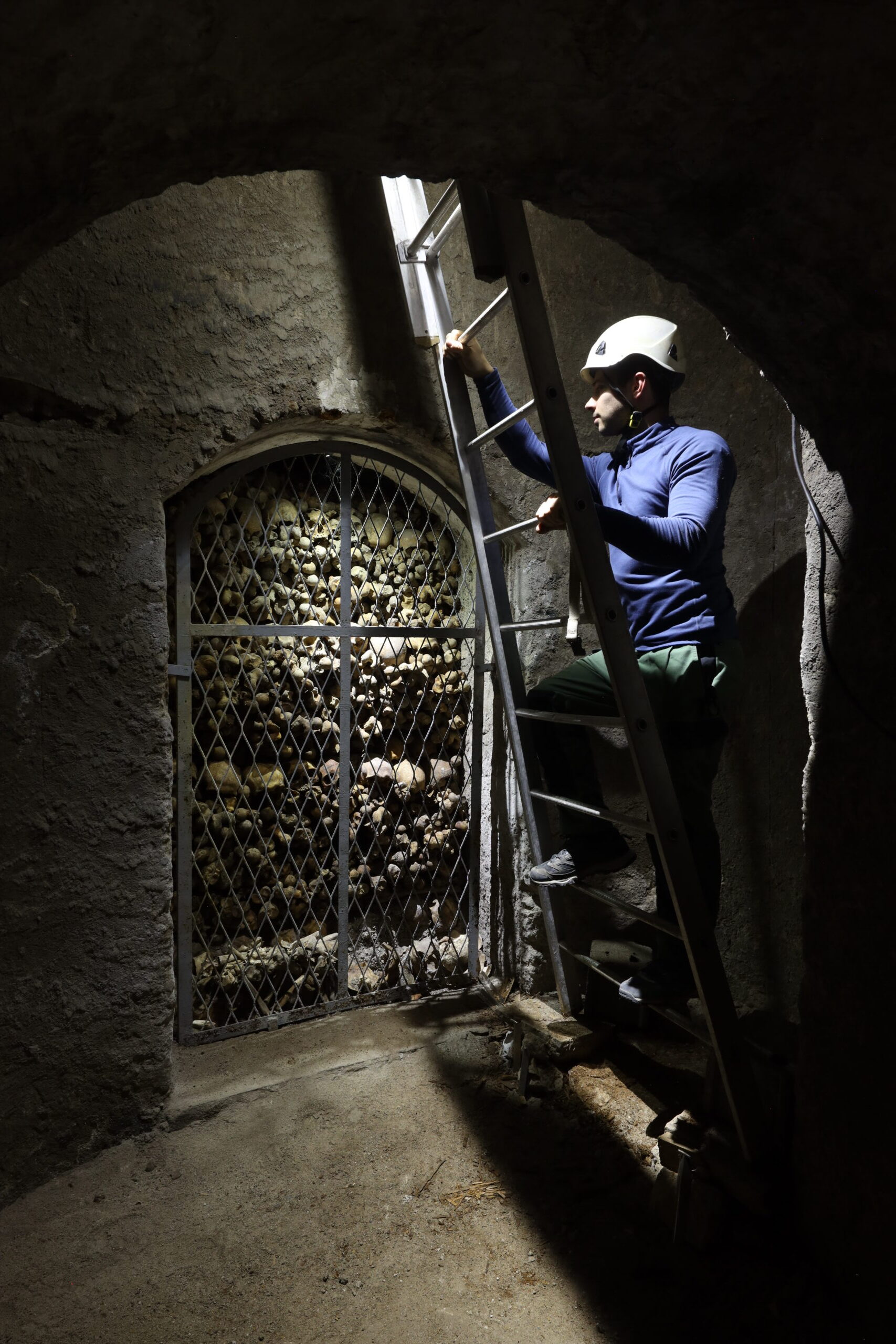
Orléans applied the same logic, on its own scale and with what it had at hand: the void of an old quarry already converted into a cellar. The exhumed bones were transferred there. A shaft with an oval cross-section, still visible today, was used to lower the coffins, a detail that says everything about how the place worked: this is not a crypt one enters, it is a receptacle filled from above.
This is not a catacomb
The city’s archaeologists insist on the word, and they are right. A catacomb is an underground cemetery laid out in galleries whose walls are cut with superimposed tombs, each of the dead occupying their own niche. This is the Roman model, and it is specific to Rome. Everywhere else, when bones are simply gathered in an underground space, it is an ossuary.
The distinction is not pedantic: it separates a place of burial from a place of storage. Beneath Saint-Paul, no one was ever buried; what was deposited there were already old remains, detached from any individual grave. The Paris catacombs, despite their name, belong to exactly the same category.
This strictness of vocabulary also works against legends. Like many old cities, Orléans carries its own mythology of secret tunnels linking churches, castles and the Loire. Systematic surveys have never found the slightest trace of them: what people take for escape tunnels are cellars, quarries and hydraulic works. On the family to which this place belongs, see our pages crypts and ossuaries.
1940: the church burns, the underground reappears
The church of Saint-Paul is a major monument of Orléans. Joan of Arc came to pray there for a whole week in 1429, before a rare Black Virgin. Its bell tower was completed in 1627.
In June 1940, bombing devastated the district. The church was destroyed and burned; only the tower and the Notre-Dame-des-Miracles chapel survived, the chapel losing only its roof, and the Black Virgin was found intact amid the ruins. Pierre Hamel then set about saving what could be saved of the furnishings and remains. It was during this clearance, in 1940, that he rediscovered the quarry and the ossuary beneath the building.
Several years later, the bones were gathered into two small spaces, where they still lie. The ground floor of the Saint-Paul tower now houses a small museum displaying the remains recovered from the rubble. What is left of the church is protected as a historic monument.
A monitored subsoil
Seven hundred cavities beneath a city means as many ceilings to monitor. Collapses, subsidence, destabilization: the risk is real and known. The BRGM has drawn up a register of the underground cavities of Orléans, supplemented by the campaigns of the archaeology department and the SICAVOR program.
The method combines systematic inventory, regular inspection and reporting by residents: many cellars are known only because their owner declared them. It is the same work, less visible, as that of the Inspection générale des carrières in Paris: a heritage documented first of all to keep it from opening up beneath a street.
Sources: archaeology department of Orléans Métropole, “Les souterrains d’Orléans” file; SICAVOR research program (since 2015) and its reports published in ADLFI; BRGM, register of underground cavities of Orléans; Monuments historiques records (remains of the church of Saint-Paul, PA00098845); documentation from the Ville d’art et d’histoire of Orléans.
This tour is part of the catalogue of virtual tours of underground heritage.