

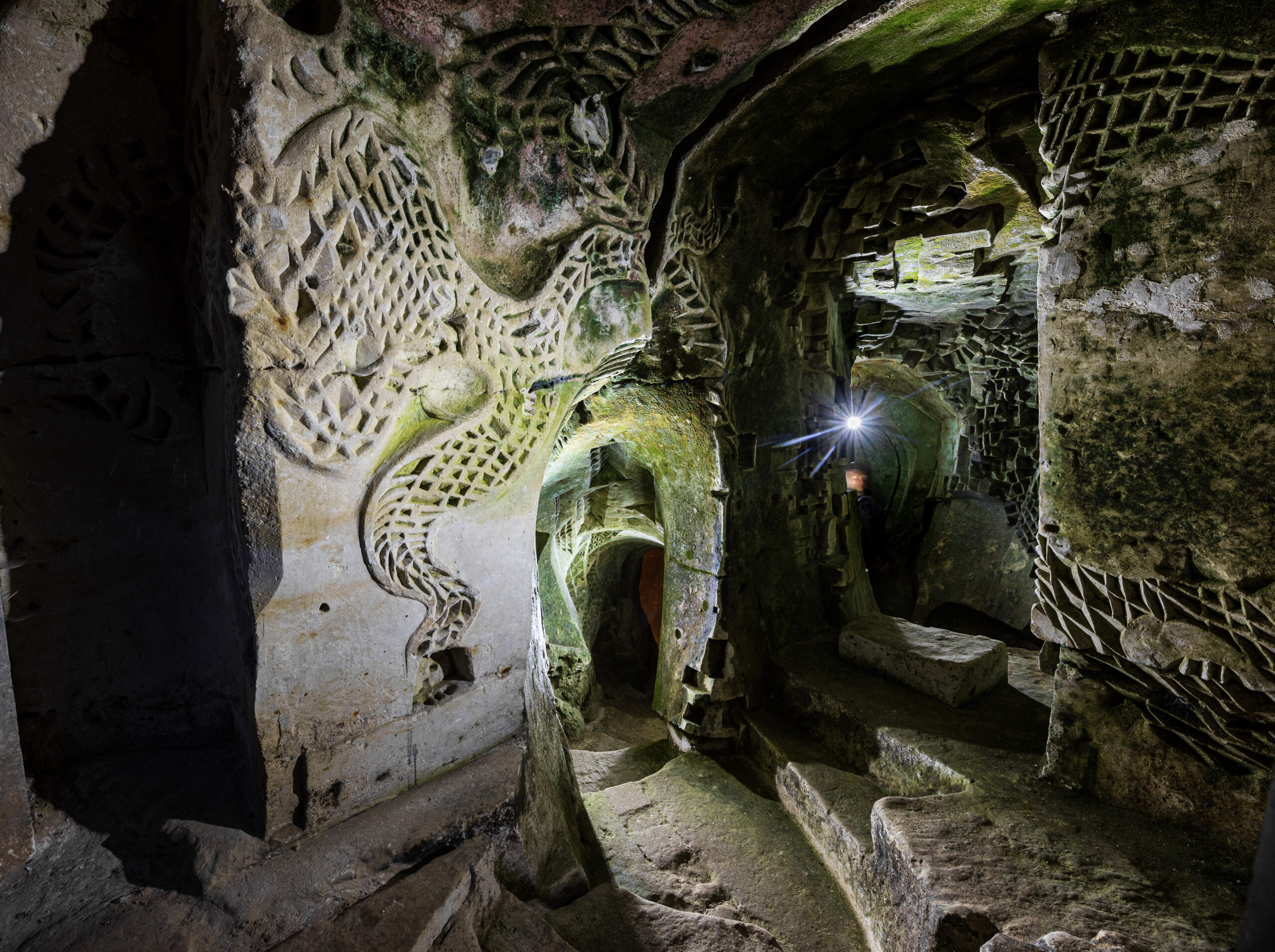
There are few works of art that one walks into. The Hélice Terrestre is one of them: a monumental sculpture that Jacques Warminski dug and then built between 1988 and 1993 in a troglodyte hamlet in Anjou, and which is explored physically, from underground to the open air, as one might pass through a body.
A hamlet dug out, then abandoned
L’Orbière, in the commune of Saint-Georges-des-Sept-Voies (now Gennes-Val-de-Loire), is one of those lowland troglodyte villages typical of the Saumurois. Here, people do not live in a cliff: they go down into the plateau. The dwellings are arranged around courtyards dug straight into the ground, and the rooms are carved into tuffeau, the soft Turonian limestone that supplied the stone for the châteaux of the Loire.
Traces of occupation there go back to the Middle Ages. Five families still lived there around 1940; then the hamlet emptied, like most rural troglodyte sites, and the caves served at best as storage sheds, at worst as rubbish dumps.
Jacques Warminski
Born in 1946, trained at the École des beaux-arts in Angers and then in interior architecture at the École Boulle in Paris, Jacques Warminski approached sculpture through the question of space rather than that of the object. His encounter with the troglodyte world gave him an unusual material: not a block to carve, but a void to create.
He settled at L’Orbière and embarked on a five-year project. The principle is one of reversal: what is removed underground is given back as volume above. The underground part is dug entirely into the tuffeau, a continuous space with no right angles, where the walls spiral; the outdoor part, cast in concrete, offers its negative, a solid mass that one climbs and walks around. Visitors pass from one to the other and experience, literally, the inversion of solid and hollow.
Warminski, who readily drew on Rabelais, the other great explorer of this Loire country, died in 1996, three years after completing the work. He did not have time to carry out the extensions he had planned.
A work maintained by an association
Since the artist’s death, the site has been run by the association Artrodytespace, which looks after its conservation, its opening to the public and its programme. Such an object raises unusual heritage questions: neither a conventional historic monument nor a museum facility, the Hélice Terrestre is a unique work whose material, a soft, frost-sensitive limestone on one side and 1990s concrete on the other, requires constant monitoring.
The association also organises exhibitions, residencies and events that extend Warminski’s approach, the idea being to keep the place alive rather than to freeze it.
Sources: Artrodytespace association, Hélice Terrestre de l’Orbière site; documentation from Saumur Val de Loire Tourisme and Anjou Tourisme.
This tour is part of the catalogue of virtual tours of underground heritage.


