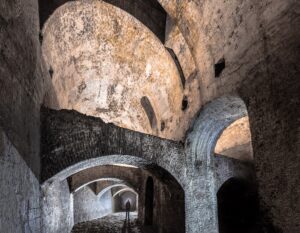
Button mushrooms were grown underground long before they were grown in sheds. Tradition credits the idea to Chambry, a farmer from Passy, around 1811, but Gibault, in his Histoire des légumes published in 1912, already admitted that he did not know who had been the first. The first quarries to be used were those of Passy and Montrouge.
Quarries offer what mushrooms need: darkness, a steady temperature of between 12 and 16 °C, and humidity of 85 to 90%. In 1891, there were 250 mushroom growers working 3,000 quarries. At the beginning of the 20th century, those of the Seine department employed more than a thousand workers and delivered up to 25,000 kilos a day at the height of the season. Cultivation then spread to the Loire Valley, and the Saumur area now provides more than half of French production. Underground, it has given way to refrigerated sheds.
How growing methods evolved
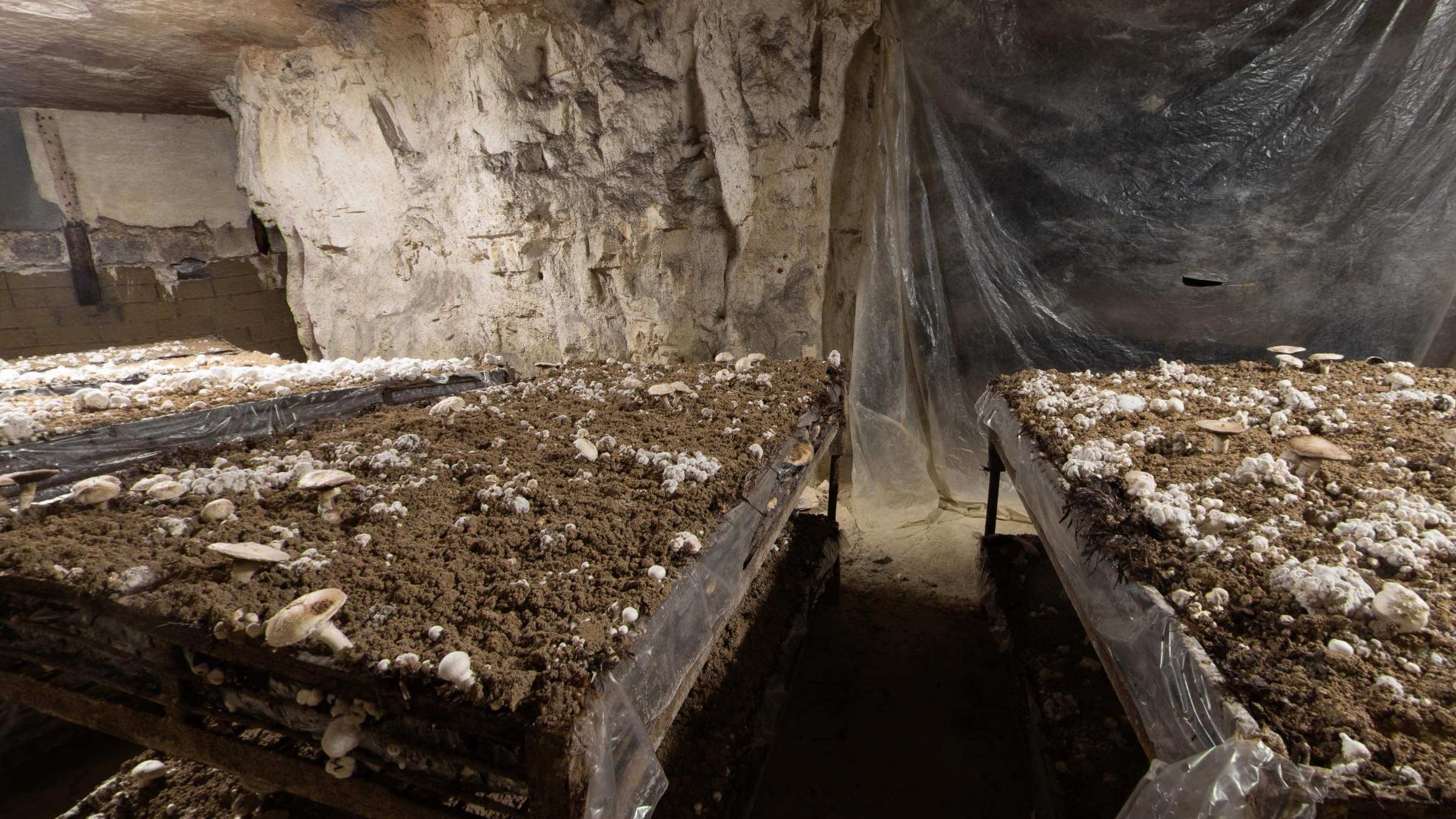
Ridge-bed cultivation, on parallel furrows, is the oldest method; it was practised until 1970. The quarry’s limestone was also put to use: crushed by the grower with machines designed for the purpose, it produced a powder called “cron”, spread over the beds in a layer about two centimetres thick. This is casing, which keeps the compost underneath moist.
From the 1970s, bag cultivation saved time: the bags arrived underground already filled with manure. From 1990, growers switched to stackable metal crates, prepared outside the quarry and brought in by machines. Oyster mushrooms, for their part, grow in compost bags pierced with holes.
The tour shows these stages side by side: ridge beds, bags, stacked trays, oyster mushrooms, and abandoned crops.
Sources: G. Gibault, “Histoire des légumes”, 1912; Larousse agricole
This tour is part of the catalogue of virtual tours of underground heritage.