In the 17th century, the Locle valley featured a marshy area, located between the village and the Col-des-Roches, which seemed unfavorable for the installation of mills due to the low flow of the stream, the Bied. However, in 1652, Daniel Renaud, Isaac Vuagneux, and Bathalzard Calame obtained authorization to exploit the Bied’s emposieu, a natural funnel-shaped well where the waters plunge, in order to set up two waterwheels each driving a mill.
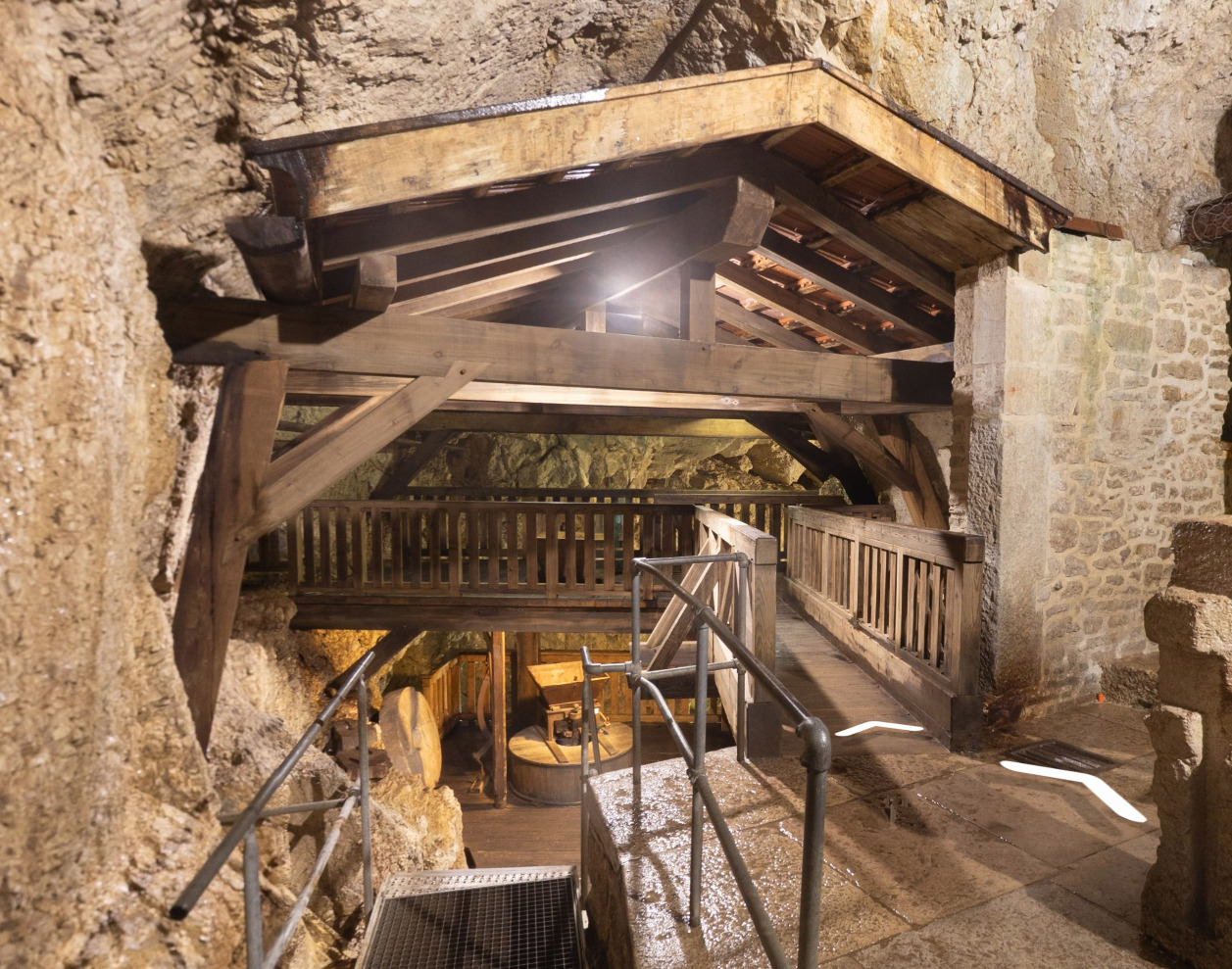
In 1660, Jonas Sandoz, tax collector of the Neuchâtel Mountains, took over the site to install new equipment. Not content with the two existing waterwheels, he had the cave’s wells dug out to install five waterwheels, thus setting in motion mills, a sawmill, and an oil mill. Underground channels were built to route the water from one wheel to another, while galleries and stairs facilitated the maintenance of the machinery. Despite these innovations, Sandoz was forced to sell the underground factory in 1690, a victim of financial difficulties and the low flow of the Bied, which was further reduced later by its canalization and the installation of turbines around 1880.
With the industrial era, Jean-Georges Eberlé improved the infrastructure, notably through the introduction of a modern turbine.
In 1884, the old mills were transformed into a border slaughterhouse responsible for the sanitary control of imported animals. Unfortunately, the cave then served as a dumping ground for meat waste and wastewater, causing severe pollution of the site. The slaughterhouse ceased its activities in 1966, leaving the cave contaminated.
In 1973, a group of enthusiasts, the Confrérie des Meuniers, undertook a colossal restoration effort. Fifteen years were needed to clean the cave and partially restore the old mills. Since then, the Col-des-Roches Underground Mills have been transformed into a museum, open to the public today.
This tour is part of the catalogue of virtual tours of underground heritage.