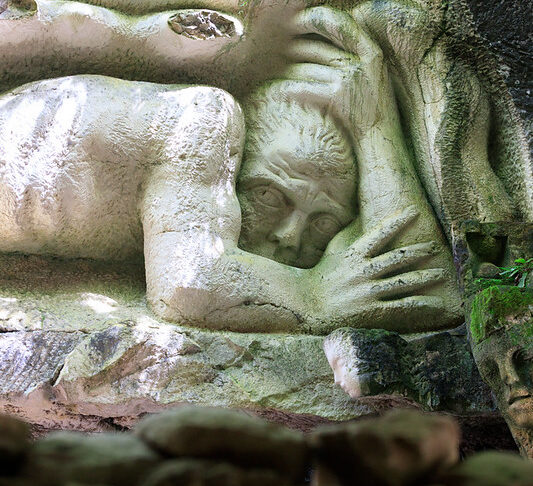
An abandoned quarry always raises the same question: what is to be done with it? At Port-d’Envaux, in Charente-Maritime, the answer came from a sculptor. Since 2001, the faces of the former Chabossières quarry have been covered with a collective sculpted fresco, carved year after year by artists from all over the world. The site is freely accessible, free of charge and open day and night.
Saintonge stone
The limestone of this Charente valley, Crazannes stone, also quarried at Port-d’Envaux and Plassay, is a material with a long-standing reputation: soft when extracted, it hardens in the air and lends itself admirably to sculpture. It is found in some very large projects: Cologne Cathedral, the port installations of Hamburg, and above all the great maritime works of the Atlantic coast, the Cordouan lighthouse, Fort Boyard, the towers of La Rochelle.
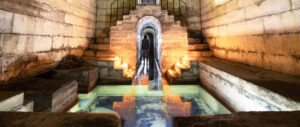
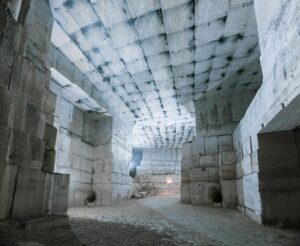
Extraction was carried out first in the open air, with the flat Charente pick, in the 17th and 18th centuries, then underground with saws in the more recent extensions. The quarrymen left vertical walls several metres high, jumbles of blocks and cavities: exactly the surfaces a sculptor might covet.
An open-ended collective project
The association Les Lapidiales, governed by the law of 1901, was founded in 2000 by the sculptor Alain Tenenbaum. Its project can be summed up in one sentence: to create a space for art in perpetual evolution, where sculptors from every country would come, over the decades, to work on a collective work bearing witness for future generations to their condition as human beings of their time. In 2001, the association moved into the Chabossières quarry.
The way it works has not changed. Each year, five to seven sculptors are hosted in residence between 1st May and 30 September; they co-opt one another from one season to the next. Since the beginning, some fifty artists have followed one another there and produced nearly sixty monumental sculptures.
The works are not placed side by side at random: they are organised into thematic groups that structure how the site is read, “Memorial to Those Who Died for Nothing”, “From the Abyss to the Azure”, “In the Belly of the World”, “Earth, Planet, Life”, “The Imaginary of the River”, and “The Galaxy of Standing Stones”.
An association, not a museum
Les Lapidiales openly lays claim to its model as an association: some 250 members, an annual budget of around 80,000 euros, of which only a small part comes from membership fees and services, the rest from public grants. There is no ticket office, no opening hours, no security staff.
The activity goes well beyond sculpture: stone-carving training workshops, workshops for children, philosophy cafés, readings, talks, and an annual festival that draws four to five thousand people. During the residency season the public can watch the artists at work and talk to them, which, in the world of monumental sculpture, remains rare.
Sources: Les Lapidiales association; commune of Port-d’Envaux; Cœur de Saintonge community of communes; documentation on Crazannes stone and its quarries.
This tour is part of the catalogue of virtual tours of underground heritage.