Below street level, Orléans preserves two of the oldest Romanesque crypts in France. Saint-Aignan and Saint-Avit both date from the 11th century, and both were built for the same reason: to house the relics of a saint and allow pilgrims to approach them without disturbing the service celebrated above.
The Saint-Avit crypt
This one almost disappeared. Filled in, its vaults partly collapsed, it had been purely and simply forgotten when it reappeared by chance in the middle of the 19th century: extension works in 1852 came upon it.
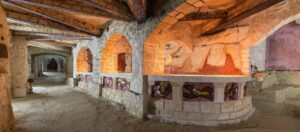
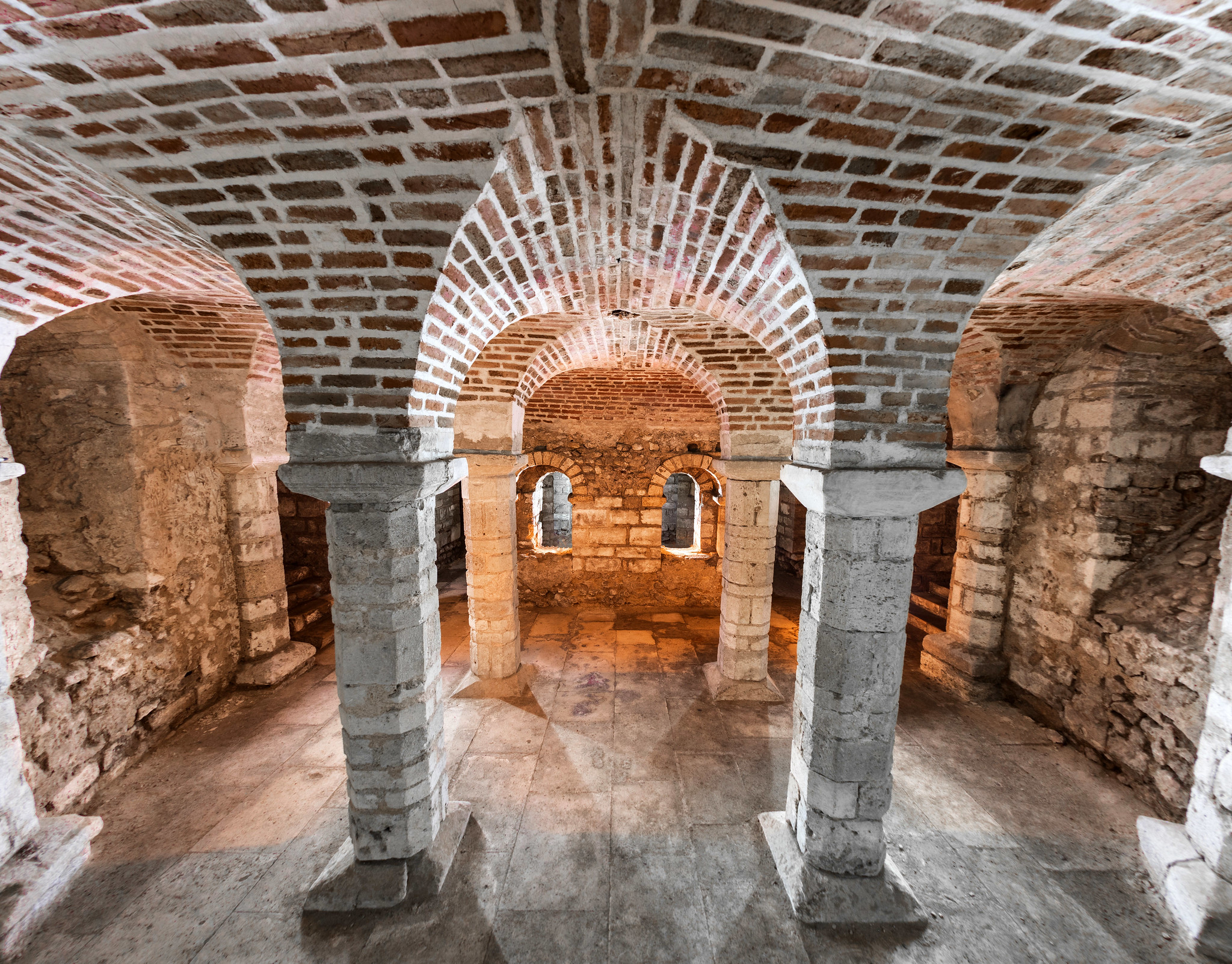
The plan is that of a martyrium attached to a chapel, the two separated by a thick wall pierced with openings. This arrangement is far from incidental: the fenestellae allowed the faithful to see and sometimes touch the reliquary without entering the space reserved for the clergy. The whole architecture of the relic crypts of this period rests on this compromise between display and protection.
Saint Avit, an abbot of the 6th century, was venerated here. The crypt, protected as a historic monument, is today one of the few Romanesque remains still standing in a largely rebuilt city.
The Saint-Aignan crypt
The crypt of the former collegiate church of Saint-Aignan is of quite another ambition. It was rebuilt in the first third of the 11th century on the initiative of King Robert the Pious and consecrated in 1029, the roof timbers being set in place in 1031.
Half-buried, it follows the plan of a true underground church: a large semicircular hall, an ambulatory that runs around it and served five radiating chapels, of which only one survives, and, to the west, a martyrium holding the relics of Saint Aignan, the bishop who defended Orléans against Attila in 451. Pilgrims could glimpse the reliquary through openings made in the wall.
Its main interest lies in its capitals: carved and still polychrome, they are among the oldest sets of this kind preserved in France. For the history of Romanesque sculpture, this underground space in Orléans is a milestone.
Being buried as close as possible
A crypt is never just a reliquary. Around the holy body, people wanted to be buried, ad sanctos, as close as possible to the relics, in the hope of a better resurrection. Burials therefore accumulated over the centuries in and around these spaces, to saturation point; it was this pressure that, much later, would force the city to empty its cemeteries into its subsoil.
Orléans preserves the most spectacular outcome of this, in an old quarry turned into a mass grave: see our article on the underground ossuary of Orléans. On the general logic, see also the crypts and ossuaries of Europe.
Sources: Orléans Métropole tourist office; Ville d’art et d’histoire department of the city of Orléans; Monuments historiques records (Saint-Avit crypt, PA00098841); Bulletin monumental, studies on the crypt of Saint-Aignan in Orléans.
This tour is part of the catalogue of virtual tours of underground heritage.