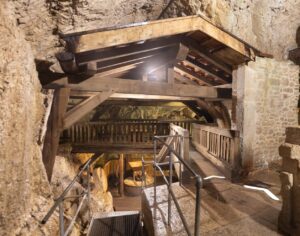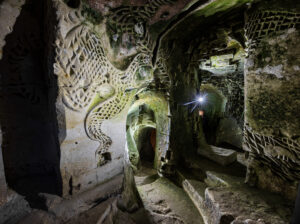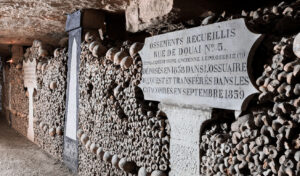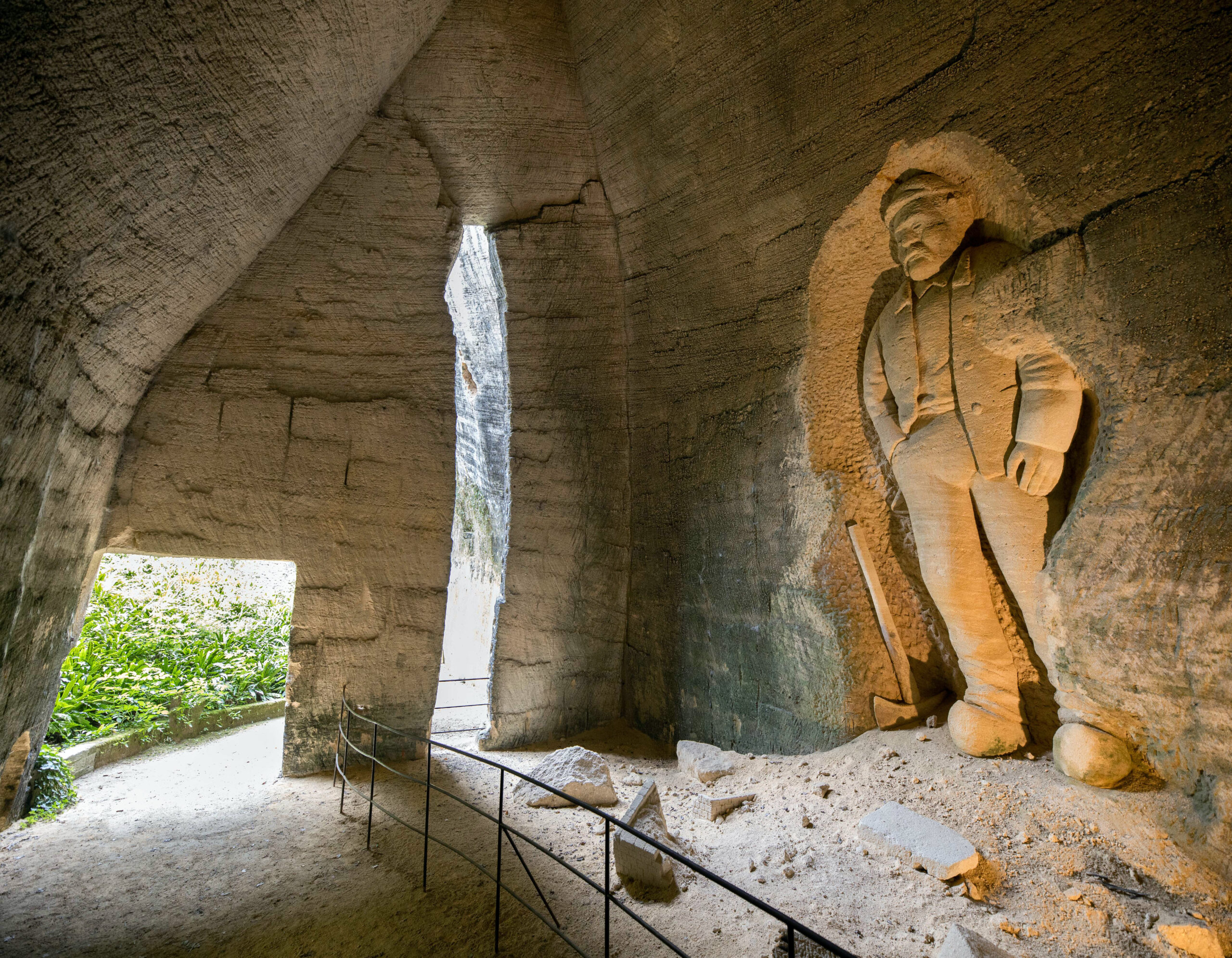
The underground quarries of Les Perrières, at Doué-en-Anjou, are called “cathedrals”, and the word is not undeserved: chambers fifteen to twenty metres high, open to the sky through a skylight, with sloping walls like vaults. Yet the material extracted is neither granite nor hard limestone, but a crumbly shelly sediment, falun, laid down on the floor of a tropical sea some ten million years ago.
A sea over Anjou
In the Middle Miocene, about 11 to 15 million years ago, the sea covered a large part of what is now the Loire Valley. It was shallow, rough, and much warmer than today’s Atlantic. Shell debris accumulated on its floor: bryozoans, bivalves, gastropods, sea urchins and even shark teeth, mixed into a sandy matrix.
This deposit is falun. It was never compacted or cemented like an ordinary limestone: it remains soft and porous, and can be dug almost by hand. The quarry sections show superb oblique and cross-bedded stratification, which records the movement of currents and the migration of underwater dunes. It is a geology book lying open in large format.
Quarrying without bringing down the roof
Two uses drove the quarrying. First, soil improvement: rich in calcium carbonate, falun corrects the acidity of the soils of the Armorican Massif, and it was spread by the cartload throughout the region. Then construction, the stone being used for local building.
The technique responds to the weakness of the material. Rather than opening long, flat galleries, the quarrymen dug bell-shaped chambers: they went down through a narrow shaft, widened out towards the bottom, and obtained a flared volume whose very shape ensured its stability, like a vault obtained by subtraction. Where the workings came too close to the surface, keys of stronger stone were left in place to prevent collapse. Activity peaked in the 18th and 19th centuries.
The result is a spectacular geometry, its effect further heightened by the overhead light falling from the shaft. The Perrières site preserves a remarkable group of these chambers, which earned them their nickname of “cathedrals”.
The Mystère des Faluns
The visitor route draws on precisely these two registers, the geological and the architectural. Over about a kilometre of galleries, a scenography designed by the Lucie Lom studio recreates the vanished marine environment: plays of blue light, shoals of fish, a water mirror, an educational film, a cast of a whale skeleton, an evocation of the savannah that bordered this shore.
The subject is not only palaeontological. The route also tells the story of the men who did the digging, the perreyeurs, and of the way a territory organised itself around a fragile resource. The visit lasts from three quarters of an hour to an hour and a quarter, depending on the pace.
Sources: Le Mystère des Faluns / Les Perrières site, Doué-en-Anjou; Planet-Terre resource from the ENS de Lyon on the Miocene faluns of Doué-la-Fontaine; Saumur Val de Loire Tourisme.
This tour is part of the catalogue of virtual tours of underground heritage.