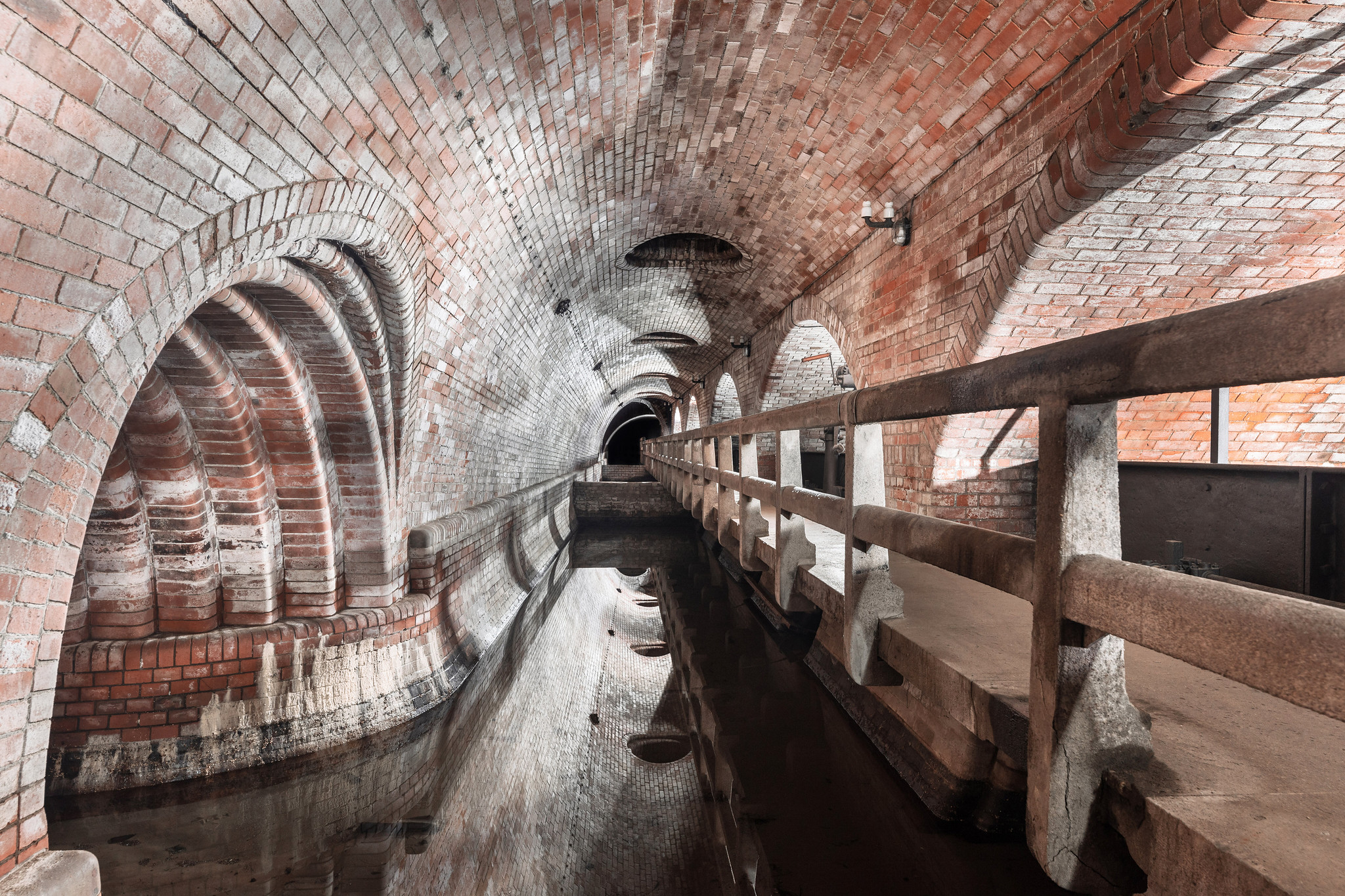
No one expects municipal works to produce architecture. The Bubeneč wastewater treatment plant in Prague disproves this idea at first glance: long rows of brick vaults, settling tanks eighty-seven meters long, an engine room treated like a nave. Put into service in 1906 and shut down in 1967, it is the oldest facility of its kind preserved in Europe.
Prague before the sewers
In the 19th century, Prague grew fast and drained badly. Wastewater flowed into the Vltava untreated, epidemics followed, and the city finally accepted that the problem would not be solved piecemeal. In 1884, a competition was launched to give the capital a complete sewerage network, treatment plant included.
Only one project would be selected and built: that of William Heerlein Lindley, a British engineer specializing in sanitation, who had already equipped several major cities in Central and Eastern Europe. Lindley designed the whole as a coherent system, trunk sewers, network, outfall, with the Bubeneč plant as its final element.
Five years of construction
Work began in 1901 and was completed in 1906, at a cost of 2,331,778 crowns. Trial operation started on 27 June 1906; administrative approvals then followed in stages until 15 January 1909, the date of final approval.
Treatment is purely mechanical and takes place in three stages. First, screening, cleaned by hand, catches the coarse waste. Then grit removal, in tanks 34 meters by 12 and 5 to 6 meters deep, from which the sand is lifted out and washed. Finally settling, in ten tanks 87 meters long, 5.52 wide and 2.70 deep, where suspended matter settles before the sludge is pumped out.
The whole installation first ran on steam: boilers and engines drove the pumps, until electrification in the 1920s. In 1927, a modernization brought mechanical screening and four additional settling tanks. It is this mix of Victorian engineering and early 20th century machinery, still in place, that makes the site so interesting today.
Shutdown, then recognition
The plant operated until 1967, when Prague’s new central treatment plant, on Císařský island, took over. Bubeneč went on treating sludge until 1983, then stopped for good and fell dormant, which, paradoxically, saved it: no one dismantled the machines or filled in the tanks.
Heritage recognition followed. Declared a cultural monument in 1991, the complex was raised to the rank of national cultural monument in 2010. In 2016, it became an anchor point of the European Route of Industrial Heritage (ERIH), the network that brings together the continent’s major industrial sites. Since 2019, Czechia has been pursuing its nomination for UNESCO World Heritage status.
The argument is solid: nowhere else in Europe is there a wastewater treatment plant of this generation preserved with its architecture, its galleries and its equipment. On underground sanitation works, see also the page on underground water management.
Sources: Stará čistírna odpadních vod, Praha-Bubeneč; Trade Centre Praha a.s.; European Route of Industrial Heritage (ERIH); Czech encyclopedic entry on the Stará čistírna odpadních vod (Praha-Bubeneč); Prague City Tourism.
This tour is part of the catalogue of virtual tours of underground heritage.