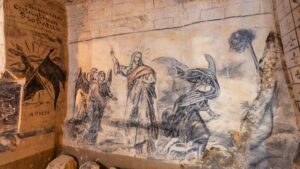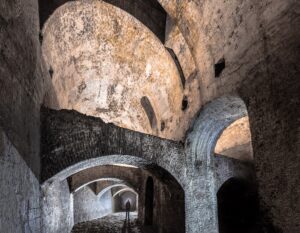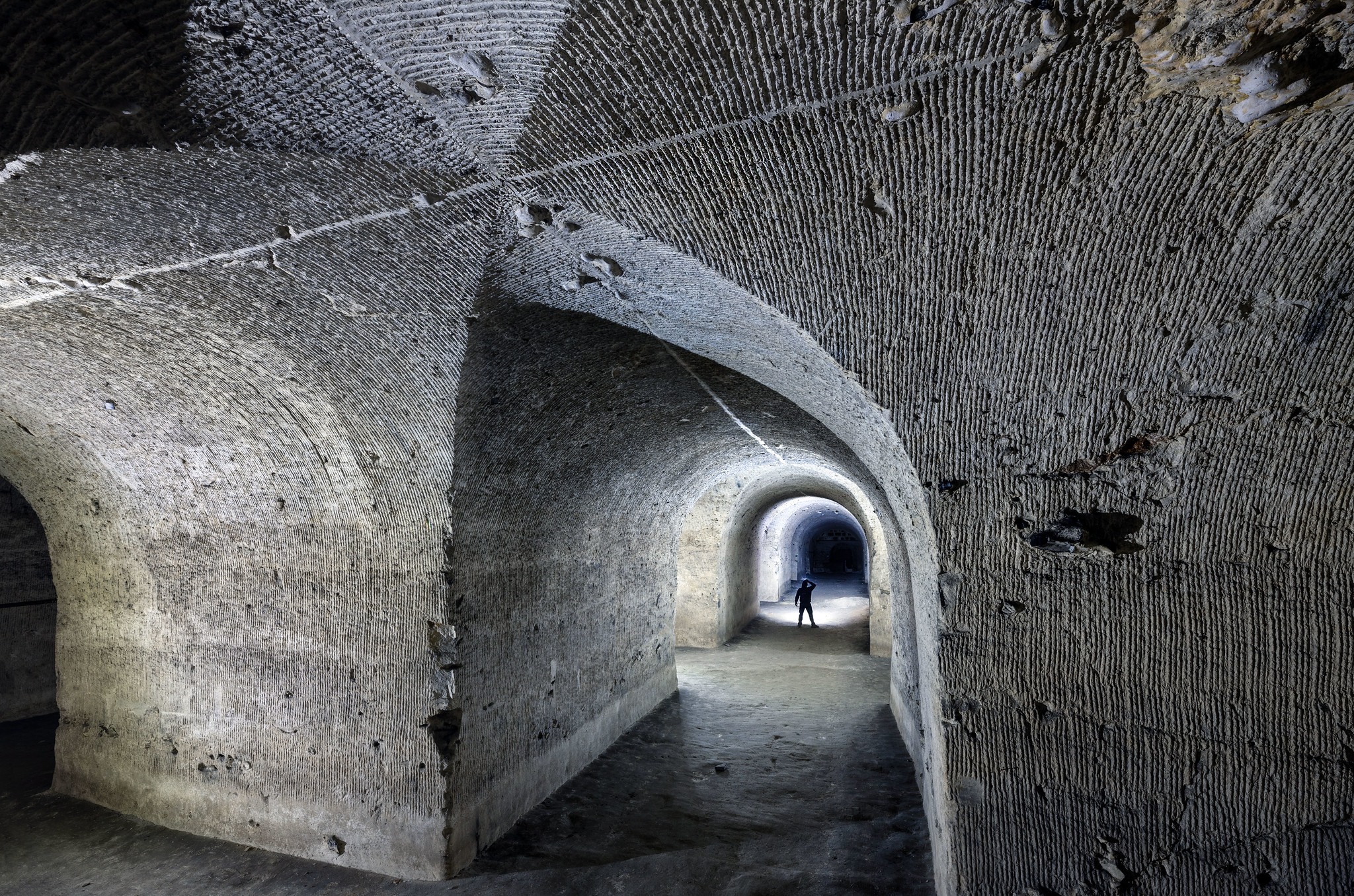
Beneath the Colline Rodin in Meudon lie nearly eight kilometers of galleries cut into the chalk, spread over three levels, with vaults rising up to ten meters. These are the Arnaudet quarries: a site protected since 1986, long forgotten, and now at the center of a dispute over its partial backfilling.
Chalk and blanc de Meudon
The Meudon hillside exposes a thick sequence of Upper Cretaceous chalk, topped by marls. This chalk has two outlets. Mixed with clay and fired, it yields limes and cements. Ground, washed and decanted, it provides a mineral filler of great whiteness, blanc de Meudon, whose name has traveled around the world: it is found in paints, glaziers’ putty, cleaning products and even cosmetics.
Underground extraction began in the 18th century on an artisanal scale, then became industrial in the early 19th century. It ended in 1925. Two layouts coexist in the network: chambers about ten meters across and three to four meters high, inherited from the first phase, and a grid of tall galleries, around ten meters high under the vault and three meters wide, resulting from industrial extraction. It is these galleries, with their barrel vaults and pointed arches, that earned the place its reputation as an underground cathedral.
Mushrooms, shelters, fossils and film shoots
As everywhere in the Paris region, the void left by extraction immediately found a new user. Mushroom farms moved into the galleries and produced there until 1973: constant temperature, darkness, high humidity, the quarry is a greenhouse in reverse.
During the Second World War, part of the network was fitted out as passive defense shelters, notably beneath a former Renault factory. Elsewhere, the Meudon chalk has yielded a considerable amount of material to paleontologists and archaeologists, and the site has served as a set for film shoots, as a concert hall and as a workshop for artistic and musical projects.
Since 2004, a karst feature developed in the chalk has also supplied a water intake used for irrigation, proof that the underground still provides very concrete services.
A protected and threatened site
All the galleries are protected under the 1930 law on sites, by an order of 7 March 1986 that lists them as a scientific and artistic site. This is a rare protection for an underground quarry, and it says a great deal about what this network represents.
But the weakened chalk poses a stability problem. A study by INERIS carried out in 2017 documented the risk of collapse, a risk the region knows well: on 1st June 1961, the collapse of old chalk quarries in nearby Clamart killed 21 people. In 2022, authorization was given to backfill about 45% of the network with spoil from the Grand Paris construction sites.
The project has met organized opposition: scientists, cavers, local residents and heritage protection associations, notably Sites & Monuments and Patrimoine-Environnement, contest both the chosen method and the irreversible nature of the loss. The debate sets two legitimate requirements against each other, the safety of people on the surface and the conservation of a listed site. The panoramas above document a state of the site that, in part, will no longer exist.
Visiting the site
- Status: partly municipal property, listed site under the 1930 law (order of 7 March 1986). The quarries are not open for self-guided visits: access is forbidden and dangerous.
- Occasional openings: guided visits have been organized for the European Heritage Days or by local associations; inquire with the town of Meudon.
- Above ground: the Villa des Brillants, the Musée Rodin in Meudon, and the tomb of Auguste Rodin lie above the network.
Sources: town of Meudon, “Carrière Arnaudet” file; site listing order of 7 March 1986; INERIS study (2017); Sites & Monuments and Fédération Patrimoine-Environnement; encyclopedic entry on the Meudon quarries.
This tour is part of the catalogue of virtual tours of underground heritage.