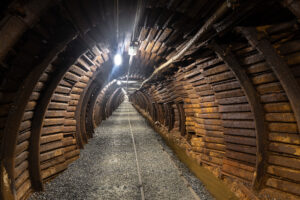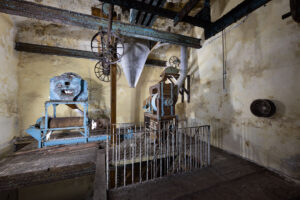
In the Schlossberg hill in Homburg, Saarland, sand was extracted underground for centuries. Galleries may have existed as early as the Middle Ages, but systematic extraction of quartz sand probably began in the mid-17th century. It was used to make glass, as moulding sand for iron casting and as an abrasive sand.
The town and the operator present them as the largest Bunter sandstone caves in Europe. The galleries are arranged over twelve levels, within a space 140 metres long and 60 metres wide.
The Bunter sandstone
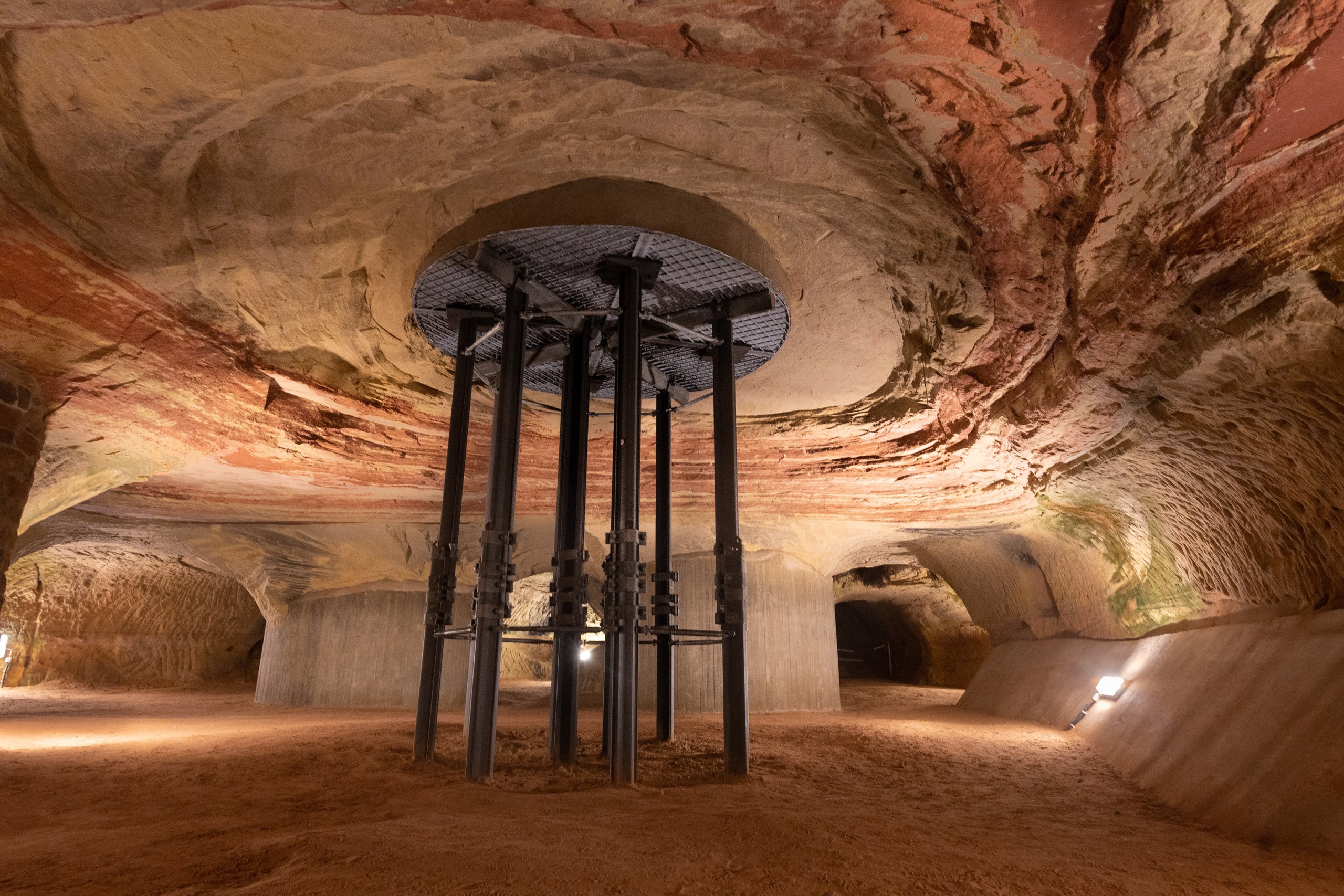
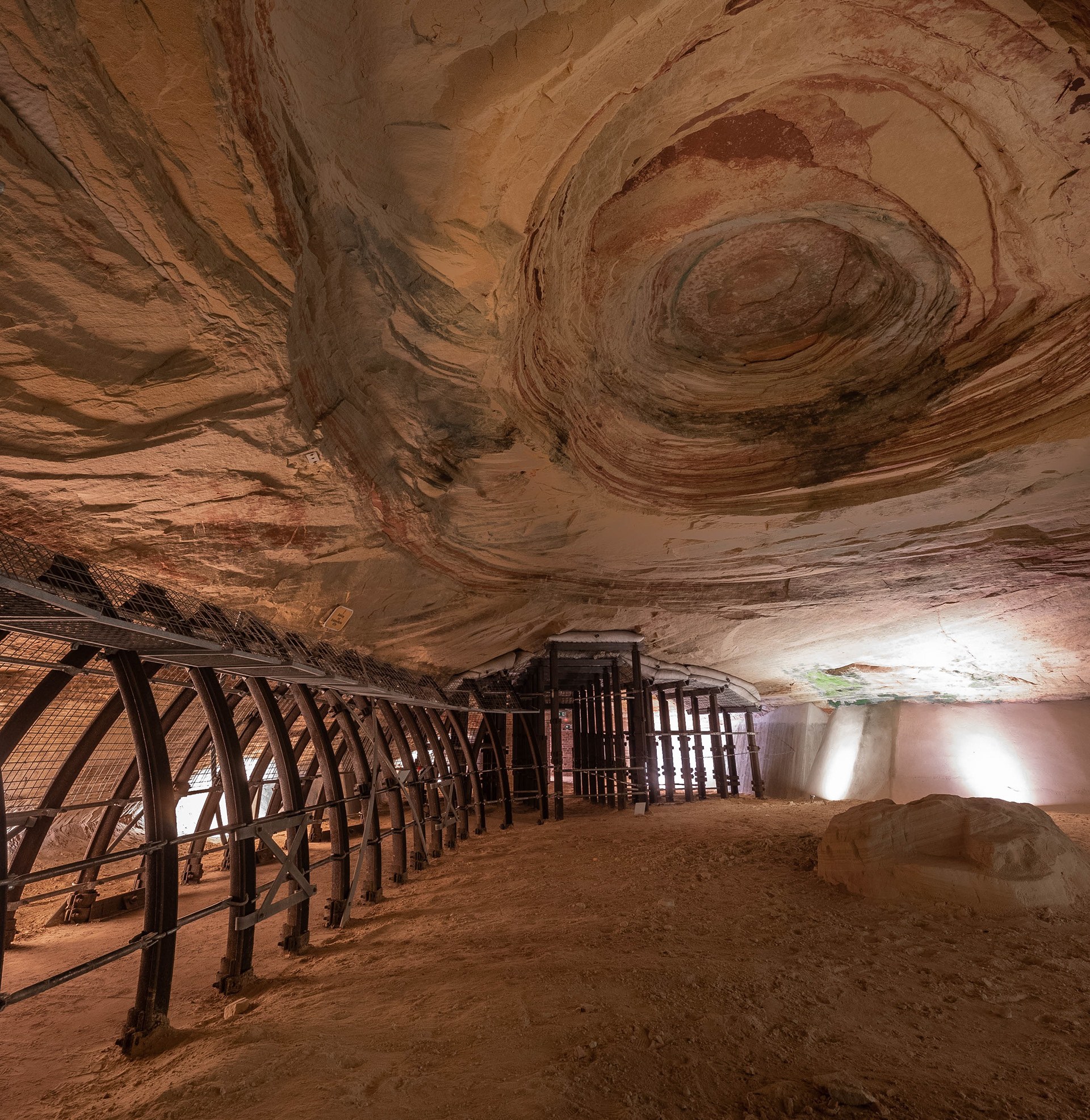
The walls show the layers of the Schlossberg’s Bunter sandstone. Around 250 million years ago, at the beginning of the Triassic, the site lay in a desert landscape, near a depression. The thick layers of yellow sand are former dunes, recognisable by their cross-bedding. The horizontal red-striped strata were deposited beneath a temporary, shallow sheet of water: they show ripple marks, cracks and animal tracks.
The successive uses of the caves
During the French occupation, from 1679 to 1714, the caves were enlarged and used as a storehouse. Yet in 1708 an officer’s letter of complaint reported that the humidity, from 80 to 100%, was suitable neither for gunpowder nor for provisions.
At the end of the Second World War, especially in 1944 and 1945, Homburg was heavily bombed. Several thousand people took refuge in the caves, sometimes for weeks.
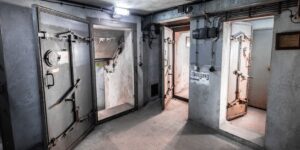
From 1952 to 1955, a bunker intended for Johannes Hoffmann’s Saarland government was built in the lower levels; the hotel constructed at the same time on top of the hill concealed the works. Work stopped with Hoffmann’s resignation in 1955, and Saarland joined the Federal Republic in 1957.
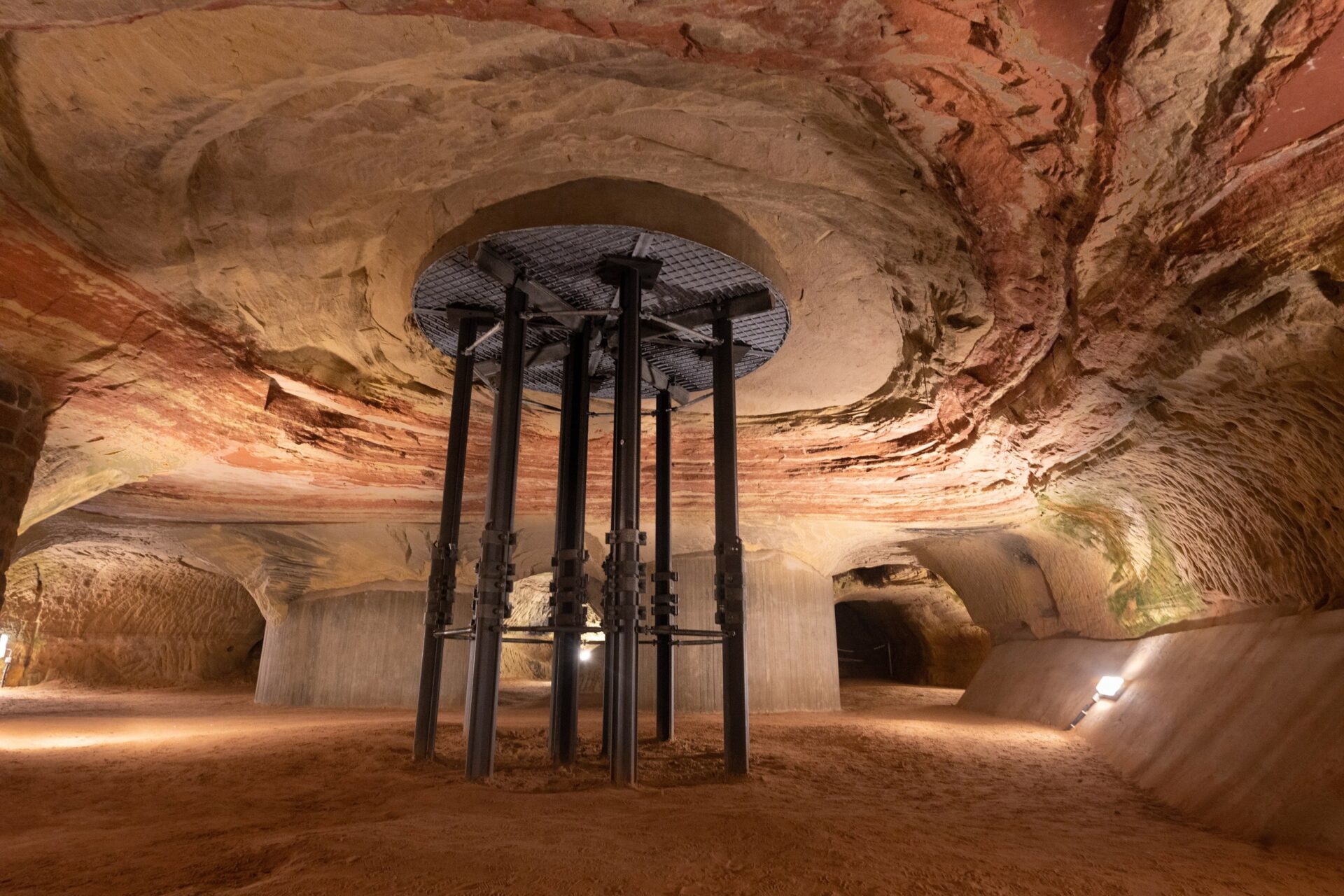
One shaft descends 30 metres to the former barrel beer cellar of the Karlsberg brewery, another rises 30 metres to the basement of the Hotel Schlossberg. The largest chamber, the “throne room”, lies 47 metres below the hotel. Its name dates from the 1960s: the caves were then used as a venue for festivities, and a “cave queen” was elected there and took her place on the throne.
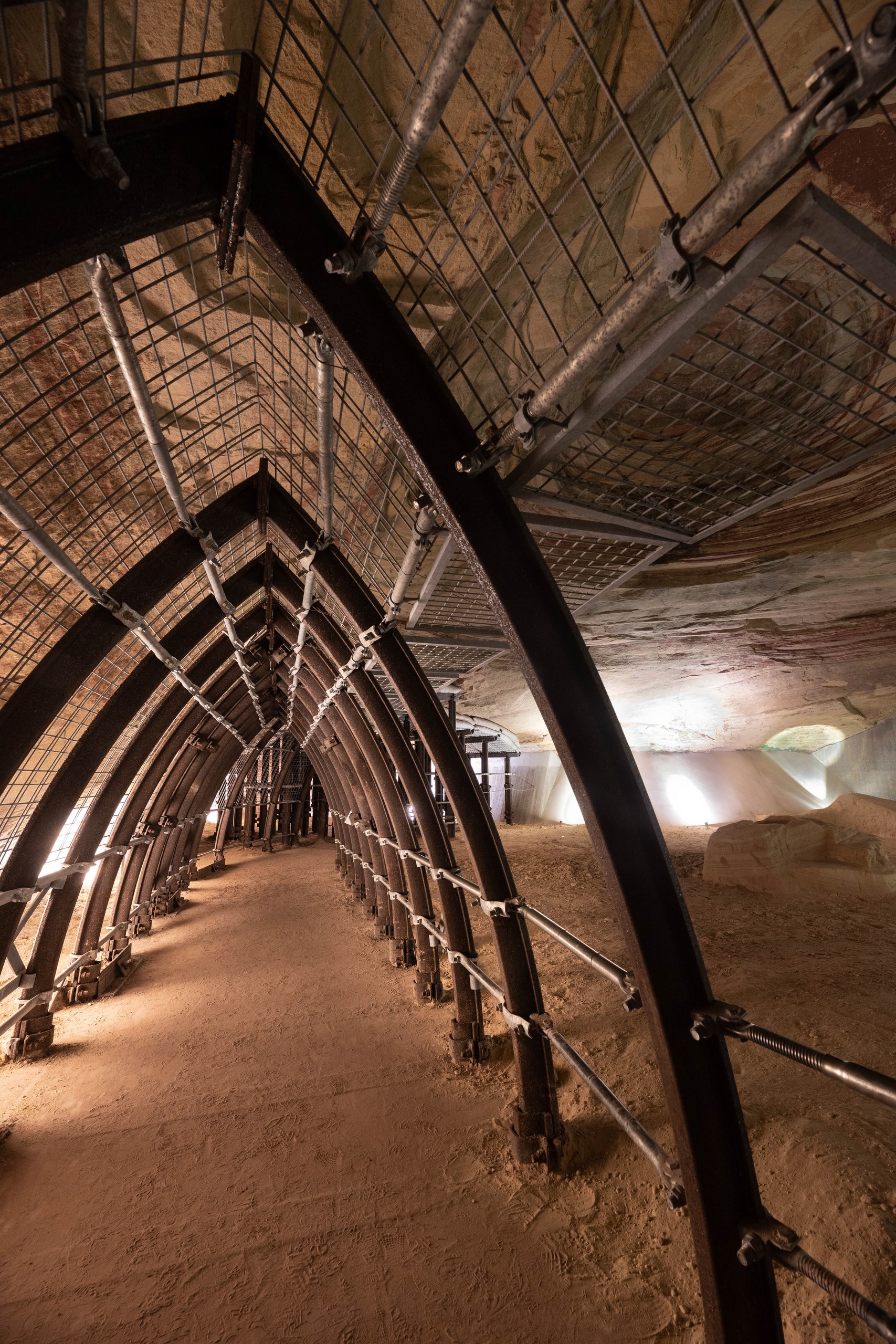
In 2003, sand falling from the ceiling of the throne room led to the closure of the caves. From 2003 to 2007, they were consolidated with steel arches, at a cost of around 3 million euros, with support from the State of Saarland, and then reopened to the public.
The Schlossberg caves in pictures
The Schlossberg caves, photo 1 of 3
The Schlossberg caves, photo 2 of 3
The Schlossberg caves, photo 3 of 3
Sources: Homburger Schlossberghöhlen; town of Homburg
This tour is part of the catalogue of virtual tours of underground heritage.