Underground mills for an island traumatized by war
In the 1950s, Malta was still rebuilding after the massive destruction of the Second World War. The memory of the 1940-1942 siege, of hunger and bombings, remained vivid in the island’s collective memory. The priority was no longer just to rebuild, but also to prepare for the next threat.
In the context of the Cold War and the growing fear of a nuclear conflict, the British authorities, who still administered Malta, designed a civil defense system centered on an essential element: bread. The idea was both simple and radical: even if ports, airfields, and surface infrastructure were destroyed, the population had to continue to be supplied with flour and bread.
A network of eight underground flour mills
Between 1954 and 1955, the British Colonial Office ordered the construction, or rather the excavation, of a network of eight underground flour mills. Seven were located on the main island of Malta and one on Gozo. They constituted a true food safety net, designed to operate in the event of a disaster.
These mills were installed in areas that were rural at the time but close to the main urban centers, in order to be both discreet and easily accessible. They remained far enough away from areas considered priority targets: the Grand Harbour, and the airfields of Luqa and Ta’ Qali. The objective was clear: to have protected facilities capable of continuing to operate even if the port area or military infrastructure were struck.
An orientation designed for a nuclear explosion
The care taken in the location of the mills can be seen even in the orientation of their entrances. These were facing north, in order to minimize the impact of a nuclear explosion that would strike the south of the island, near the Grand Harbour and strategic installations. We are no longer talking here only about camouflage, but about protection against the shockwave and the direct effects of a detonation.
These underground mills were therefore not simple wartime “reserves”, but true emergency industrial facilities, sized to take over in the event of the destruction of surface infrastructure.
A threat that would never materialize
The underground mills of Malta are the direct product of nuclear fear and the traumatic experience of the 1940s siege. They embody a survival strategy that relies on hidden infrastructure and preparation for the unthinkable. Although the dreaded disaster never occurred, these facilities remain the concrete testimony of an era when rock was excavated to give oneself a chance to continue living “as before”.
Today, these underground mills constitute a discreet heritage, at the crossroads of military history, civil defense, and underground architecture.
Operating principle
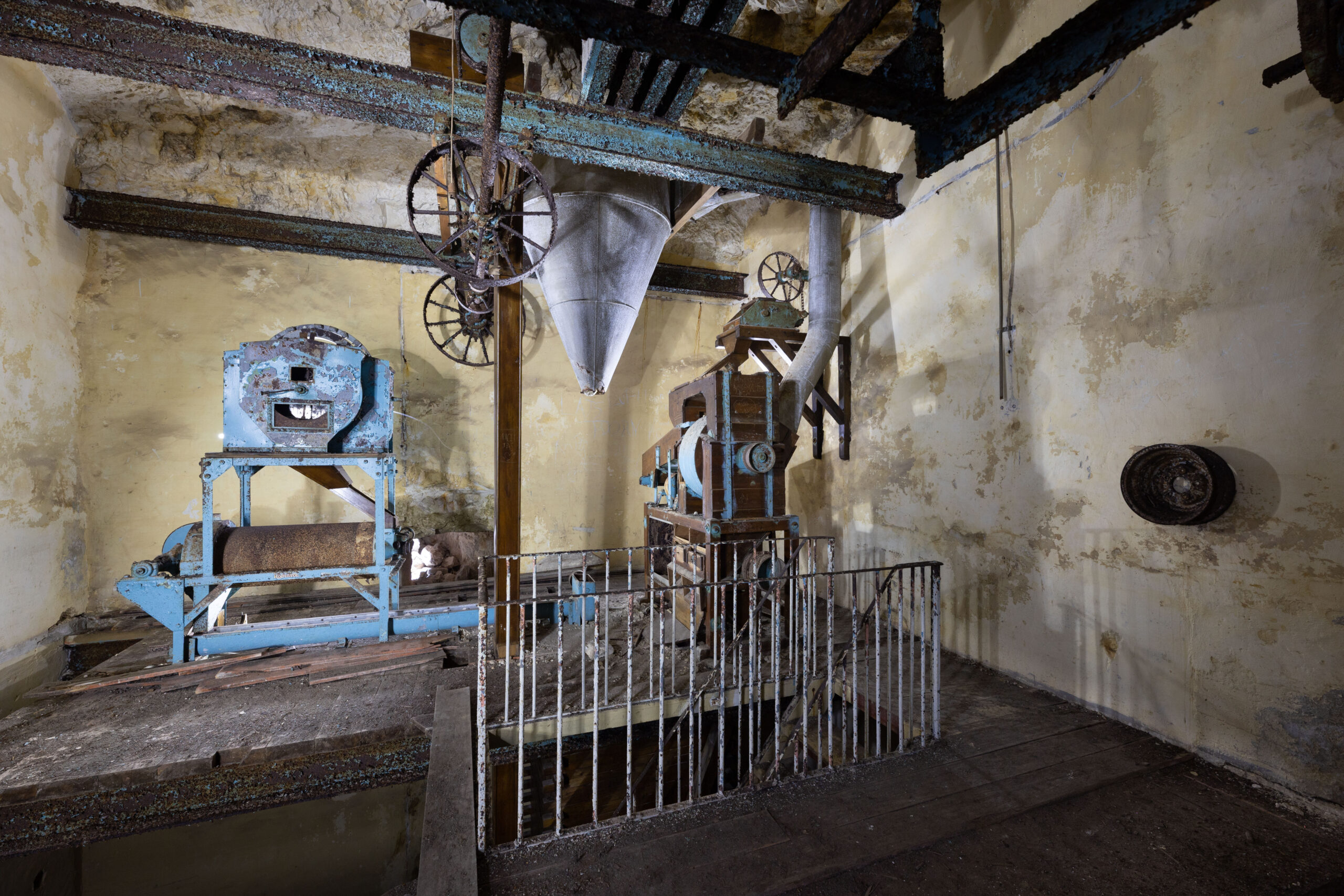
The wheat was stored in silos, then transported by augers to the dosing and cleaning area. It then went to the roller mills and then to sifting in plansifters to separate the flour, bran, and residues. The mill operated in a continuous circuit, with dust extraction, sorting of fractions, and recovery of intermediate products until the final flour was obtained.
This tour is part of the catalogue of virtual tours of underground heritage.