Thirty metres beneath Bourré, in the Cher valley, a village street runs between facades of tuffeau. It passes Gothic doorways, balustraded balconies, outside staircases and a fountain sheltered under arcades. Everything is carved out of the solid rock, at the bottom of a former quarry of the Cave des Roches. The tour follows this underground town in fifteen panoramas.
The stone of Bourré
Tuffeau is a marine sedimentary rock. Its grains, fossil debris cemented together, settled on the sea floor some 90 million years ago. The rock is soft and easy to cut. The stone of Bourré, known locally as “pierre de Bourré”, has the particular quality of whitening and hardening as it ages.
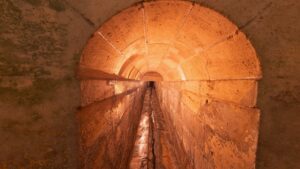
The first traces of extraction date back to the 11th century. For several centuries the stone of Bourré was used to build the houses of the region, and also châteaux of the Loire: Chenonceau, Chambord, Cheverny, Chaumont-sur-Loire. Extraction stopped in 1920, when rising prices made it too costly. It left some 300 kilometres of recorded galleries beneath the commune. The Cave des Roches owns 120 of them, spread over seven levels and reaching a depth of 50 metres.
The perriers
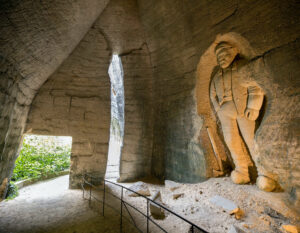
The quarrymen who dug these galleries were called “perriers”, and the quarries themselves “perrières”. They worked by hand, with flexible-handled mallets, hammers, picks and wooden wedges, dressed in a blue smock, a miner’s waistcoat, canvas breeches and clogs. The work was dangerous. The galleries of Bourré saw many accidents, among them roof collapses.
Mushroom growing
The abandoned galleries found another use from the end of the 19th century. In 1893, Louis Fay, who worked the quarry, and Emirin Buchet began growing button mushrooms in them. The galleries keep a temperature of about 12 °C and a humidity of 95 % all year round, which is what the mushroom needs. In the 1930s, the Cave des Roches produced around 200 tonnes of mushrooms a month and employed fifty people.
In the 1990s, mass production in greenhouses from the Netherlands made it impossible to compete on button mushrooms. The Delalande family, who run the cave, turned to rarer species. Today they grow shiitake on blocks of compressed sawdust, yellow oyster mushrooms on bales of organic straw, grey oyster mushrooms, a little button mushroom in pasteurised horse manure, and above all the blewit, known in French as “pied bleu”. This species grows wild in the region and stays white when it is cultivated underground. The Cave des Roches claims 40 % of its world production.
The underground town
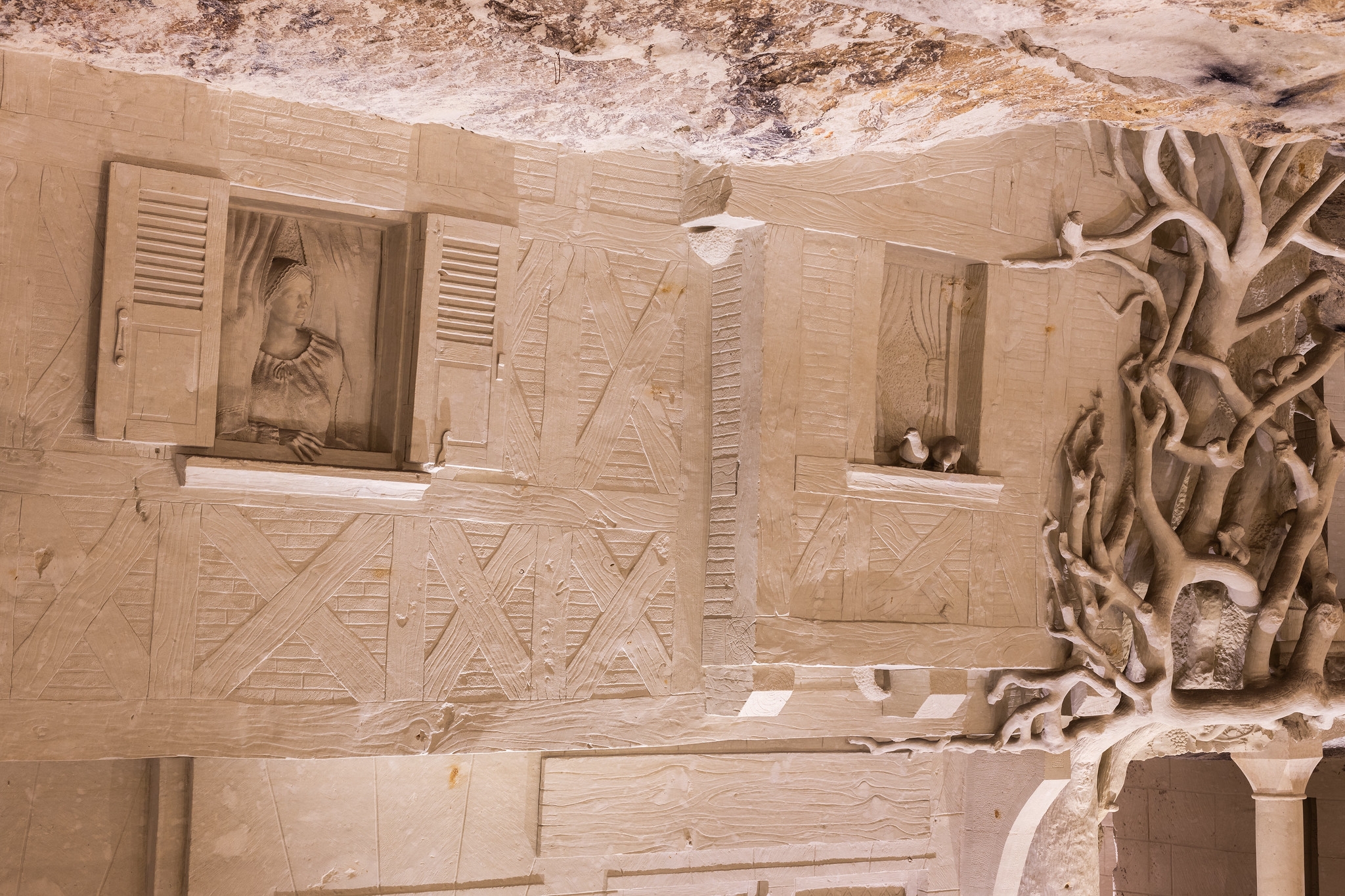
The idea of the underground town came from Maurice Delalande. Two sculptors, Christian Lhermite and Slobodan Bugaric, began carving it in 1998, and it opened to the public in 2001. It covers 1,500 square metres. The project set out to keep a record of a threatened architecture: on the surface, tuffeau is friable and sensitive to weather and pollution. Underground, the facades escape the erosion that would have worn them away in the open air.
The panoramas show the work in detail. The facades alternate between ashlar and rubble walls, imitated down to their joints. A pointed-arch doorway is crowned with Gothic tracery. Further on, a staircase climbs to a balustraded balcony, and a tree carved in high relief spreads its branches across a facade. A fountain is sheltered under arcades. Above the roofs, the ceiling is still that of the quarry, raw and stained with black.
The tour of the Cave des Roches takes in the quarry, the mushroom farm and the underground town, and ends with a gallery of carvings on the theme of vanished trades. The guided tour lasts about an hour.
Sources: Cave des Roches, pages on the quarry, the village of Bourré and the guided tour (le-champignon.com); Blois-Chambord tourist office, “Tuffeau, Bourré’s white gold”; Showcaves.com, “Cave des Roches”; Days on the Claise, “Mushroom caves at Bourré”, 17 August 2011, and “Growing mushrooms underground”, 21 August 2023; Wikipédia, “Bourré”.
This tour is part of the catalogue of virtual tours of underground heritage.