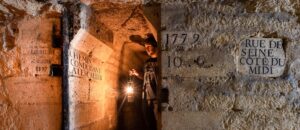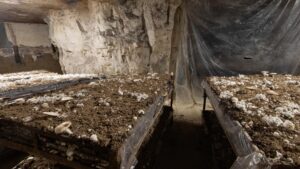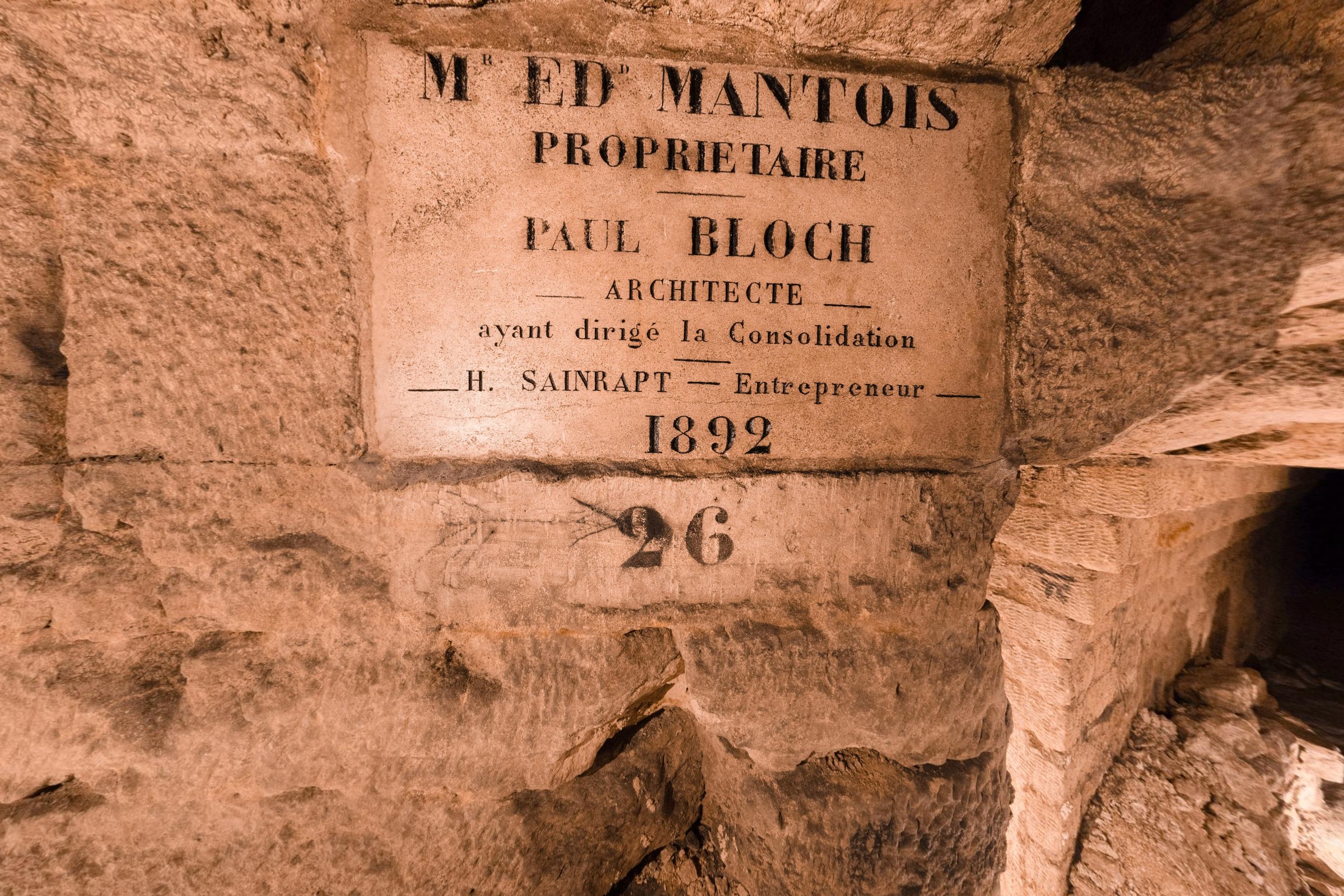
Beneath a bus depot in the 13th arrondissement, near the rue Le Brun, run the galleries of a former limestone quarry. Others pass beneath the cellar of an apartment building. Part of the quarry was used as a cellar to store coal, which gives the place its name. On the pillars, plaques record the consolidation works of 1880 and 1892.
The quarry
The ground beneath Paris was worked until the end of the 19th century for calcaire grossier, the city’s building stone, and for gypsum. The rue Le Brun, in the Salpêtrière district, runs from the boulevard Saint-Marcel to the avenue des Gobelins. Its line follows that of the ditch of the wall that protected the bourg Saint-Marcel in the 14th century, and it was part of the rue des Fossés-Saint-Marcel until 1867.
Once extraction was over, the voids remained beneath the houses. Since the owner of the land also owns what lies beneath it, their safety is his responsibility, as the Inspection générale des carrières, created in 1777, points out. The two large plaques of this quarry thus open with the name of an omnibus company, in 1880, and with that of an owner, in 1892.
The plaques of 1880 and 1892
The older one reads: “Compie Gle des Omnibus. Dépôt de Lebrun. Travaux de consolidation exécutés en 1880 sous la direction de Mr Simonet.” Then come the architect, M. Baril, then the contractor Sainrapt and a second one whose name is partly worn away. The Compagnie générale des omnibus, created in 1855 with the monopoly of omnibus services in Paris, had one of its depots here. Its lines later passed to the STCRP, then to the RATP, and the depot is today the Lebrun bus centre.
The second, from 1892, names “Mr Edd Mantois, propriétaire”, the architect Paul Bloch, “ayant dirigé la consolidation”, and the contractor H. Sainrapt. Beneath the plaque, the number 26 has been inscribed. Édouard Mantois made optical glass: around 1900, a large share of the largest objective lenses in the world were cut from his glass. His firm, taken over by his brother-in-law Numa Parra under the name Parra-Mantois, then had its address at 26 rue Lebrun.
Other, smaller plaques served for finding one’s way: “Sous le bâtiment” (under the building), “Sous les fours” (under the furnaces) and “Blot, rue Lebrun”, the last two preceded by an arrow. Another, partly worn away, still lets one read “Les flèches tendent” and “de sortie”.
The coal cellar and the depot
In the part that served as a coal cellar, the floor and the lower walls have stayed black. Masonry pillars hold up the quarry roof, and rusty iron bars stand against the walls.
A masonry gallery with an egg-shaped cross-section links two shafts fitted with rungs, one of them closed by a spiked grille. The last panorama climbs into the depot itself, during building works: an opening in the floor looks down into the quarry. The Lebrun bus centre is one of the centres the RATP has adapted for electric buses under its Bus2025 programme.
Sources: plaques recorded in the quarry; Wikipédia, “Rue Le Brun”; PSL digital library, entries “Mantois, Edouard Etienne Charles” and “Parra-Mantois”; RATP Histolab, on the creation of the Compagnie générale des omnibus; City of Paris, Inspection générale des carrières, 2022 annual report; Paris police prefecture, collection of administrative acts of 14 February 2023; RATP, Bus2025 programme.
This tour is part of the catalogue of virtual tours of underground heritage.