Andra (National Agency for Radioactive Waste Management) aims to implement deep geological disposal for intermediate-level long-lived and high-level waste.
Since the 1990s, Andra has therefore developed a comprehensive study program named Cigéo, for Industrial Center for Geological Disposal located in Bure, in the Meuse region.
The objective of the CIGEO project is to safely store radioactive waste at a depth of about 500 meters in a stable clay layer called Callovo-Oxfordian. The waste will be stored in steel and concrete containers, placed in underground galleries.
Since its inception, the project has been the subject of numerous studies and public consultations. Opponents of the project have expressed concerns regarding the long-term safety of radioactive waste storage and the potential environmental impact.
However, proponents of the project argue that deep geological disposal is the best option for managing radioactive waste in the long term, as it offers protection against leaks and natural disasters.
The CIGEO project is still ongoing and receives continuous attention from the public, media, and governments in France. It is important to remember that the 2006 law requires reversibility for at least a century for this type of storage.
If Andra obtained the necessary authorization, CIGEO would include various underground structures with specific functions. On the one hand, surface-to-underground connecting structures would allow the transfer of packages, workers, and materials. They would also handle the ventilation and removal of excavated clay. On the other hand, connecting galleries would link these structures to the storage areas. Finally, the storage areas themselves would be equipped with access galleries and cells.
Each structure has its own geometric characteristics as well as specific construction and operation methods. For example, the diameter could vary between 0.7 m for cells intended for High-Level waste, and more than 10 m for those intended for Intermediate-Level long-lived waste. The cells for HL waste would be lined with a metal casing to facilitate the installation and possible retrieval of the packages. The other structures would be equipped with cementitious linings using specific excavation methods such as the tunnel boring machine for the access ramps and the roadheader for the logistical structures.
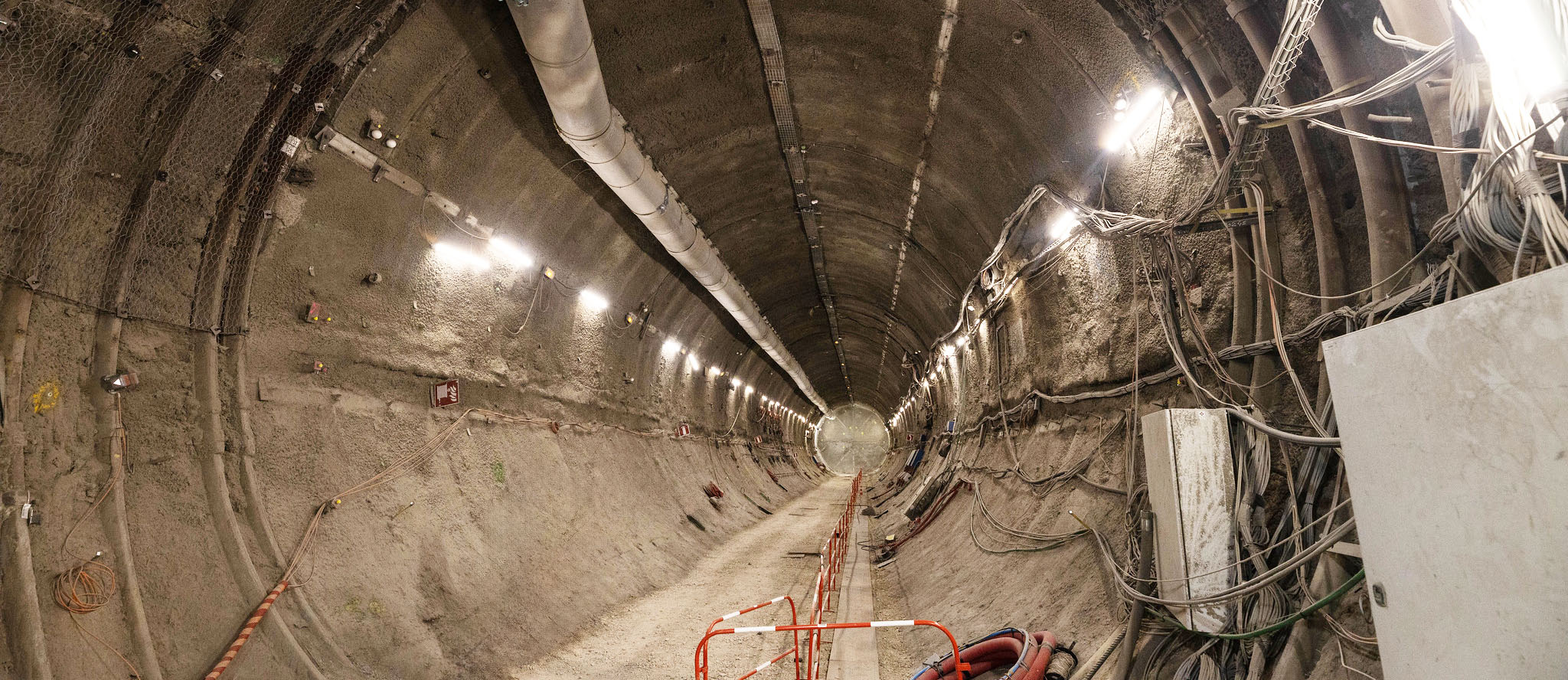
More than 2 kilometers of galleries have been excavated so far, allowing an in-depth study of the structural behavior and a comparison between different excavation techniques. The main objective was to master the interaction between the rock and the structure, which required a thorough understanding of the behavior of both the rock and the structure itself, as well as the method used to build the latter.
Each product used for the consolidation of these galleries is the subject of an in-depth study on its integration methods. The incorporation of these linings requires careful consideration of the phasing of the work. It takes into account safety, the homogeneity of the final product, technological constraints as well as cost optimization.
Take for example the VMC® compressible monobloc segment (Andra/CMC).
The VMCⓇ segment is a two-layer specimen. Its particularity lies in the integration of a compressible layer on its outer surface. It is made of an agglomerate of Callovo-Oxfordian shell elements. The latter come from the excavation, are treated and then fired. They are then agglomerated together by a cementitious grout called “slip”.
Conclusion:
Andra now possesses in-depth knowledge of the technical feasibility and behavior of compressible supports and linings. The tests, carried out at the scale of galleries, attest to their effectiveness. They limit the transfer of stress into the concrete linings. Specific techniques have been implemented, adapted to conventional excavation methods and to the tunnel boring machine.
This tour is part of the catalogue of virtual tours of underground heritage.