Introduction
The Harnekop nuclear bunker served as the main command post for the East German Ministry of Defense and the National People’s Army in the event of a nuclear attack. Officially, the authorities presented it as an aviation weather station in order to conceal it.
Today, this site embodies one of the most impressive examples of GDR military engineering. Above all, it shows how a state prepared for the continuity of command, even in an extreme scenario.
Harnekop: role and secrecy
The bunker met a clear objective: to maintain a functional chain of command in a crisis situation. In other words, it had to allow directing, coordinating, and communicating, even after a major shock.
However, secrecy remained central. That is why the authorities chose a civilian cover: an “aviation weather station”. In this way, the site could remain discreet while maintaining a visible and “ordinary” activity.
An extraordinary construction (1971)
Construction began in 1971. At the time, many considered Harnekop to be one of the largest, safest, and most modern bunkers in the GDR.
The complex covers approximately 7,500 m². Furthermore, it is organized over three underground levels. Finally, it can accommodate 450 to 500 people for three to four weeks, including in a context of nuclear or chemical threat.
Shock resistance
To withstand the effects of shockwaves, the teams installed essential equipment on hydraulic jacks. In this way, part of the vibrations and impacts dissipates before reaching critical systems.
Construction technique
The construction uses a monolithic structure with slipforming. According to some estimates, the project required nearly 40,000 m³ of concrete. In practice, this illustrates the logistical scale of the project, but also the ambition for durability.
Communications: the BARS system
A command bunker only has value if it communicates. That is why Harnekop was connected to a Soviet backup communication network dedicated to bunkers: the BARS system (tropospheric radio station).
Thus, the site could take over if a nuclear war rendered conventional links unusable. In other words, communications remained the number one objective: “no contact, no control”.
Revelation in 1990 and current status
For a long time, NATO failed to locate the facility precisely. Yet, the secret eventually came out at a pivotal moment.
The authorities made the bunker public in 1990, on the day of German reunification. Today, the bunker is listed as a national historic monument.
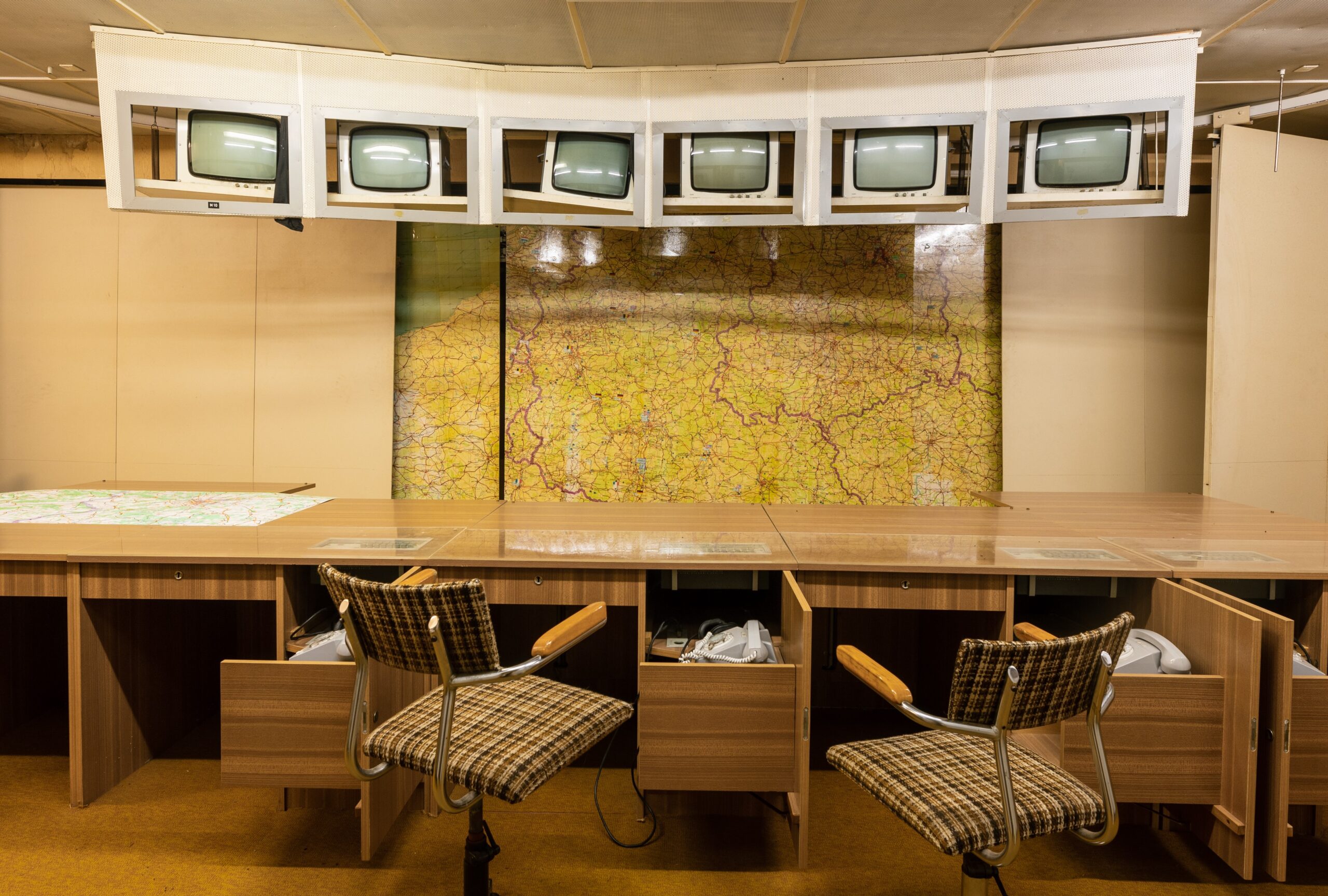
Inside: a complete base to survive and command
The bunker brings together all command and control functions. It includes in particular:
- Operational areas.
- Meeting rooms.
- Apartments intended for ministers.
Next, the site provides for daily life over time:
- A canteen and a kitchen.
- Dormitories.
- A medical center.
Finally, the infrastructure features everything required for extended autonomy:
- Water and electricity.
- Ventilation and air purification.
- Air conditioning.
- Waste management.
This tour is part of the catalogue of virtual tours of underground heritage.