45 million years ago, Champagne was a tropical coast. After a short period during which the land had emerged, a warm sea once again invaded the region. Its shoreline ran between Reims and Épernay, and a very rich fauna developed there: nearly 1,800 species of molluscs have been identified, whereas the French Atlantic coast now has only about 250.
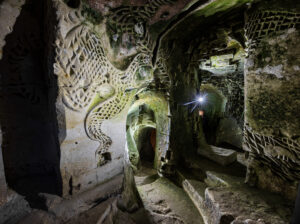
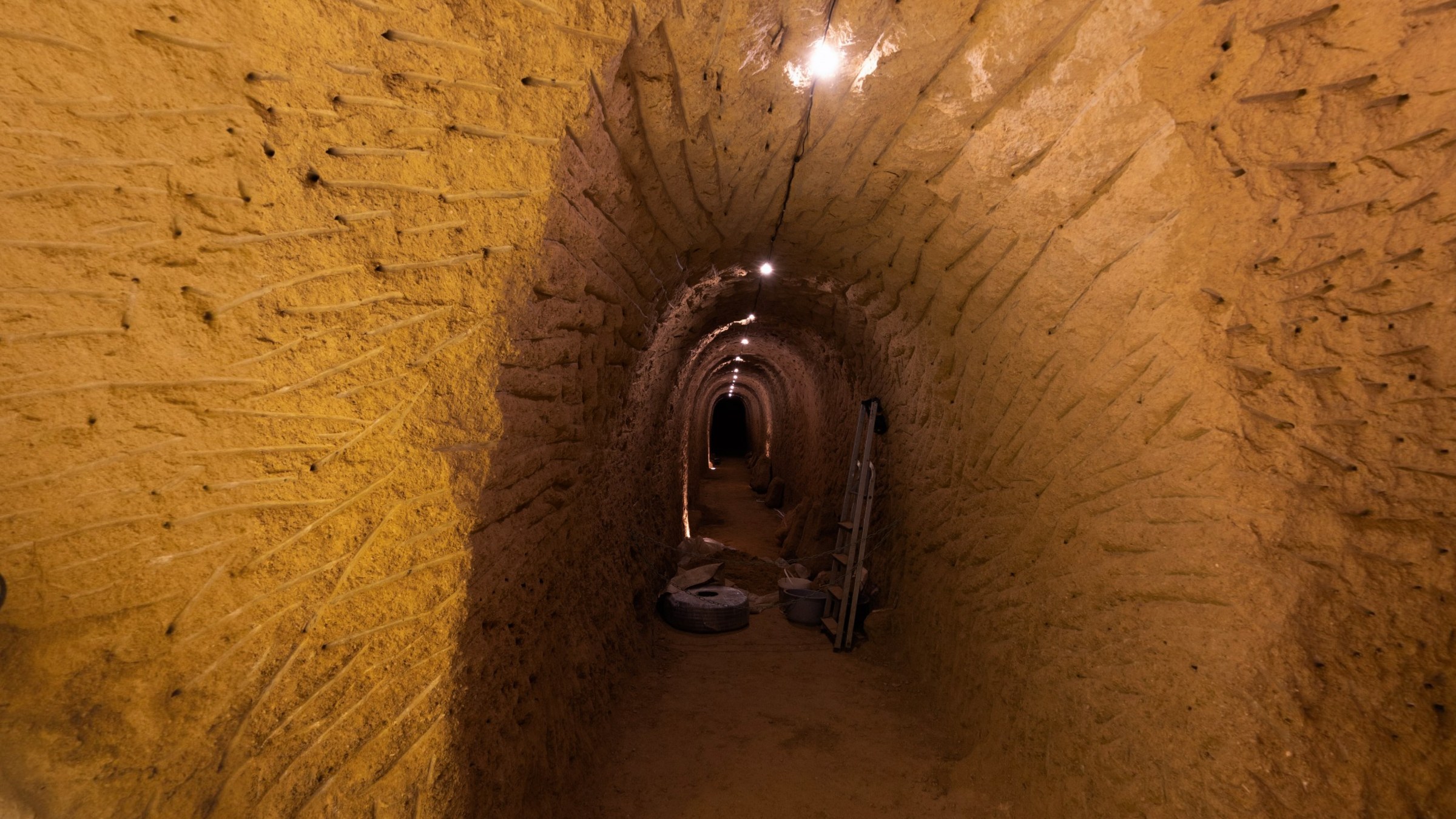
The Cave aux coquillages is in Fleury-la-Rivière, in the Marne valley. Since 1997, Patrice Legrand, a winegrower with a passion for geology, has been uncovering the marine remains of the Lutetian there. The galleries he digs form a visitor route where the fossils stay in place, where they were found.
The giant campanile
The site’s emblematic fossil is Campanile giganteum, a sea snail whose shell exceeded 40 centimetres. It is a gastropod, a word formed from the Greek gaster, stomach, and podos, foot: a soft-bodied mollusc folded inside a one-piece shell, most often spiralled, which moves about on a muscular foot. The animal kept the same shell throughout its life.
The reefs also sheltered sharks, away from the open sea and the large predators. Their size has been reconstructed by comparison with present-day sharks of the same family.
The excavation site
A chamber was dug to show the stratigraphy of the ten metres of sand that represent the Lutetian: eight successive levels can be followed there. Further on, a workshop shows the excavation method, with pick, knife and brush. The fossils are removed in a whole block of sand, which is carried to the laboratory so that they do not break. The sand is kept, so that they can later be displayed in their original matrix.
The fossils of the Damery tuffeau have attracted researchers from all over the world and enriched many collections. More than 300 species have been recorded there, and the sieved sand also yields an abundant microfauna. The collection assembled on site is recognised as a reference collection.
The champagne cellars
The route joins the cellars of the Legrand-Latour champagne house. When the galleries intended for storing the bottles were dug, the fossils encountered were left in place. The estate’s vines, on the slopes of the Marne valley, are planted mainly with Meunier, along with Pinot Noir and Chardonnay.
Source: La Cave aux coquillages, Fleury-la-Rivière
This tour is part of the catalogue of virtual tours of underground heritage.