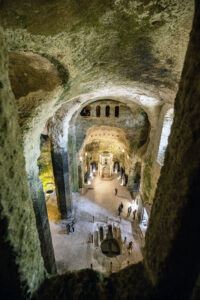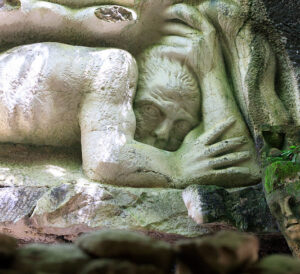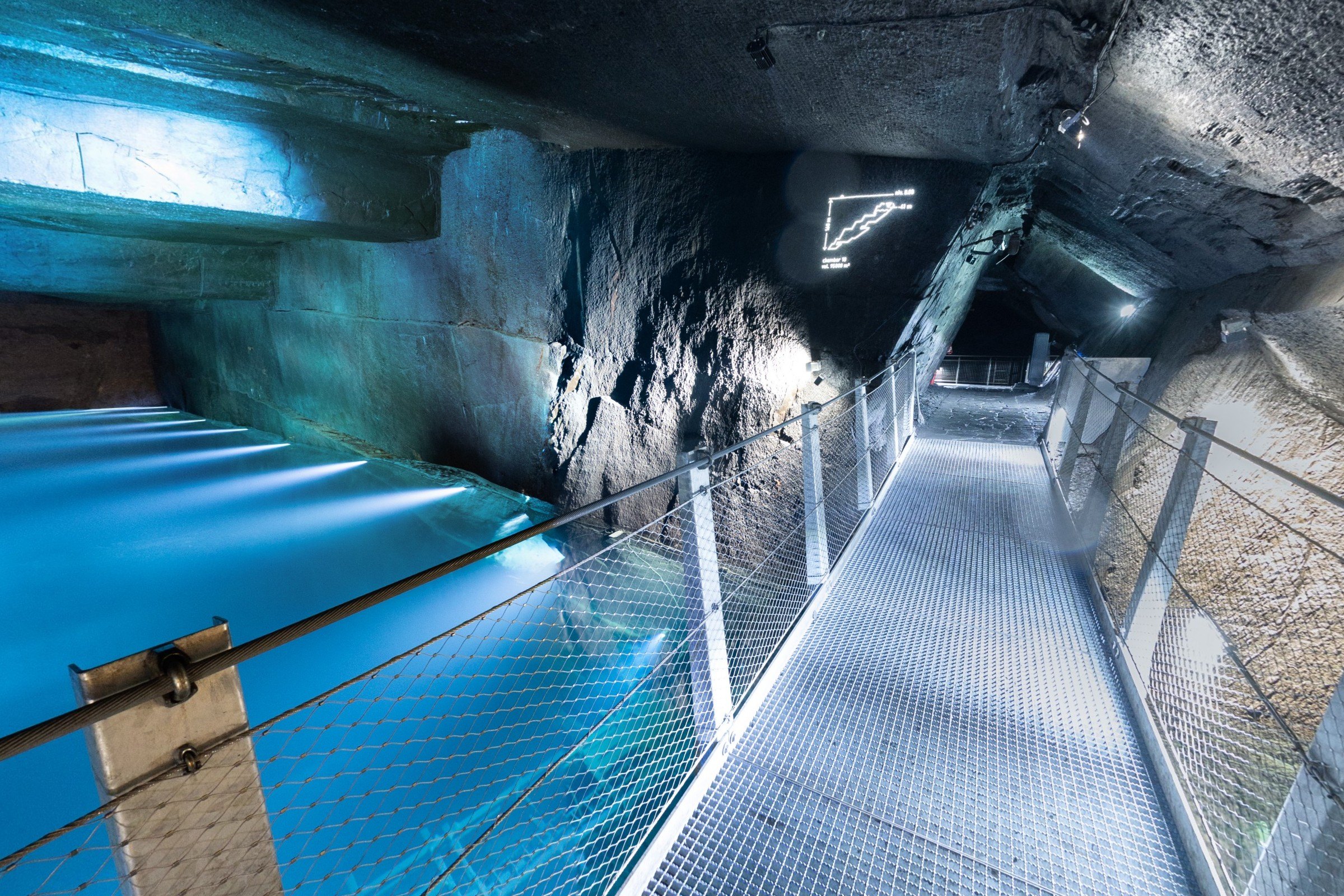
Slate was taken from beneath Haut-Martelange for almost two centuries, from 1790 to 1986. It was here, near the Belgian border, that Luxembourg’s last slate quarry closed. Part of the old extraction chambers can now be visited through the Johanna gallery, which descends 400 steps to 42 metres below the surface. The panorama was taken on the metal footbridge that crosses one of these chambers. Below the grating, the floor is flooded.
Slate extraction
The first underground mines opened at the end of the 18th century. Several companies, held by a few families, shared the deposit; by the end of the 19th century they were already producing more than six million roofing slates a year. At first the rock was split with pick and hammer. In the second half of the 19th century, steam engines appeared in some quarries to drive the winches, the pumps and the transmission shafts of the workshops. Compressed-air tools arrived around the turn of the 20th century and made the slate worker’s labour somewhat lighter.
The Gebrüder Rother
From 1890 onwards, in less than twenty years, a family of German entrepreneurs, the Gebrüder Rother, bought all the slate quarries of Haut-Martelange and every house in the village. The workshops were modernised, and both the industrial site and the village were given a uniform architecture. Two reasons lay behind these investments: a promising deposit, and the connection of Haut-Martelange to the Jhangeli, the narrow-gauge line that carried the finished slates out and brought raw materials in.
Around 1900, 600 workers were employed on the site. Four years later, Haut-Martelange had its own power station, driven by steam engines.
From the wars to closure
During the First World War, the occupier deemed the company essential to the war effort, and extraction went on. Sales stagnated from the 1930s onwards with the global recession. During the Second World War, some workshops even took on more workers: in this way the management kept Luxembourgers out of German labour camps. Between 1946 and 1948, a few German prisoners of war are recorded as working in the quarries.
Until the middle of the 20th century, slate extraction and processing was the country’s second-largest industry. After 1960 the decline became clear: new roofing materials and cheap imported slates won out over local production. In 1986, the firm Ardoisières de Haut-Martelange ceased all activity.
The Johanna gallery
The site then fell into oblivion. In 1992, residents of the neighbouring villages founded the association Les Amis de l’Ardoise to bring its past back to life. In 1993 the commune of Rambrouch bought most of the village, together with the industrial buildings and the underground chambers. The Luxembourg State bought the site in 2003 and immediately entered it on the supplementary inventory of historic monuments. Since 2019 the museum has been run by the association Musée de l’Ardoise, which brings together the State, the commune and Les Amis de l’Ardoise.
In 2018 the government committed 7.1 million euros to open the museum every day and fit out the underground chambers. The work was carried out by the Service des sites et monuments nationaux, and the circuit opened to the public in 2022. It takes in seven chambers of the Johanna gallery. Archive photographs are projected onto the walls, and a suspended footbridge has been installed in chamber 18. The temperature stays at 9 °C all year round.
The descent must be booked at least twenty-four hours in advance; it is open to children from the age of four.
The slate landscape
Above ground, the site covers eight hectares and has 22 buildings, among them the workshops, the owner’s house and the administrative buildings. The small train that once took slate blocks to the workshops has been restored and now carries visitors around the site.
In May 2026, the museum and the commune of Rambrouch, with the backing of the Minister of Culture, officially launched the bid to have the “Slate Landscape of Haut-Martelange” inscribed on the UNESCO World Heritage List. The bid draws in particular on the slate landscape of north-west Wales.
Sources: Musée de l’Ardoise, history of the site (ardoise.lu); Visit Luxembourg, “The Slate Museum: learning and entertainment”; Paperjam, “Visite à -42 mètres au Musée de l’Ardoise”, 5 March 2022; La DH, “Le Musée de l’ardoise au patrimoine de l’UNESCO ?”, 4 May 2026.
This tour is part of the catalogue of virtual tours of underground heritage.