The Caves of Kanne are located in Riemst, in the southeast of Belgian Limburg, right on the Dutch border, near Maastricht. For centuries, underground limestone was extracted here in the marl region. This is how a vast network of underground galleries nearly 16 km long was created here in Kanne, in which people still work today.
Popularly, people speak of “marl caves” but technically this term is not correct. Marl is actually a soft limestone. Moreover, these are not natural caves, but artificial quarries. A more correct name is therefore “Limestone quarry”.
In this underground, it is possible to taste local agricultural products in the banquet hall. There is also an authentic mushroom farm.
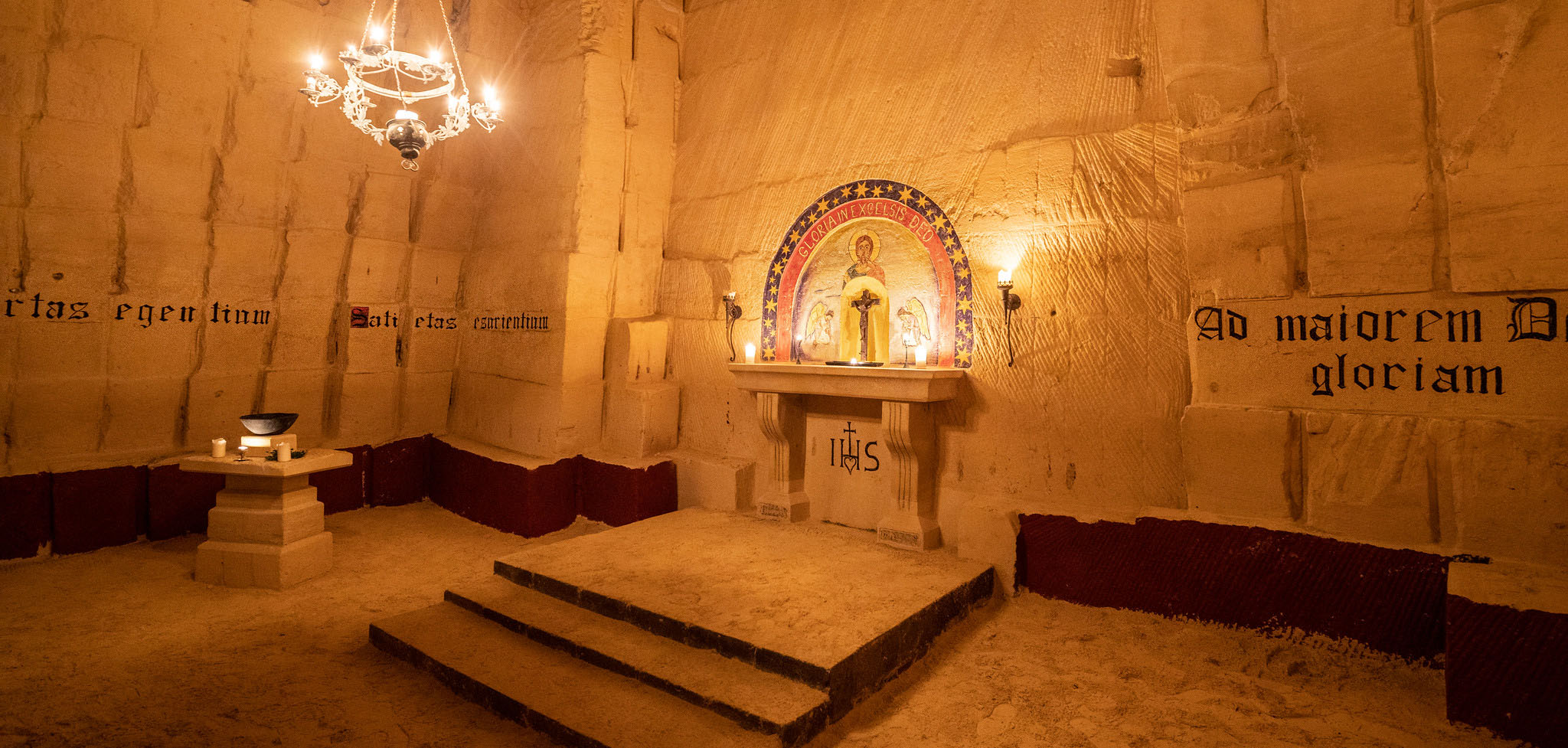
The galleries were carved with saws and pickaxes. The extracted stone was used for building construction.
The height of these galleries approaches 8 meters. The marks of the tools can be seen on the walls.
Limestone was already exploited in this region by the Romans to fertilize agricultural land. Around the 14th century, underground limestone mining began to be used as building stone.
This tour is part of the catalogue of virtual tours of underground heritage.