Beneath the main square of Saint-Émilion lies a void of 15,000 cubic metres. This is the monolithic church, the largest church in Europe dug entirely out of the rock: three naves, six bays, eleven metres to the vault, achieved not by stacking stones but by removing them. Above it, a 53-metre bell tower bears down on this ceiling, and therein lies the whole recent history of the monument.
The history of the site
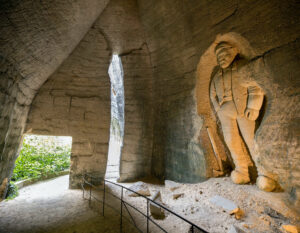
According to tradition, a Breton monk named Émilion arrived in the 8th century and settled as a hermit in a natural cavity in the limestone hillside, where he fitted out an oratory. On his death, around 767, his disciples dug a modest underground chamber around his tomb. The hermitage and the grotto can still be visited, a few dozen metres from the church.
Everything started there, and the matter was as much economic as spiritual. A vita of the saint, the oldest known version of which dates from the 12th century, highlights his miracles; the aim was to draw pilgrims, who would spend money locally, onto a secondary variant of the Way of St James.
The crowds still had to be accommodated. At the end of the 11th and the beginning of the 12th century, the colossal project was launched under the authority of Benedictine monks, at the initiative of Pierre de Castillon, viscount of Aubeterre, the same lord who, in his lordship, had the monolithic church of Aubeterre-sur-Dronne dug out. An inscription engraved on the third south pillar, recalling the dedication to Saint Émilion, makes it possible to date the consecration to this period.
Fifteen thousand cubic metres to remove
The method was that of the rock-cut sites of Cappadocia, whose principle the crusaders had brought back: the work starts from the top. The vault was opened first, which entirely removed the need for shoring, and then the floor was lowered level by level. The pillars separating the naves were not built up: they are reserves of rock that the stonecutters refrained from cutting away.
This is what makes the undertaking so daunting. A mason who makes a mistake takes it down and starts again; here, every blow of the pick is final, and an undersized pillar cannot be put right. Nearly 15,000 cubic metres of limestone had to be extracted while keeping in mind, from the first day to the last, the plan of what was to remain standing.
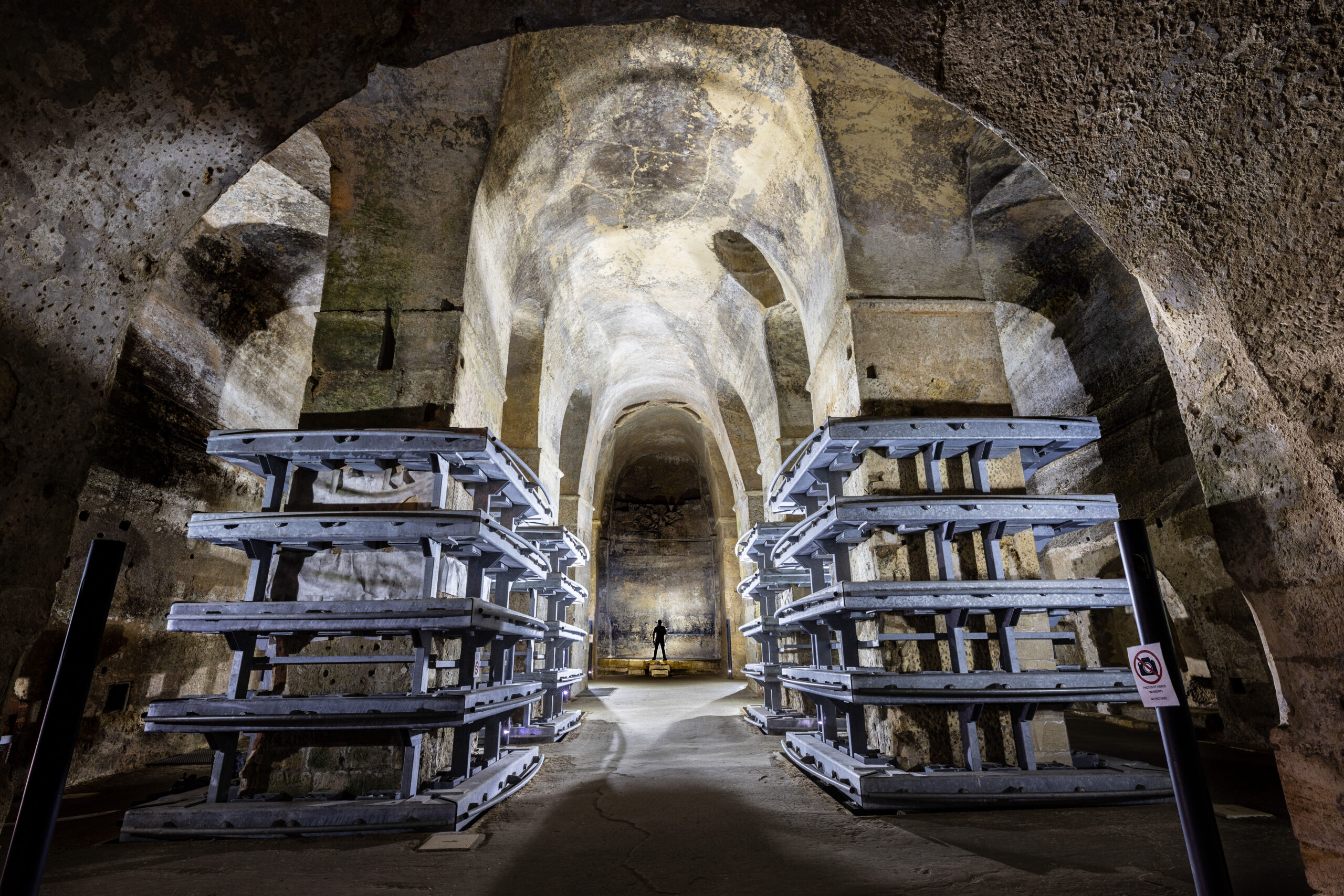
The result is the largest monolithic church in Europe: a central nave and two aisles of similar dimensions, over six bays, with the central nave rising to eleven metres. In the choir, bas-reliefs carved into the mass, including a group of angels, form the main surviving decoration. The rest disappeared in 1793, when the church was converted into a saltpetre works and its walls were scraped.
The catacombs and the Trinity Chapel
The church is only one part of a larger underground complex. To the west of the access gallery lie the medieval catacombs: an excavated funerary space topped by a dome, whose walls hold burial niches. People were buried there as close as possible to the saint, following the logic that also governs the crypts and ossuaries of the Middle Ages.
Above, the Trinity Chapel, this one built above ground, completes the circuit. In the 14th century, Gothic windows and a portal were at last opened up in the façade of the church, the only part visible from the square.
The bell tower that bears down
The danger came from above. The bell tower, whose base dates from the 12th century, was raised to 53 metres, with a 16th-century spire. It stands directly over the void. Add the vibrations from the traffic of a tourist town, and cracks appear in the ceiling of the church.
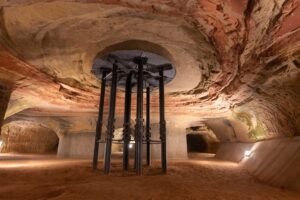
In the late 1990s, the World Monuments Fund placed the monument on its list of endangered sites. The response was massive: strengthening of the foundations and pillars, installation of steel tie rods stretched across the space. They jar the eye, and one understands why they are there as soon as one looks up. They are holding the monument together.
Listing as a historic monument had come in 1886, and in 1907 for the bell tower. In 1999, the Jurisdiction of Saint-Émilion, the vineyard and its built heritage, was inscribed on the UNESCO World Heritage List as a cultural landscape. Today the bell tower is reached by nearly 200 steps: the town and its vineyards on one side, and on the other the awareness of standing on the roof of a quarry.
Sources: Saint-Émilion tourist office; Monuments historiques records (1886, 1907); World Monuments Fund, list of endangered sites; UNESCO, Jurisdiction of Saint-Émilion (1999); Planet-Terre resource from the ENS de Lyon on the monolithic church.
This tour is part of the catalogue of virtual tours of underground heritage.