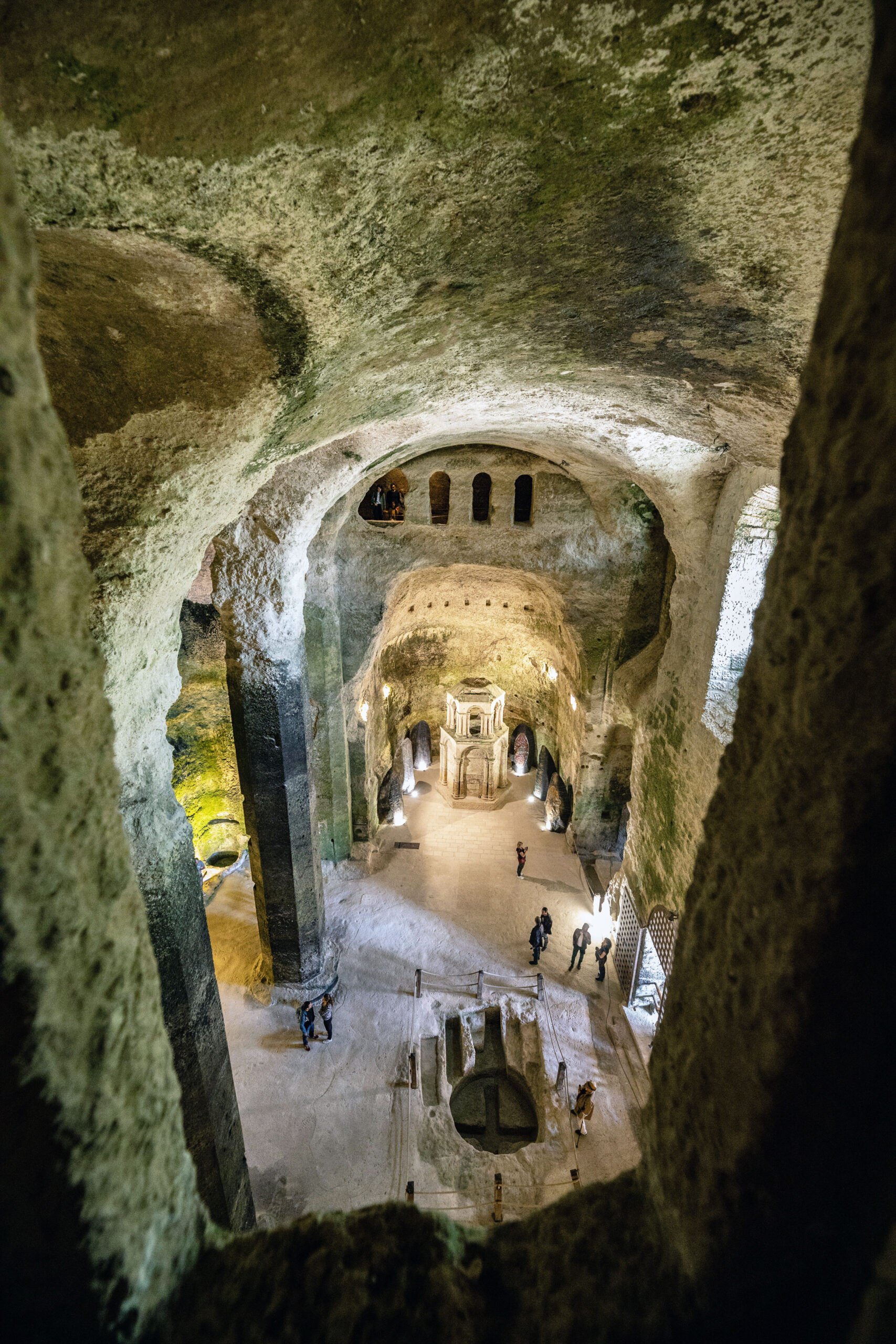
At the centre of the church of Aubeterre-sur-Dronne stands a block six metres high that was never brought in: it was spared. Around it, the cliff was hollowed out to a height of twenty metres to clear a nave. This block is a reliquary, a copy of the Holy Sepulchre in Jerusalem, and the whole church is, at bottom, merely the setting carved around it, above a far older cemetery.
A necropolis before the church
Before it was a sanctuary, the place was a burial ground. The clearance campaigns of the 20th century uncovered, on the west side, a true necropolis: some 80 shouldered stone sarcophagi and nearly 170 grave pits, the oldest of which date back to the 9th century.
People are not buried just anywhere. Such a density of burials points to a sacred character that was already established, several centuries older than the Romanesque church, and probably linked to an early religious excavation dug into the cliff in the early Middle Ages.
From this primitive phase a rare piece survives: a baptismal font cut into the rock in the shape of a Greek cross, sized for baptism by immersion. It bears witness to a liturgy that predates the general adoption of infant baptism, when people entered the Church as adults, stepping down into the water.
A Holy Sepulchre in Charente
The decisive enlargement was the work of one man and one specific project. Pierre de Castillon, viscount of Aubeterre, returned from the First Crusade with relics and wanted to give them a worthy setting. He had the cliff hollowed out above his own stronghold, drawing inspiration from the rock-cut churches of Cappadocia that the crusaders had seen on their way.
The centrepiece is this monumental reliquary, six metres high, carved in a single piece and left standing in the middle of the void. On two levels and beneath Romanesque ornamentation, it reproduces the aedicule of the Holy Sepulchre. The intention is explicit: to offer those who would never go to Jerusalem a tomb of Christ within walking distance. The pilgrimage came to them.
The same patron was behind a second undertaking of the same kind in his lordship, the monolithic church of Saint-Émilion, larger still, where the same ambition to draw a stream of pilgrims can be found.
From 1155 until the Revolution, the building had the status of a secular collegiate church: a community of canons celebrated the daily office there beside the relics.
The upper gallery
The church measures about 27 metres long by 16 wide, and the vault rises to nearly 20 metres above a broad nave flanked by a single aisle. Yet its distinctive feature lies elsewhere: along three sides runs an upper gallery, a kind of triforium reached by stairs that are also cut into the rock face.
This arrangement, exceptional in a rock-cut church, made it possible to move about above the congregation and look down on the reliquary, a staging of the gaze that must have served on days when crowds came. It is from up there that one best grasps today what the removal of several thousand cubic metres of limestone represented.
Gunpowder, graves and backfill
The Revolution deconsecrated the church and turned it into a saltpetre works: the nitrate efflorescences on the walls were gathered to make gunpowder. It then served as a parish cemetery until 1865, so funerary use returned a thousand years after the sarcophagi, before the church silted up under backfill and faded from memory.
It was listed as a historic monument on 3 September 1912, but it was not until the clearance campaigns begun in the late 1950s that the space was restored to its original reading, and that the necropolis reappeared. The site now receives several tens of thousands of visitors a year: about 65,000 in 2014.
Sources: Monuments historiques record (listing of 3 September 1912); documentation from the commune of Aubeterre-sur-Dronne and the Sud-Charente tourist office; encyclopaedic entry on the monolithic church of Aubeterre-sur-Dronne.
This tour is part of the catalogue of virtual tours of underground heritage.