The Mine Bleue produced slate for only fifteen years. Opened in 1916 at Noyant-la-Gravoyère, in the Maine-et-Loire department, the slate quarry closed in 1936 while it was making money: its bank had gone bankrupt. It stayed shut for more than half a century, until its conversion into a visitor site in 1991. Today the way down is by lift, to 126 meters underground.
Anjou slate
The Noyant slate comes from the formation d’Angers-Traveusot, of Ordovician age. These are ancient marine muds, laid down on a coastal platform that grew steadily deeper, which have become a blue-gray to black rock with a very fine grain. It contains fossils, graptolites and trilobites.
The strata were tilted up to the vertical. Following a bed therefore means digging ever deeper. Quarrying is recorded at Trélazé and Renazé as early as the 15th and 16th centuries, and a slate quarry at Trélazé reached a depth of 25 meters at the end of the 15th century. Until 1840, work was open-cast, in descending benches, and the walls often collapsed.
Before the First World War, the slate industry employed about 9,000 workers in France, nearly 5,000 of them in Maine-et-Loire. In 1891, the largest producers in the Angers area merged into the Commission des Ardoisières d’Angers. Slate and the other rocks extracted underground are presented in the article on the extraction of materials from underground quarries.
The underground chambers
The “working downwards” method appeared in the 18th century. A shaft was sunk, then a wide chamber the height of one block was dug, and the work then went down in benches as the rock was cut out. The chambers ended up measuring 100 meters from floor to roof. They were not backfilled, and blasting shook the roof. At Misengrain, on 15 November 1888, the collapse of the base of the shaft and of part of the roof killed eighteen people.
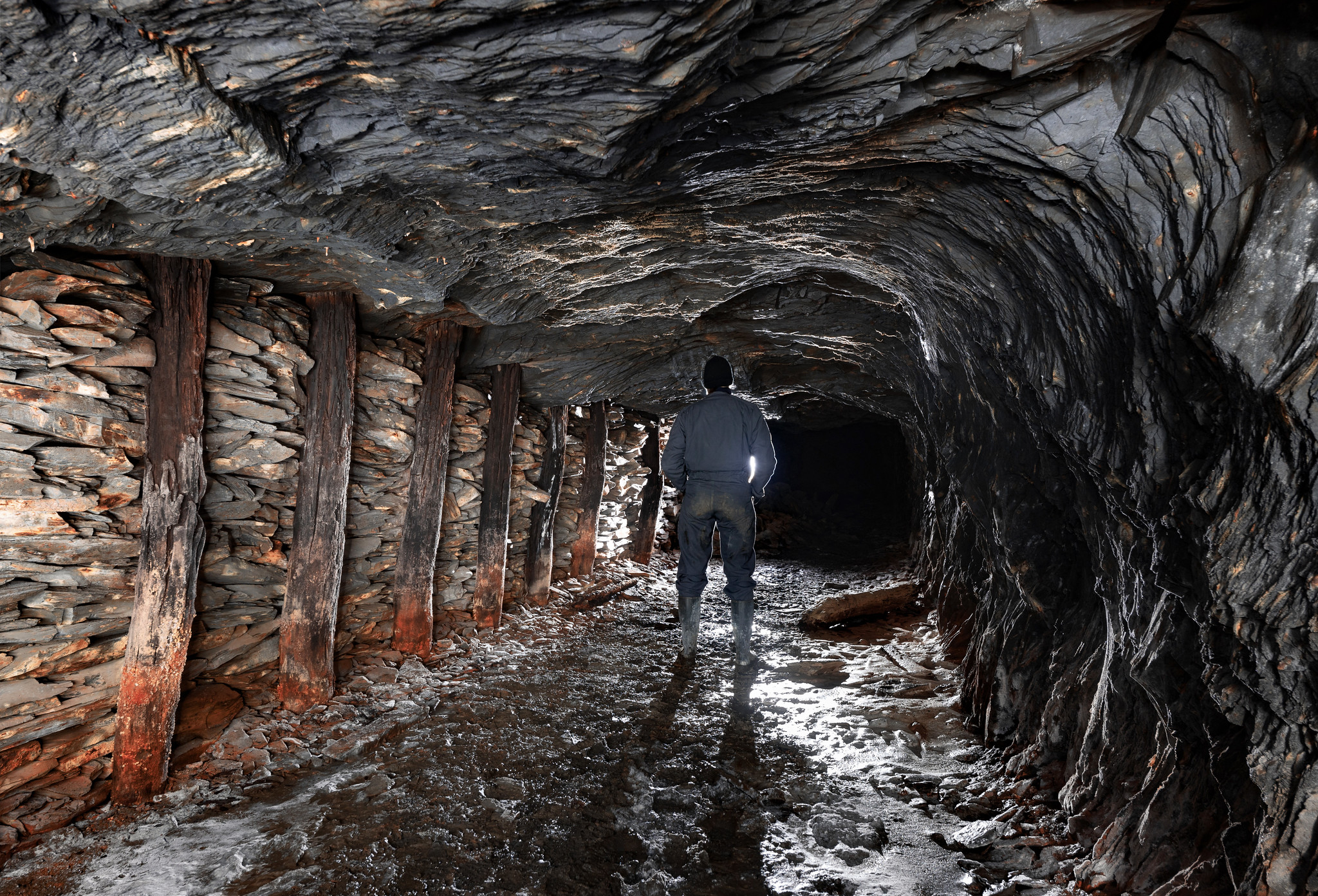
The “working upwards” method appeared in the late 1870s. After a first chamber, the roof was brought down by overhand stoping. Half of the schist brought down was unusable: it was left on the floor, the floor rose as the work went on, and the roof stayed about ten meters above the workers.
The vertical shaft remained the rule in the slate quarries of Anjou. Blocks were hoisted up it with winches, then with headframes, made of wood at first, then of metal from 1909.
The Saint-Blaise slate quarry
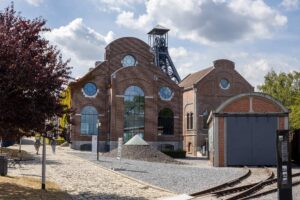
The Saint-Blaise slate quarry was opened one kilometer north of Noyant-la-Gravoyère, beneath the village of La Gâtelière, whose name it also took. The capital came from the banque Bougère of Angers. The joint-stock company Ardoisières angevines de Saint-Blaise was founded on 30 May 1916, and the entrance arch of the inclined drift still bears that date.
At Saint-Blaise, the bottom is reached by two inclined drifts at 37°, dug from 1919 to 1921, 210 meters long and 50 meters apart, an exception in Anjou. One was used to bring up the stone, the other for taking the miners down and for rescue. Extraction began in 1921, between 116 and 126 meters deep.
The first section, in a faulted zone, yielded only mediocre stone. In 1924, the workings were turned to the west-north-west: this intermediate section is the one visited today. In all, the mine opened 26 chambers, worked upwards, and its cavities are 60 to 80 meters long.
In the 1930s, La Gâtelière made wire sawing its main method, and this technique kept it profitable at the height of the crisis. The pneumatic rock drill arrived in 1931. It drilled 40 meters a day and raised a dust that causes schistosis, a lung disease. From 1920 to 1950, until water-injection drills came in, the disease took a heavy toll in the slate quarries of Anjou.
The splitters
A distinction was made between the “d’à-bas” workers, who cut the rock underground, and the “d’à-haut” workers, on the surface, who made the slates from it. In 1935, La Gâtelière had 68 workers underground and 176 on the surface, most of them splitters. In Anjou, a slate worker was also called a “perreyeur”.
The splitter first divides the block into slabs of 5 to 10 centimeters, then breaks it along the grain. He then splits each piece down to the required thickness, 2.7 millimeters for the French models, before trimming the slate to its shape. There were once 165 slate sizes; about twenty remain.
The offcuts form the buttes, the spoil banks where the splitters work. At Saint-Blaise, the butte has kept a ventilation chimney and low schist walls, which served as shelter and as supports for stacking the slates.
The 1936 bankruptcy
The production record came in 1935: 7,487 tonnes of slates, sold mainly in Great Britain. The company was making money, but its shareholding bank, Bougère Fils et Pousset, went bankrupt. The slate quarry closed on 25 July 1936, at the end of the first paid holidays.
In 1938, the Commission des Ardoisières d’Angers bought the site, did not reopen it and dismantled it. In 1959, a dewatering showed that the workings had remained in good condition and that the reserves were worthwhile, but economic conditions prevented a restart.
The conversion
In the second half of the 20th century, Spanish slate, extracted at shallow depth, competed with Anjou slate. Renazé closed in 1975, Combrée in 1982. In 1985 and 1986, the end of the area’s iron mines and slate quarries cost about 300 jobs around Noyant.
In 1989, the municipality of Noyant-la-Gravoyère launched the conversion of La Gâtelière, under the direction of a former manager of the neighboring Misengrain slate quarry. The chambers were dewatered in one winter. The work required bringing up 2,000 mine cars of waste and fitting 1,000 rock bolts, steel strapping and wire mesh along the paths. Some forty slate miners on retraining courses did this work, supervised by Charbonnages de France Ingénierie.
The Mine Bleue opened in 1991. Visitors then went down by funicular through the old inclined drift, and former miners acted as guides. It received more than 100,000 visitors a year at first, then about 70,000. The municipality could not bear the deficit alone, and the site closed around 2000. During the closure, former miners, as volunteers, kept pumping out the seepage water, a few cubic meters a day.
The joint body of the Pays du Haut-Anjou segréen reopened the site in 2007 with a private operator, which went into liquidation at the end of 2013. Since 2014, the Pays has run it itself, now under the name Pays de l’Anjou bleu. Misengrain closed in 1999, Trélazé in 2014.
The visit
Visitors go down by lift to 126 meters, then a small mine train takes them to the worked section. The guided tour continues on foot for an hour and a half, between 116 and 126 meters deep, at a constant temperature of 13 °C. It ends on the surface with a splitting demonstration on the splitters’ butte.
The stairway to the Mine Bleue train

Mine cars filled with slate. The red mark on the wall shows the former water level in the mine.

Double lift

The site received 46,317 visitors in 2024. It is the only underground slate quarry open to visitors in France. For those who cannot go down, a twenty-minute virtual tour has been offered since 2022. In 2027, the season runs from 27 March to 11 November, with opening during the February holidays.
At Trélazé and Renazé, two slate museums tell the story of the rest of the basin. Other mines open to visitors are presented among the underground museums.
Sources: BRGM, explanatory notes to the 1:50,000 geological map (Y. Vernhet and B. Pivette), 2010; Inventaire général du patrimoine culturel des Pays de la Loire, files “Le schiste ardoisier” and “Les carrières souterraines”, and record IA49002220 in the Mérimée database; L’Ardoise association, “Histoire de l’industrie” and visit report of 30 August 2003; Archives départementales de Maine-et-Loire, collection 15 J; Assemblée nationale, written question no. 806, 1997; Socotec, 2018; France 3 Pays de la Loire, 2 July 2023; Maville Angers, 2022 and 2023; Ouest-France, December 2013 and 2025; Le Pèlerin, 24 July 2025; Trésor de la langue française; Mine Bleue website
These photographs are part of the underground heritage photography collection.