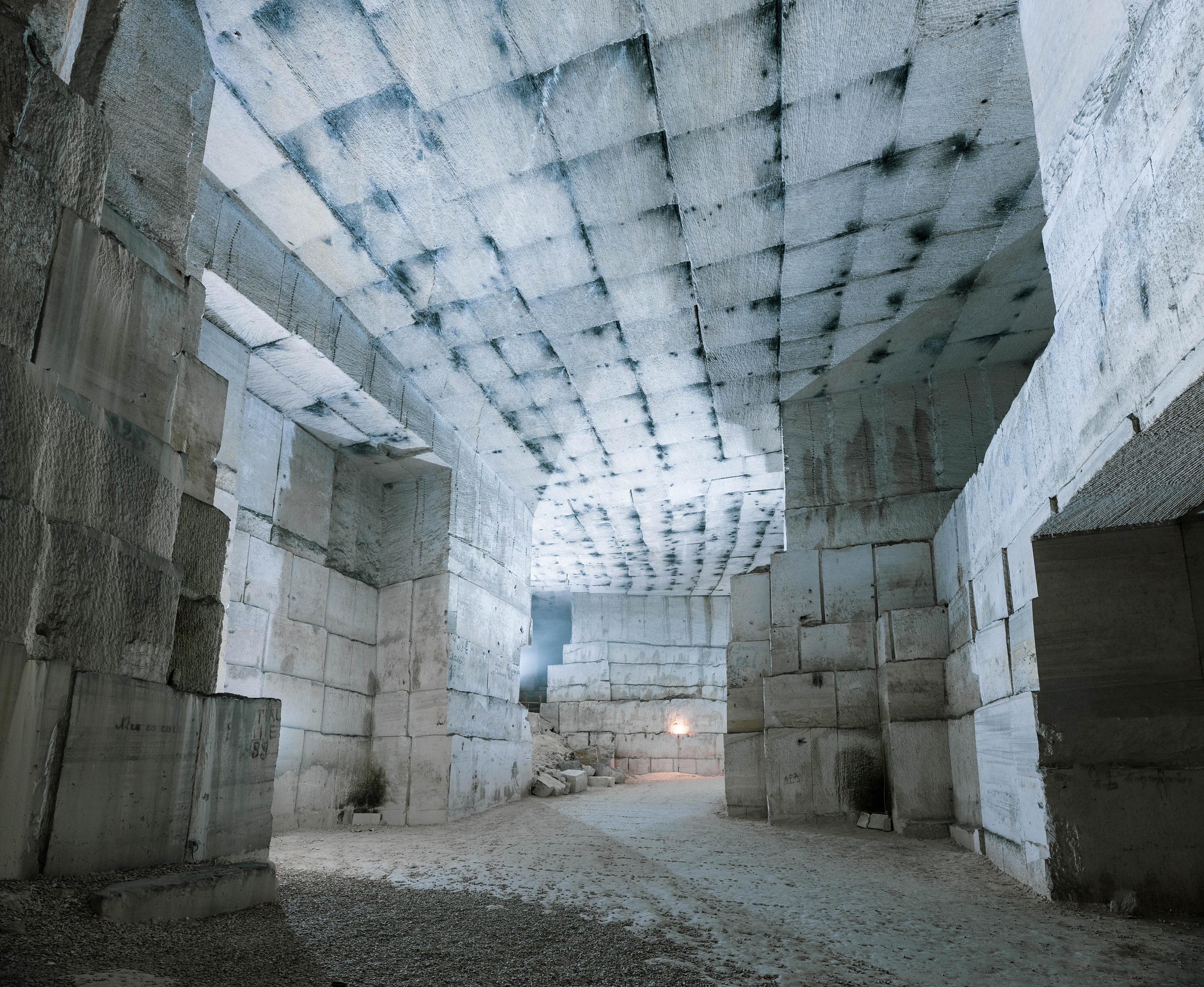
There are few quarries where the quarryman’s craft can be read so clearly. At Aubigny, in the Yonne, stone was extracted for centuries by sheer muscle power, with two iron tools, without ever resorting to machinery. The walls still bear, intact, the vertical marks of this work.
A stone of great renown
Aubigny lies beneath the former commune of Taingy, now Les Hauts de Forterre, in the heart of the Forterre plateau in Puisaye. The Jurassic limestone quarried here is white, homogeneous and fine-grained: a first-rate building stone that is easy to work and ages well.
From the Middle Ages to the 19th century, it went to prestigious building projects. First the cathedrals of Sens and Auxerre, which were within carting distance. Then Paris, once the waterways and the railway were available: the Louvre, the Hôtel de Ville, the Opéra Garnier, the Conservatoire national des arts et métiers, and even the masonry foundations of the Eiffel Tower. A rural quarry in the Yonne thus supplied the stone face of the capital.
The lance and the needle
The technique used at Aubigny is what makes the site so interesting. To detach a block, the quarryman first cuts two vertical slots into the working face, about one meter deep. For this he uses the lance: a heavy pointed iron bar, hung from a chain to balance its weight, which he swings and lets drop, again and again, into the same cut. The rhythm is slow and steady, and the result surprisingly precise.
Once the block is free on its sides, it has to be separated from its bed. This is the job of the needle, a wedge driven in until the stone gives along its natural fracture plane. Two tools, then, and nothing else: no explosives, no cutting machine, no mechanical saw. Because of this absence of mechanization, the galleries of Aubigny have kept remarkably legible walls, where every stroke of the lance is still visible.
The void left by extraction forms vast chambers with rock pillars left in place, where ceiling heights follow the thickness of the bed being worked. The temperature stays at 12 °C all year round, winter and summer alike.
Sources: Carrière souterraine d’Aubigny; Puisaye-Forterre tourist office; documentation on the Forterre limestones and their use in the monuments of Sens, Auxerre and Paris.
This tour is part of the catalogue of virtual tours of underground heritage.